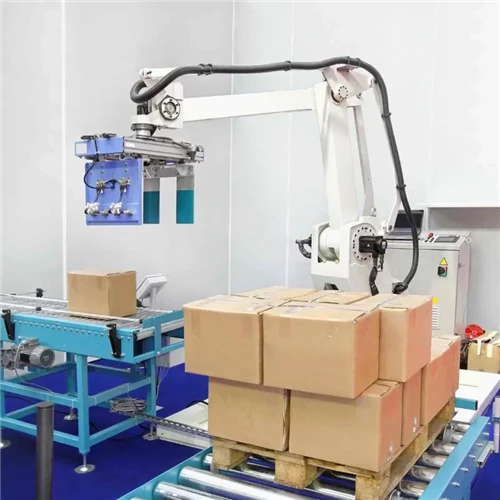
Integrating an automated e-commerce palletizing robot into fulfillment centers eliminates manual stacking bottlenecks, boosts throughput by up to 60%, and drastically reduces transit product damage. Driven by 3D vision perception, dynamic layer-forming algorithms, and custom End-of-Arm Tooling (EOAT), a modern robotic palletizer seamlessly builds stable pallets from unpredictable, multi-SKU product streams. Deploying this high-speed end-of-line solution allows logistics facilities to overcome labor shortages and achieve a full capital payback within 12 to 15 months.
1. The E-Commerce Palletizing Bottleneck
E-commerce fulfillment centers and regional distribution facilities handle thousands of distinct stock-keeping units (SKUs) daily under strict shipping deadlines. While upstream order picking and sorting have largely transitioned to automated storage systems, the final staging area-where packages are stacked onto pallets for shipping-frequently remains an expensive manual bottleneck.
Logistics managers face three primary operational constraints during end-of-line palletizing:
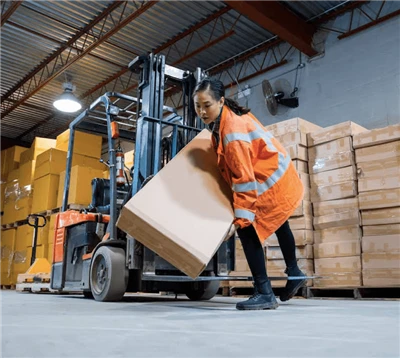
- Physical Fatigue and High Labor Turnover: Manual pallet stacking requires operators to lift, twist, and position thousands of cartons weighing 5kg to 30kg per shift. The grueling physical exertion in fast-paced fulfillment environments leads to high employee turnover and escalating ergonomic injury claims.
- Unstable Pallet Builds from High SKU Variability: Unlike uniform manufacturing packaging, e-commerce orders produce non-standardized box proportions and mixed packaging types. Inexperienced operators often stack heavy cartons over fragile packages or leave uneven gaps, resulting in collapsed pallets during truck transport.
- Surge Capacity Strains: Peak shopping events create massive volume surges that overwhelm manual packing teams, causing floor congestion, delayed truck departures, and missed fulfillment SLAs.
Deploying a multi-axis robotic palletizer equips fulfillment operations with continuous, high-speed stacking performance capable of processing variable product feeds without fatigue.
2. Core Engineering Architecture of Palletizing Robots
A modern robotic palletizing system combines articulated mechanical arms, heavy-duty structural bases, intelligent safety enclosures, and advanced motion controllers engineered for high-cycle industrial performance.
2.1 Articulated Mechanical Arm Configurations
Depending on payload requirements and spatial constraints, logistics engineering teams select between two primary robot kinematic architectures:
- 4-Axis Articulated Palletizing Robots: Engineered specifically for high-speed pick-and-place stacking. The mechanical linkage keeps the end-effector parallel to the floor at all times, maximizing rotational speed and payload capacity (up to 300kg) while minimizing energy consumption.
- 6-Axis Articulated Industrial Robots: Offer full spatial dexterity, allowing the robot arm to reorient cartons in tight spaces, perform vertical tilting, or service multiple infeed lines and pallet stations positioned in a 360-degree radius around the robot pedestal.
2.2 End-of-Arm Tooling (EOAT) Versatility
The robotic gripper directly determines the system's ability to handle dynamic packaging formats without dropping or damaging packages.
- Large-Area Vacuum Foam Arrays: Utilize check-valve technology to maintain strong suction across partial package surfaces, ideal for handling corrugated cartons, rigid trays, and shrink-wrapped items.
- Pneumatic and Servo Side-Clamping Grippers: Apply regulated lateral clamping pressure to pick sturdy crates, plastic totes, or heavy boxes safely during high-speed arm acceleration.
- Hybrid Vacuum and Mechanical Bottom-Support Grippers: Deploy retractable support fingers beneath the package during arm rotation, offering 100% mechanical security for heavy or slippery parcels.
Read More: 《Robotic Palletizing Systems in Food & Beverage Distribution》

3. 3D Vision Systems and Dynamic Mixed-Case Stacking
The primary challenge in e-commerce fulfillment is mixed-case palletizing-building stable, dense pallets from an unpredictable sequence of box sizes, weights, and structural strengths.
3.1 Real-Time 3D Scanning and Profiling
As incoming cartons travel along the infeed conveyor, overhead 3D vision sensors capture high-density stereoscopic point-cloud images.
The vision system instantly computes critical geometry and orientation details:
- Dimensional Verification: Validates length, width, and height against the WMS order manifest.
- Top-Surface Profiling: Detects structural bulging, open flaps, or tape misalignments that could destabilize upper layers.
- Center-Point Coordinates: Calculates exact pick coordinates for the robotic gripper, compensating for skewed box positions on the conveyor belt.
3.2 Dynamic Pattern Generation Algorithms
Traditional matrix palletizers rely on rigid, pre-programmed stacking recipes. In contrast, an advanced vision-guided palletizing cell utilizes real-time pattern-generation algorithms to calculate load distribution dynamically.
The software prioritizes three engineering principles:
- Heavy-On-Bottom Rules: Automatically routes denser, heavier cartons to the lower pallet tiers to build a solid foundation.
- Interlocking Pattern Creation: Arranges adjacent box layers in overlapping pinwheel or brick patterns, using friction locking to increase lateral pallet stability.
- Center of Gravity Optimization: Balances the total payload weight evenly across the pallet footprint, preventing leaning towers during forklift transport.
Read More:《Robotic Bag Palletizing For PP Woven & Paper Bags: How To Prevent Stack Collapses & Bag Deformity》
4. Technology Comparison: Manual Stacking vs. Mechanical Matrix vs. Robotic Palletizer
Evaluating end-of-line automation options requires comparing throughput capacity, SKU versatility, floor footprint, and overall operational efficiency.
| Performance Metric | Manual Pallet Stacking | High-Level Mechanical Matrix Palletizer | 3D Vision Robotic Palletizer Cell |
| Peak Throughput | 6–10 cases/minute (Per operator) | 40–70+ cases/minute | 15–30 cases/minute (Multi-case capability) |
| SKU Flexibility | High (Human adaptivity) | Very Low (Single-SKU focus) | Extremely High (Dynamic mixed-case) |
| Footprint Requirements | Variable staging floor area | Large (80-50m²) | Compact (15-30m²) |
| Product Damage Rate | 1.5% – 3.0% (Manual handling) | < 0.1% (Uniform boxes) | < 0.02% (Gentle soft-touch EOAT) |
| Changeover Downtime | None | 15–45 minutes (Mechanical adjustments) | Instantaneous (Recipe/Vision auto-switch) |
| Labor Dependency | Extreme (High turnover) | Low (Operator required for jams) | Minimal (Single supervisor for multiple cells) |
5. Integration with Warehouse Management Systems and Upstream Lines
To achieve maximum efficiency, an automated e-commerce palletizing robot must operate as an integrated module within the broader warehouse material handling network.
5.1 Infeed Conveyor Sequencing and Accumulation
Upstream accumulation conveyors regulate carton arrival rates, preventing bottlenecks at the robot picking cell. Photoelectric sensors and optical encoders track carton positions, ensuring the robot arm picks packages at the optimal motion vector without stopping the conveyor belt.
5.2 Automated Auxiliary Material Handling
Complete robotic palletizing cells incorporate peripheral automation to minimize human intervention:
- Automated Pallet Dispensers: Store empty wooden or plastic pallets and feed individual pallets into the stacking zone via motorized roller conveyors.
- Slip-Sheet Inserters: The robotic gripper uses integrated auxiliary vacuum cups to pick protective cardboard or plastic slip-sheets and lay them between pallet tiers for added vertical load friction.
- Automatic Stretch Wrappers: Integrated turntable or rotary arm stretch wrappers secure the completed pallet with film immediately after stacking, preserving load integrity prior to forklift pickup.
Read More:《 Overseas After-Sales Support For Chinese Machinery: How Remote PLC Diagnostics Keep Lines Running》

6. Technical Specifications for Vision-Guided Robotic Palletizing Cells
Logistics automation engineers must review technical specifications during equipment selection to match facility performance goals.
| System Specification | 4-Axis Articulated Palletizing Robot | 6-Axis Heavy-Duty Palletizing Robot |
| Maximum Payload Capacity | 100 kg – 250 kg | 180 kg – 500 kg |
| Reach Radius | 2,400 mm – 3,150 mm | 2,650 mm – 3,500 mm |
| Stacking Height Range | Up to 2,400 mm (Including pallet) | Up to 2,800 mm (Including pallet) |
| Vision System Technology | Overhead 3D Stereoscopic / ToF Sensor | Multi-Angle 3D Laser / Point-Cloud Camera |
| Repeatability Precision | ± 0.05 mm | ± 0.08 mm |
| Control Architecture | High-Speed Motion Controller + EtherCAT | Industrial Motion Controller + PROFINET |
| Enclosure Rating | IP54 Standard / IP65 Washdown Optional | IP65 Arm Body / IP67 Wrist Axis |
7. Financial Payback and Cost Metrics
Investing in an automated robotic palletizer requires quantifying direct labor replacement, freight damage elimination, and throughput acceleration against total system capital cost.
Financial Scenario: High-Volume Regional Distribution Center
Consider a distribution center operating 2 shifts daily, running 2 parallel packaging outfeed lines:
- Direct Labor Cost Reduction: Eliminates 3 manual stacking positions per shift across 2 shifts (6 total workers reallocated), saving $270,000 annually in wages, benefits, and injury insurance premiums.
- Transit Damage Reduction: Eliminates crushed box claims and collapsed pallet spills, saving $45,000 annually in lost inventory and repacking expenses.
- Capacity Expansion Value: Increases line throughput capacity by 40%, yielding an estimated $35,000 in annual operational efficiency gains.
Simple Payback Calculation
Total turnkey capital investment for a dual-infeed vision-guided palletizing cell-including 4-axis robot, 3D vision hardware, custom vacuum EOAT, safety light curtains, automatic pallet dispenser, and WMS software integration-is approximately $350,000.
- Total Annual Operational Savings: $270,000 + $45,000 + $35,000 = $350,000 / year
- Simple Payback Period Formula:
Payback Period = Total Capital Investment / Net Annual Operational Savings = $350,000 / $350,000 = 1.00 Year (12.0 Months)
In exactly 12.0 months, the robotic palletizing system pays for itself completely, converting all subsequent savings directly into plant profitability.
8. Strategic Implementation Checklist for Facility Managers
To ensure a successful deployment when integrating a robotic palletizer, engineering teams should follow this implementation checklist:
- Map Complete Package Weight and Size Matrix: Catalog the minimum, average, and maximum dimensions and weights for all SKUs processed across the line.
- Define Peak Hourly Surge Rates: Base cycle time calculations on peak surge capacity (e.g., 25 cases/minute peak) rather than average daily throughput.
- Ensure Safety Standard Compliance: Confirm that the robot cell adheres to ISO 10218-1/2 and ANSI/RIA R15.06 safety regulations, utilizing safety light curtains, interlocked fencing, and emergency stop circuits.
- Verify WMS Bi-Directional API Communication: Confirm that the robot controller seamlessly communicates with your WMS/WCS over EtherNet/IP, PROFINET, or OPC UA for real-time order manifest updates.
- Require IIoT Remote Diagnostic Architecture: Ensure an integrated VPN gateway is installed in the primary electrical enclosure to allow OEM service engineers to perform 24/7 remote PLC troubleshooting and vision calibration.
To explore how high-speed robotic palletizing automation can streamline your fulfillment operations, visit our technical solution page for Automatic Palletizing Robots.