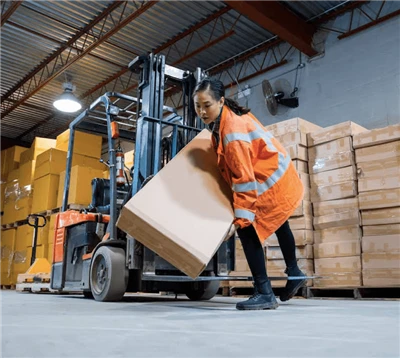
Palletizing serves as the final link between secondary packaging and physical distribution in modern manufacturing. Whether handling corrugated boxes, multi-wall paper sacks, plastic crates, or shrink-wrapped trays, automated palletizing systems replace manual material handling to maintain consistent line speeds, reduce labor overhead, and minimize transit damage.
Selecting the appropriate palletizing machinery requires a detailed analysis of physical package characteristics, rate requirements, layout constraints, and upstream equipment capacities. This article outlines the major mechanical classifications, industry-specific designs, operational comparisons, real-world applications, and selection parameters for modern palletizing systems.
Primary Mechanical Categories of Palletizers
Industrial palletizers are broadly divided into two foundational mechanical categories based on how they handle incoming products: conventional mechanical systems and articulated robotic systems.
1. Conventional Low-Level Palletizers
Conventional low-level palletizers receive incoming products at standard conveyor heights, typically between 800 mm and 1,000 mm above floor level. The machine creates rows and layers at this working height using mechanical sweepers, turning pins, and pneumatic pushers.
Once a complete layer is formed on a split apron plate, a hydraulic or motor-driven elevator lowers the pallet incrementally to receive subsequent layers.
- Key Characteristics: Floor-level maintenance access, simple mechanical drives, integrated safety guarding.
- Best Suited For: Moderate-speed lines, facilities with restricted ceiling heights, and operations requiring straightforward mechanical maintenance without dedicated robotics programmers.
2. Conventional High-Level Palletizers
High-level conventional palletizers process incoming products at an elevated platform level, usually 2.5 meters to 3.5 meters above the factory floor. Products are elevated via inclined belt conveyors, spiral chutes, or continuous vertical lifts before entering the pattern-forming section.
The machine forms layers on a stationary slide plate while a pallet lift elevator raises an empty pallet to meet the top plate. After each layer drops or slides onto the stack, the pallet lowers by one layer height.
- Key Characteristics: Continuous high-speed operation, heavy-duty structural frame, footprint expansion via elevated walkways.
- Best Suited For: High-throughput bottling plants, canning operations, consumer packaged goods (CPG) facilities, and continuous 24/7 manufacturing operations.
3. Robotic Palletizers
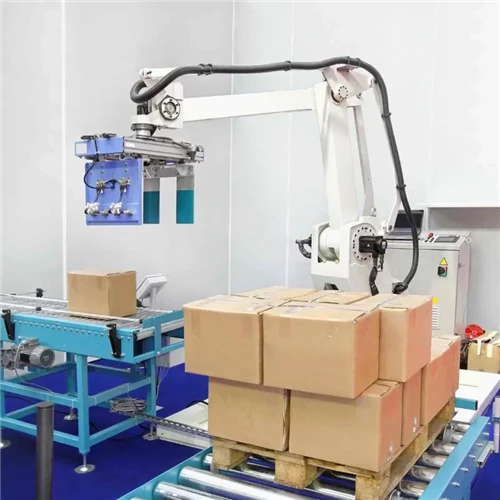
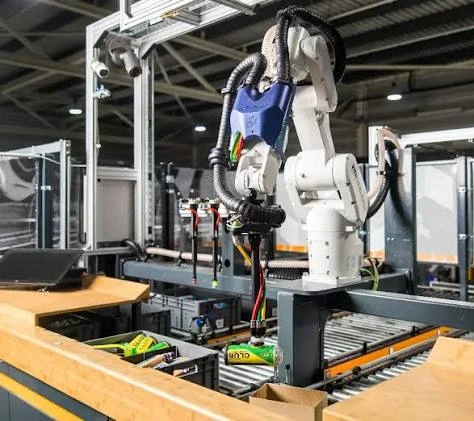
Robotic palletizers utilize 4-axis or 6-axis articulated industrial robot arms to pick products from an infeed position and place them onto a pallet according to digital stacking patterns.
Equipped with specialized End-of-Arm Tooling (EOAT)-such as vacuum suction pads, mechanical side-clamps, bottom-support forks, or hybrid grippers
-robotic palletizers manipulate individual units, multiple boxes, or full product rows with precise positioning.
- Key Characteristics: Multi-axis motion control, small footprint, multi-line servicing capability, programmable pattern changeovers via Human-Machine Interface (HMI).
- Best Suited For: Facilities running multiple product lines simultaneously, operations with frequent packaging SKU changes, and tight floor layouts.
4. Gantry / Cartesian Palletizers
Gantry palletizers employ a linear Cartesian frame (X, Y, and Z overhead axes) to maneuver a pick head over a designated loading zone. These systems can span wide floor areas, allowing a single gantry bridge to service multiple infeed lines and pallet stations aligned in a row.
- Key Characteristics: Overhead structural frame, linear motor or belt-driven actuators, modular expansion potential.
- Best Suited For: Heavy payloads, multi-pallet staging, and high-density warehouse environments requiring linear travel over long distances.
5. Collaborative Robot (Cobot) Palletizers
Cobot palletizers use power- and force-limited articulated arms designed to operate alongside plant personnel without full perimeter safety fencing (subject to risk assessment). They feature compact footprints and plug-and-play installation.
- Key Characteristics: Low capital expenditure, simple drag-and-drop programming, minimal floor space requirements, integrated safety sensors.
- Best Suited For: Low-to-medium speed operations (5 to 12 units per minute), craft breweries, batch chemical processing, and facilities with limited physical footprint.
Specialized Product-Specific Palletizer Types
Beyond overall mechanical architecture, palletizers are specialized to handle specific product types, flexible packaging, and dynamic order profiles.
1. Case Palletizers
Specifically engineered for rigid rectangular packages, case palletizers process corrugated containers (RSC), die-cut trays, shrink-wrapped bundles, and plastic totes. They rely on precise edge alignment, side guides, and squaring mechanisms to form tight, uniform pallet layers.
Modern case palletizers feature configurable turn tables or high-speed orienting belts that rotate boxes 90 degrees or 180 degrees to build interlocking layer patterns, preventing stack shifting during transport.
2. Bag Palletizers
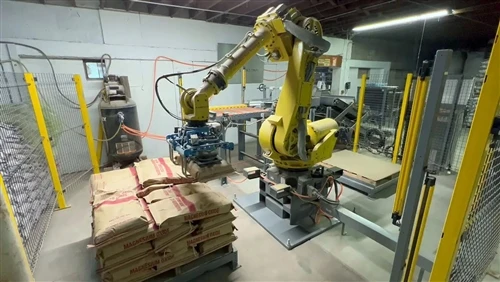
Handling non-rigid, flexible packages such as multi-wall paper sacks, woven polypropylene bags, or polyethylene pouches requires specialized handling equipment. Bag palletizers incorporate flattening conveyors, square-up side belts, and press rollers to level out bulk materials (powders, granules, grains) inside the bags prior to stacking.
Unlike rigid box systems, bag palletizers use specialized clamps or overlapping finger-style grippers that support bags from beneath. Once positioned, side-squaring plates compress each completed layer from all four sides to maintain vertical stability and eliminate top-heavy bulges.
3. Layer Palletizers
When line output demands extreme throughput that exceeds individual unit pick rates, layer palletizers are implemented. Rather than handling individual cases or bags, layer palletizers assemble an entire layer pattern on a staging table before sweeping or transferring the complete layer onto the pallet in a single operation.
This method achieves continuous high speeds because the handling cycle time is governed by layer transfer rather than individual package transfer. High-speed CPG lines frequently rely on this design to handle light, uniform packaging at scale.
4. Mixed-Load Palletizers
Driven by e-commerce expansion and retail-ready distribution, mixed-load palletizers assemble pallets containing multiple distinct SKUs, varying box dimensions, and non-uniform package weights.
These systems combine 3D vision systems, real-time software algorithms, and dynamic EOAT grippers. The software evaluates package dimensions, crush resistance, and weight distribution to construct stable, rainbow-stacked pallets for store-level replenishment.
Technical Comparison of Palletizer Types
Selecting a palletizing machine requires matching system capabilities to operational constraints. The matrix below outlines key parameters across primary palletizer categories:
| Palletizer Type | Typical Speed Range | Floor Space Requirements | Payload Capacity | Ideal Package Types | Primary Advantage |
| Low-Level Conventional | 10 – 30 units/min | Medium to Large | Up to 2,000 kg total | Corrugated boxes, crates, rigid trays | Simple floor-level maintenance |
| High-Level Conventional | 30 – 100+ units/min | Large (Height required) | Up to 3,000 kg total | Rigid boxes, cans, bottles, trays | Highest throughput speed |
| Robotic Palletizers | 10 – 40 units/min | Compact to Medium | 10 kg to 800+ kg | Cases, bags, pails, drums, totes | Multi-line flexibility & multi-SKU |
| Gantry / Cartesian | 5 – 20 units/min | Long / Linear span | Up to 1,000+ kg | Heavy boxes, industrial components | Wide reach across multiple stations |
| Cobot Palletizers | 5 – 12 units/min | Very Compact | Typically <25 kg | Small to medium corrugated boxes | Low cost, small footprint |
| Bag Palletizers | 10 – 35 bags/min | Medium to Large | Up to 2,500 kg total | Paper sacks, woven PP bags, pouches | Specialized layer squarers & flatteners |
Detailed Mechanics: How Different Palletizers Form Layers
The core engineering distinction among palletizer types lies in their layer-formation and load-placement mechanics.
Conventional Sweep & Apron Mechanism
In conventional systems, incoming products are pushed linearly into rows. A cross-pusher shifts completed rows onto a two-piece slide plate (apron).
Once a full layer pattern is arranged:
- Centering side-bar guides close to square the layer edges.
- The split apron plates retract horizontally outward.
- The layer settles smoothly onto the pallet deck below.
- The pallet elevator indexes downward by the exact height of the product layer.
Articulated Arm Vacuum and Clamp Motion
Robotic palletizers bypass mechanical pushers by utilizing direct Cartesian positioning via multi-axis motion software:
- Sensors register product arrival at the pick station.
- The robot controller calculates tool trajectory and matches gripper speed to infeed conveyor velocity.
- The end effector picks up the unit (via vacuum, pneumatic clamp, or fork).
- The arm rotates and articulates along a pre-programmed path to place the unit at precise X, Y, and Z coordinates on the pallet.
- Intermediate slip sheets or tier sheets are placed automatically using auxiliary vacuum cups built into the same gripper head.
Industrial Customer Case Study: Chemical Granule Packaging Facility
To evaluate how transitioning to specialized palletizing machinery impacts operational performance, consider the following real-world implementation in a chemical manufacturing facility.
Customer Background
An industrial chemical supplier produced dry fertilizer granules packed into 25 kg multi-wall valve bags. The packaging line operated 16 hours per day across two shifts, producing 18 bags per minute.
- Existing Operations: The facility relied on manual labor (four operators per shift) to lift 25 kg bags from a drop-conveyor, flatten them manually, and stack them onto wooden pallets.
- Operational Challenges:
High employee turnover rate (42% annually) due to physical fatigue and heavy lifting.
Frequent pallet instability caused by uneven material distribution inside the bags, resulting in product spills during forklift transit.
Line bottlenecks during shift changes and operator rest breaks, reducing overall plant OEE (Overall Equipment Effectiveness) to 68%.
System Integration
The facility replaced the manual stacking area with a fully automated end-of-line packaging cell featuring a high-capacity articulated robotic bag handling system:
- Bag Flattener & Conditioning Conveyor: Dual-belt press rollers flatten incoming 25 kg bags to distribute internal granules evenly.
- Robotic Bag Palletizer: A 4-axis industrial robot arm (180 kg payload) fitted with a servo-driven clamshell bag gripper with integrated bottom-support fingers.
- Automatic Slip Sheet Dispenser: A vacuum pickup tool integrated into the robot arm head to place protective cardboard sheets onto empty pallets prior to stacking.
- Layer Squaring & Press Station: Hydraulic side plates compress each completed layer to maintain strict vertical alignment.
- Inline Automatic Stretch Wrapper: Direct chain conveyor link to a rotary-arm stretch wrapper.
Performance Metrics Post-Implementation
| Performance Metric | Pre-Automation (Manual) | Post-Automation (Robotic) | Net Operational Impact |
| Line Speed Consistency | 12 – 15 bags/min (Variable) | 18 bags/min (Constant) | 20% throughput increase |
| Direct Labor Requirement | 4 Operators / Shift | 1 Line Attendant / Shift | 75% reduction in direct labor |
| Overall Equipment Effectiveness | 68% OEE | 89% OEE | 21% OEE efficiency gain |
| Product Transport Claims | $4,200 / Month average | < $150 / Month average | 96.4% damage reduction |
| Capital Recovery Period | N/A | 16.8 Months | Full ROI achieved |
The installation eliminated physical lifting hazards, stabilized output at maximum line speed, and provided a rigid, square pallet profile that eliminated freight damage during export shipping.
Key Decision Factors for Equipment Selection
Selecting between conventional high/low level systems, robotic palletizers, or specialized packaging units requires systematic evaluation of technical criteria.
1. Product Characteristics and Geometry
The physical state of the product dictates gripper and mechanical design:
- Rigid Cases/Boxes: Suited for standard case palletizers, vacuum-based robotic palletizers, or low-level conventional units.
- Flexible Bags/Sacks: Requires specialized bag palletizers with conditioning belts, bottom-support grippers, and layer squaring systems.
- Unstable/Fragile Goods: Benefits from layer palletizers or bottom-load robotic tools to prevent product distortion.
2. Required Throughput (Units Per Minute)
- Under 12 units/min: Cobot systems or entry-level low-level conventional units offer cost-effective automation.
- 12 to 40 units/min: Robotic palletizers and standard conventional low-level systems handle these rates comfortably.
- Above 40 units/min: High-level conventional palletizers or dual-robot cells are necessary to match upstream line output.
3. Footprint and Plant Ceiling Height
- Low Ceilings (<3.5 meters): Low-level conventional, cobots, or articulated robotic palletizers avoid overhead obstruction.
- Tight Floor Area: Robotic palletizers offer the highest ratio of throughput to square-meter footprint, as they eliminate long orientation conveyors.
- Ample Overhead Space: High-level palletizers utilize vertical space, keeping floor areas clear for forklift movement.
4. Product Diversity and Changeover Frequency
If a facility runs a single product size continuously, a high-level conventional unit provides maximum speed. However, if a plant runs multiple SKUs, varying box sizes, and custom pallet patterns daily, robotic palletizers or mixed-load palletizers are necessary due to software-driven recipe changeovers that take seconds rather than hours of mechanical adjustment.
5. Total Cost of Ownership (TCO) and Maintenance Capability
Capital expenditure includes initial equipment purchase, integration, safety perimeter fencing, and conveyor installation. Operational expenditure includes energy consumption, routine maintenance, and software support. Facilities without in-house robotics technicians may prefer low-level conventional palletizers for ease of mechanical troubleshooting.
Conclusion
Understanding the distinct categories of palletizing equipment-from conventional high/low level designs to flexible robotic palletizers, case palletizers, bag palletizers, layer palletizers, and dynamic mixed-load palletizers-is essential for optimizing end-of-line packaging infrastructure. Matching product geometry, throughput requirements, and factory layout to the correct machinery architecture ensures consistent production output, mitigates occupational safety risks, and protects finished goods throughout the logistics supply chain.
Ready to optimize your end-of-line packaging infrastructure? Contact our automation engineering team today to review your application specifications, receive a customized layout drawing, and evaluate system ROI for your plant.