An automatic flip flop stacker is a machine installed at the delivery end of a printing, laminating or carton production line. It collects finished paperboard sheets, turns selected groups of sheets over, and stacks them into square, stable piles on a pallet without manual handling. It is used where line output is too fast for workers to stack by hand, and where pile quality affects the next process, such as die cutting, folding, gluing or shipping.
This guide explains how the machine works, what its main parts do, which specifications matter and how to choose a model. The technical data comes from the UltraMech DFM series (DFM-1510-P and DFM-1710-P), listed on the Full Automatic Stacker Machine and Automatic Stacking Machine pages.
Key Facts at a Glance
| Item | Description |
|---|---|
| Machine name | Automatic flip flop stacker, also called automatic stacking and flipping machine |
| Position in the line | Delivery end, after the printing, laminating or box production machine |
| Main functions | Sheet collecting, counting, flipping, stacking and pile delivery |
| Sheet size range (DFM series) | L400 × W430 mm to L1500 × W1700 mm |
| Speed (DFM series) | 6,000–18,000 sheets per hour, depending on the paper |
| Maximum pile height | 1,700 mm |
| Power supply | 380 VAC |
| Typical users | Corrugated carton plants, paperboard converters, printing plants |
What Is an Automatic Flip Flop Stacker?
An automatic flip flop stacker receives sheets from the upstream machine at line speed, counts them, flips groups of sheets when the program requires it, and builds the pile on a pallet. The operator sets the sheet size, the turning rule and the pile height on the control panel. After that, the machine runs without a worker standing at the delivery table.
The term "flip flop" describes the stacking pattern. Sheets are collected in groups. One group is placed face up, and the next group is turned over and placed face down. The pattern repeats until the pile reaches the set height. The turning rule follows the batch requirements of each job.
Laminated and printed boards are rarely perfectly uniform. Thickness can differ slightly from one edge to the other, and sheets may carry a small bow. When every sheet is stacked in the same direction, these small differences add up, and the pile can lean or become uneven. Alternating the orientation of sheet groups helps the pile stay level and square. This is one of the common reasons the function is used on laminating lines.
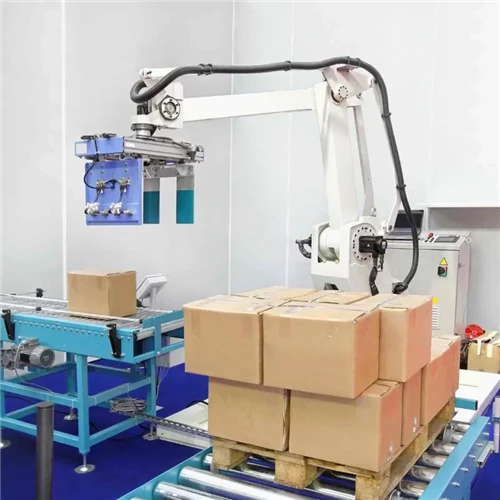
An automatic flip flop stacker is also different from a palletizer. It handles flat sheets as they leave a production machine. A palletizer handles finished boxes or bundles that are picked and placed on a pallet. The comparison table later in this article shows the difference.
Where an Automatic Flip Flop Stacker Is Installed
The automatic flip flop stacker is connected to the output of the machine that produces flat sheets. The table shows the common positions.
| Upstream machine | Why a stacker is needed at the delivery end |
|---|---|
| Automatic flute laminator | Laminated sheets leave the machine continuously. Stacking them by hand limits the speed of the whole laminating line. |
| Printing machine | Printed surfaces can be scratched when workers catch and move sheets by hand. |
| Corrugated box production line | The delivery section must remove finished sheets at the same rate as the line produces them. |
The delivery height of the automatic flip flop stacker must match the output height of the upstream machine, and the conveyor speeds must be synchronized. These two points are checked before ordering.
Why Manual Stacking Does Not Work at Line Speed
At speeds of 6,000 to 10,000 sheets per hour and above, manual stacking is not practical. A worker cannot catch, align and place that many sheets, and the problems appear in the same order in most plants:
- Line stops. When the pile at the delivery table is full, the line must stop or slow down until the pile is removed.
- Surface damage. Sheets drag against each other or against the worker's hands. Printed surfaces are scratched, and edges are crushed.
- Uneven piles. Hand-stacked piles lean and overhang. They are unstable on the pallet and difficult to handle with a forklift.
- Labor cost. Two or more workers are needed per shift at the delivery end, and the work is repetitive.
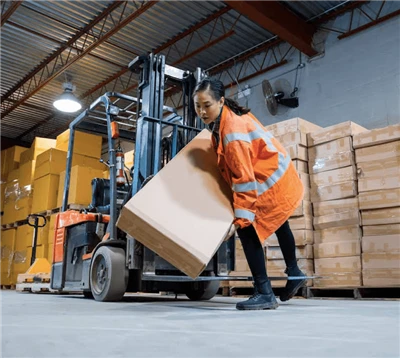
- Handling risk. Sheets up to 1,500 × 1,700 mm are large and awkward to lift and turn by hand.
An automatic flip flop stacker removes these steps from the line. The result is a continuous delivery process with a pile quality that does not depend on the operator.
How an Automatic Flip Flop Stacker Works
The working cycle has seven steps.
- Sheet entry. Sheets leave the upstream machine and enter the stacker conveyor. The conveyor speed is matched to the line.
- Counting. Sensors count each sheet. The count decides when a group is complete.
- Collecting and lifting. The group is collected on the lift platform. The platform lowers as the pile grows.
- Turning. When the program calls for it, the turning unit flips the group over before it is placed on the pile.
- Stack receiving. The sheets are aligned at the edges and placed on the pallet. The pile is built square.
- Pile delivery. When the set height is reached (up to 1,700 mm), the finished pile is moved out. Incoming sheets continue to be collected, so the line does not stop.
- Size change. For the next job, the servo axes move to the new sheet size from the control panel. No manual adjustment of guides is needed.
The DFM series uses a 10-axis industrial servo system for the size change in step 7. This matters for plants that run many short orders with different sheet sizes in one day, because setup time is part of the real output of the line.
Main Components of an Automatic Flip Flop Stacker
| Component group | Function |
|---|---|
| Electronic and control parts | Servo drives, sensors and the operator panel. They run the stacking program and position the axes for each sheet size. |
| Lift parts | Support the pile as it grows and lower it step by step, up to a pile height of 1,700 mm. |
| Turning parts | Turn groups of sheets over according to the job setting. |
| Stack receiving parts | Receive the sheets, align the edges and form the square pile on the pallet. |
Each group is a separate section of the machine. This makes inspection and maintenance easier, because a fault in one group can be isolated without dismantling the others. Photos of the electronic, lift, turning and stack receiving parts of the automatic flip flop stacker are shown on the Automatic Stacking Machine page.
Main Components of an Automatic Flip Flop Stacker
| Parameter | DFM-1510-P | DFM-1710-P |
|---|---|---|
| Design rhythm | 400–500 times/h | 400–500 times/h |
| Minimum sheet size | L400 × W430 mm | L400 × W430 mm |
| Maximum sheet size | L1500 × W1500 mm | L1500 × W1700 mm |
| Speed (depends on paper) | 6,000–18,000 pcs/h | 6,000–18,000 pcs/h |
| Paper delivery height | 1,700 mm | 1,700 mm |
| Power | 380 VAC | 380 VAC |
| Machine weight | 5,800 kg | 6,300 kg |
Speed depends on the paper type, the sheet size and the thickness. The machine is designed to deliver thin paperboard smoothly, but the actual figure for a plant should be confirmed against its own upstream machine and its own boards.
The two models differ in the maximum sheet width. The DFM-1710-P handles boards up to 1,700 mm wide and weighs 500 kg more than the DFM-1510-P. The choice depends on the widest sheet the plant runs. Application photos of the machine in operation are on the Full Automatic Stacker Machine page.
Automatic Flip Flop Stacker Compared with Other Equipment
| Equipment | What it handles | Position | Flips sheets |
|---|---|---|---|
| Automatic flip flop stacker | Flat sheets | Delivery end of a laminating, printing or box line | Yes |
| Manual stacking | Flat sheets | Same position | By hand |
| Sheet stacker at the corrugator | Cut sheets from the corrugator | After the cut-off section | Not the main function |
| Robotic palletizer | Finished boxes, bundles or packs | End of the carton line, before shipping | No, it picks and places units |
If the plant needs to stack flat sheets from a laminator or printer and wants turned groups in the pile, the automatic flip flop stacker is the correct machine. If the plant needs to place finished cartons on pallets, a robotic palletizer is the correct machine. Some plants use both: the stacker at the sheet stage and the palletizer at the carton stage.
Benefits of Using an Automatic Flip Flop Stacker
- Continuous output. Pile removal does not stop the line, so the upstream machine can run at its rated speed.
- Better pile quality. Piles are square and stable, with up to 1,700 mm height. Fewer forklift moves are needed.
- Less surface damage. Sheets are placed by the machine, not dragged by hand. This matters for printed and laminated boards.
- Fast job changes. The servo axes change the sheet size from the panel. This suits plants with many small orders.
- Lower labor demand. Workers are no longer assigned to catching and stacking sheets.
- Wide size range. One machine covers sheets from L400 × W430 mm up to L1500 × W1700 mm (DFM-1710-P).
How to Choose an Automatic Flip Flop Stacker
Use the following checklist when comparing models or suppliers.
| Question | What to check |
|---|---|
| What is the largest sheet? | The maximum size must cover the widest and longest board. DFM-1510-P: 1,500 × 1,500 mm. DFM-1710-P: 1,500 × 1,700 mm. |
| What is the smallest sheet? | The minimum size (L400 × W430 mm for the DFM series) must cover the smallest job. |
| What is the upstream speed? | The rated speed of the stacker must be higher than the maximum output of the upstream machine on the plant's own paper. |
| How often does the size change? | If there are several changes per day, a servo-driven setup saves more time than a manual setup. |
| How high should the pile be? | Check the pallet (principal pallet dimensions are defined in ISO 6780), the forklift and the next process. The DFM series builds piles up to 1,700 mm. |
| What is the power supply? | Confirm the voltage and frequency. The DFM series uses 380 VAC. |
| Is the floor suitable? | The machine weighs 5,800 kg (DFM-1510-P) or 6,300 kg (DFM-1710-P). Check the floor level and load. |
| Can it connect to the upstream machine? | The delivery heights and the conveyor speeds must match. Ask for a layout drawing. |
Both automatic flip flop stacker models are listed in the Auto Stacker Machine category.
Installation and Maintenance
Installation requires a flat floor, a clear space for the pallet and the forklift, and a power connection matching the machine. The automatic flip flop stacker must be aligned with the delivery section of the upstream machine. After installation, the speed is tested with the plant's own sheets, at the size and the paper grade that the plant runs most often. Ask the supplier which safety standards apply to the machine in your country. ISO 12100 sets the general principles for risk assessment and risk reduction in machinery design.
Routine maintenance is simple:
- Lubricate the moving parts according to the manual.
- Check conveyor belts for wear and tension.
- Clean the sensors, because dust from paperboard can cause counting errors.
- Inspect the lift and turning units for loose parts.
- Back up the stacking programs for the common job sizes.
Frequently Asked Questions
Is an automatic flip flop stacker the same as a palletizer? No. The automatic flip flop stacker works on flat sheets at the delivery end of a laminating or printing line. A palletizer places finished boxes or bundles on pallets.
Can the machine handle thin paperboard? Yes. The DFM series is designed for stable delivery of thin paperboard. The speed limit depends on the paper, so test with the plant's own boards.
What sheet sizes can it handle? The DFM series handles sheets from L400 × W430 mm. The maximum is L1500 × W1500 mm for the DFM-1510-P and L1500 × W1700 mm for the DFM-1710-P.
How much does the machine weigh? The DFM-1510-P weighs 5,800 kg and the DFM-1710-P weighs 6,300 kg. Check the floor load before installation.
What information is needed for a quotation? Send the upstream machine model, the sheet size range, the target speed, the required pile height and the local voltage and frequency.
Further Reading
FEFCO: the European federation of corrugated board manufacturers. Its technical pages cover the FEFCO code of box designs, the production process and testing methods.
AICC, the Independent Packaging Association: an association of independent corrugated, folding carton and rigid box converters and their suppliers.
How Corrugated Board and Boxes Are Made: a Georgia-Pacific tutorial on the corrugator and the converting machines that follow it.
ISO 6780: dimensions and tolerances of flat pallets for intercontinental materials handling.
ISO 12100: general principles for machinery safety design, risk assessment and risk reduction.
Conclusion
An automatic flip flop stacker takes sheets from a laminating, printing or box line, turns groups according to the job setting, and builds square piles on a pallet at line speed. It removes the manual stacking step that limits output and damages printed surfaces. The most important selection points are the sheet size range, the speed, the pile height and the connection to the upstream machine.
To select a model for your line, send the upstream machine, the sheet sizes and the target speed through the UltraMech inquiry page. Product details are on the Full Automatic Stacker Machine and Automatic Stacking Machine pages, and the full range is in the Auto Stacker Machine category.