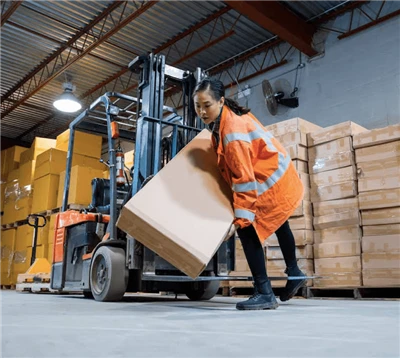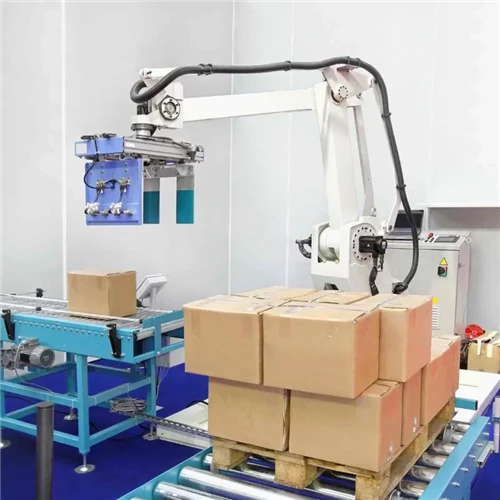
End-of-line packaging creates a massive bottleneck for modern manufacturing facilities. Ongoing labor shortages and high injury risks force operations managers to rethink manual stacking methods entirely. Workers performing repetitive lifting face severe ergonomic hazards over time. Facilities desperately need reliable automation to keep operations flowing safely and efficiently. This operational urgency drives many leaders to adopt a modern robotic palletizing solution.
You face a critical dilemma when upgrading your packaging line. Should you install a traditional, high-speed industrial machine? Or does a newer, flexible collaborative robot make more sense for your floor plan? You must weigh these exact options carefully before committing substantial resources. We will explore an objective, data-backed comparison to guide your complex decision. You will learn exactly how to evaluate payload limits, cycle speeds, and facility footprint realities. Understanding these critical variables ensures you select the perfect automation strategy for your end-of-line process.

Key Takeaways
- Payload & Speed Dictate the Baseline: Industrial robots are required for heavy, high-throughput lines; cobots excel in low-to-medium speed, lighter payload scenarios.
- Footprint Matters: Cobots eliminate the need for massive safety cages, reclaiming valuable facility floor space.
- TCO Goes Beyond Hardware: Industrial options have higher integration and programming costs, while cobots offer faster deployment but strict operational ceilings.
- Safety & Compliance: Both systems are safe, but they achieve compliance through entirely different methods (physical guarding vs. force-limiting sensors).
Understanding the Baseline: Cobot Robots vs. Industrial Robots
To make an informed choice, we must first define the core technologies operating within these systems. You cannot treat all automated systems identically because they serve vastly different operational needs.
Industrial Robots represent the traditional standard in high-volume manufacturing. Engineers design these purpose-built, high-torque machines for maximum speed and rigid repeatability. They run continuously under heavy-duty conditions without mechanical fatigue. Governed by rigid standards like ISO 10218, they excel in harsh environments requiring absolute precision and sheer power.
Conversely, Cobot Robots (collaborative robots) introduce an entirely new engineering philosophy. We define them as flexible, force-limited automation. Manufacturers build them specifically to work alongside human operators seamlessly. They operate safely without bulky physical barriers. Built-in joint torque sensors instantly halt their movement upon detecting unexpected contact, aligning seamlessly with modern safety guidelines.
Our goal is not to declare one universally better than the other. Both architectures effectively anchor a highly capable Robotic Palletizing Solution. They simply solve different production variables. Your final choice depends heavily on your unique facility constraints, output demands, and how frequently workers interact with the stacking area.
Head-to-Head Evaluation: Cobot Palletizer vs Industrial Robot Palletizer
Let us break down the performance metrics. Choosing a cobot palletizer vs industrial robot palletizer requires analyzing four primary operational dimensions.
Payload Capacity and Weight Limits
Payload dictates your initial filtering process when selecting equipment. Industrial options handle massive weights effortlessly due to their rigid cast-metal constructions and heavy-duty servomotors. These units easily manipulate heavy loads exceeding 100 to 500 kilograms. Suppose your agriculture, building materials, or chemical plant requires a robust 50kg bag palletizer. In such extreme cases, traditional industrial setups remain the only viable, safe option for continuous lifting.
Collaborative units follow entirely different physical limits. Engineers typically cap their maximum payloads around 20 to 30 kilograms to maintain safe momentum limits. You must always include the End of Arm Tooling (EOAT) weight in this total limit calculation. Pushing collaborative equipment to its maximum rated payload severely degrades its kinematic speed. Overloading also reduces the internal joint lifespan significantly, leading to premature wear.
Throughput and Cycles Per Minute (CPM)
Speed directly impacts daily production targets and overall factory throughput. Industrial systems dominate high-volume environments requiring relentless pacing. They routinely execute 20 to 40 picks per minute depending on travel distance. Integrators build them for continuous high-speed movement across large work envelopes. They often utilize multi-pick tooling to grab entire case rows simultaneously, drastically multiplying total throughput.
Collaborative units operate at a much calmer, controlled pace. They generally peak between 6 and 12 picks per minute in real-world applications. Strict global safety standards demand slower joint speeds to prevent dangerous impact forces. These kinematic limits protect nearby workers perfectly but inherently restrict overall packaging throughput. You must accept this speed trade-off for the benefit of cageless operation.
Floor Space and Facility Footprint
Space represents a premium asset inside any warehouse or production facility. Traditional automation claims a massive physical footprint. They require heavy floor anchoring and extensive structural safety fencing to isolate them from personnel. You must install complex light curtains, interlocked gates, and dedicated safety controllers. These combined safety components consume enormous amounts of valuable square footage.
Collaborative systems stay highly compact by design. You can often mount them on mobile bases, lifting columns, or minimal floor pedestals. They rely on programmable laser area scanners instead of rigid steel cages. The machine automatically slows down or pauses when human operators approach the loading zone. This modern innovation reclaims valuable aisle space and improves forklift traffic flow.
Programming, Integration, and Redeployment
Deployment flexibility separates the two technologies sharply. Traditional cells require specialized# Cobot Palletizer vs Industrial Robot Palletizer: Which Is Better?
End-of-line automation has evolved from a luxury reserved for multi-national conglomerates into a absolute necessity for manufacturers and distributors of all sizes. Rising labor costs, chronic worker shortages, ergonomic injuries, and accelerating supply chain demands have forced modern warehouses and factory floors to automate their end-of-line palletizing operations.
When evaluating automated stacking solutions, decision-makers inevitably face a central dilemma: Collaborative Robots (Cobot Palletizers) versus Traditional Industrial Robot Palletizers.
While both technologies eliminate manual labor, increase stacking accuracy, and protect workers from repetitive strain injuries, they represent radically different approaches to footprint, safety, flexibility, speed, payload capacity, and total cost of ownership (TCO). Choosing the right architecture requires a deep analysis of your operational throughput, plant layout, labor ecosystem, and long-term business goals.

Understanding the Fundamentals
To select the ideal system, it is vital to first understand the core technological differences between collaborative systems and traditional industrial automation.
- Human-Centric & Fenceless
- Integrated Power/Force Limiting
- Small Footprint & Plug-and-Play
- Rapid Deployment & Intuitive Setup
- Perimeter Guarded
- High Payload
- High Speed
- Fixed Infrastructure
What Is a Cobot Palletizer?
A cobot (collaborative robot) palletizer is an automated palletizing cell engineered to work safely alongside human operators without traditional physical safety barriers or perimeter fencing. Cobots utilize built-in safety mechanisms-such as power and force limiting (PFL), joint torque sensors, software collision detection, and customizable proximity sensors-that cause the robot to pause or slow down instantly upon contact with a person or obstacle.
- Core Philosophy: Flexibility, human-robot interaction, space-saving design, and low barrier to entry.
- Typical Payloads: 10 kg to 30 kg (including end-of-arm tooling).
- Typical Speeds: 8 to 15 picks per minute (PPM).
What Is an Industrial Robot Palletizer?
An industrial robot palletizer is a heavy-duty, high-speed automated arm-typically standard 4-axis or 6-axis articulation-designed to handle heavy payloads at rapid speeds inside a strictly secured enclosure. Because these machines operate with immense force and high momentum, safety regulations (such as ISO 10218-1 and ANSI/RIA R15.06) mandate hard perimeter fencing, safety light curtains, interlocked access doors, and physical safety zones to prevent human entry during operation.
- Core Philosophy: Maximum throughput, heavy payload capacity, durability, and continuous 24/7 duty cycles.
- Typical Payloads: 50 kg to over 800 kg.
- Typical Speeds: 20 to 60+ picks per minute (often utilizing multi-case vacuum or mechanical grippers).
Detailed Comparison: Cobot Palletizer vs. Industrial Robot Palletizer
| Performance Metric | Cobot Palletizer Cell | Industrial Robot Palletizer Cell |
| Footprint Requirements | Ultra-compact (approx. 2m x 2m to 3m x 3m); no physical fencing required | Large (approx. 4m x 5m to 6m x 8m); requires full safety perimeter |
| Safety Integration | Native power/force limiting, light curtains or area scanners optional | Mandatory hard fencing, interlocked gates, and light curtains |
| Payload Capacity | Low to Medium (10 kg – 30 kg total tool + product weight) | High to Very High (50 kg – 800+ kg total capacity) |
| Pick & Stack Speed | 8 – 15 picks/min (optimized for human-safe speeds) | 20 – 60+ picks/min (optimized for high-speed line rates) |
| Deployment Time | 1 to 3 days (plug-and-play, drag-and-drop programming) | 2 to 6 weeks (requires custom engineering, civil work, fencing) |
| Programming Complexity | Low (no-code/low-code graphical interfaces, hand-guiding) | High (requires specialized robotics programmers & PLC engineers) |
| Flexibility & Mobility | High (can be mounted on mobile bases or moved via forklift) | Low (permanently anchored to factory floor with concrete bolts) |
| Initial Capital Expenditure | Lower ($60,000 – $130,000 average total system cost) | Higher ($180,000 – $400,000+ standard cell cost) |
| Maintenance Needs | Minimal periodic maintenance; simple modular joint replacements | Dedicated industrial maintenance schedule; lubrication, gearbox servicing |
1. Safety and Footprint Considerations
In modern manufacturing facilities, floor space is valuable real estate. Every square meter occupied by fixed equipment is space that cannot be used for active inventory, production lines, or forklift traffic.
Cobot Palletizers: Fenceless and Compact
The primary advantage of a cobot palletizer is its remarkably small footprint. Because cobots comply with ISO 15066 safety guidelines, they do not require physical perimeter chain-link fences or interlocked safety cages under normal operating conditions.
- Proximity Safety: Most commercial cobot palletizing stations utilize safety laser scanners at the base. When an operator enters the warning zone, the cobot slows down automatically. If the operator steps into the inner stop zone, the cobot gracefully halts execution and resumes instantly once the path is clear.
- Real-World Advantage: Cobot cells can fit into tight spaces previously deemed impossible for automation, such as legacy plants with narrow aisles, low ceiling clearances, or tight packed end-of-line conveyors.
Industrial Robot Palletizers: The Safety Cage Requirement
An industrial robot operates with enough inertia and speed that contact with a human can cause severe or fatal injuries. As a result, industrial robot cells require a safety cage surrounding the entire working envelope.
- Footprint Inflation: The physical fence must be placed at a distance determined by the robot's maximum physical reach plus momentum stopping distance. Adding conveyor infeed lines, pallet dispensers, safety interlocks, light curtains, and safety clearance zones easily increases the footprint to three or four times that of a cobot cell.
- Floor Infrastructure: Industrial robots frequently require thick reinforced concrete foundations, chemical anchor bolts, and dedicated power lines to absorb dynamic torque loads generated during rapid acceleration and braking.

2. Speed, Throughput, and Payload Capacity
Production demands dictate the required automation architecture. Over-specifying or under-specifying robot capacity leads to bottlenecking or unnecessary capital expenditure.
Cobot Palletizer Limitations
Because cobots rely on force monitoring to keep human operators safe, their operational speeds are capped by design.
- Payload Constraints: While top-tier cobots now feature payloads up to 30 kg, this rating must accommodate the weight of the End-of-Arm Tooling (EOAT)-such as vacuum grippers, mechanical clamps, or pneumatic actuators-along with the actual box, case, or bag.
- Throughput Limits: If your line produces 25 cases per minute, a single cobot palletizer running single-picks will create a massive bottleneck. Multi-case picking on a cobot is rarely feasible due to strict payload boundaries.
Industrial Robot Dominance
When sheer volume and heavy payloads are mandatory, traditional industrial palletizers remain unmatched.
- High Payload Handling: Industrial units easily handle heavy multi-case vacuum tools, allowing them to lift 4, 6, or even an entire layer of boxes in a single motion (layer-palletizing). They effortlessly lift heavy bags of mortar, drums of chemicals, beverage crates, and bulk agricultural products weighing over 50 kg per pick.
- Continuous High Speed: Operating at accelerations exceeding 10 m/s², industrial robots can comfortably process line speeds of 30 to 60 cases per minute without breaking a sweat, ensuring continuous production across multi-shift operations.
3. Programming, Usability, and Deployment Flexibility
The availability of skilled controls engineers and industrial programmers has become a significant challenge for modern operations. System deployment and everyday software usability are major factors in choosing an automation pathway.
Intuitive "No-Code" Cobot Operation
Cobot systems are built for user-friendly operation. Manufacturers design cobot software so that shop-floor operators without formal robotics backgrounds can program and adjust palletizing patterns.
- Graphical Pallet Building: Modern cobot software offers visual drag-and-drop interfaces. Operators simply input box dimensions (length, width, height, weight), pallet size, and desired stacking pattern (interlocking, column, or custom slip-sheet layouts). The software calculates pathing, collision avoidance, and speed profiles automatically.
- Hand-Guiding & Rapid Deployment: Operators can move the cobot arm manually to program waypoints. A complete cobot cell can often be unpacked, positioned, configured, and integrated with an infeed conveyor in under three days.
- Mobility: Cobot palletizers built on modular baseframes can be transported via pallet jack or forklift to different production lines within the same plant in under an hour, providing adaptable automation for dynamic seasonal demands.
Industrial Robot Complexity
Deploying a traditional industrial palletizing arm requires specialized engineering expertise.
- Proprietary Code: Programming an industrial robot requires proficiency in proprietary languages (e.g., FANUC KAREL/TP, ABB RAPID, Yaskawa INFORM, KUKA KRL). Modifying a box pattern or introducing a new SKU typically requires bringing in a systems integrator or a dedicated automation engineer.
- Lengthy Integration Timelines: From initial cell design, mechanical safety panel construction, PLC integration, and sensor tuning to final safety validation, industrial installations typically require weeks or months from contract signing to production line start.
4. Total Cost of Ownership (TCO) and Return on Investment (ROI)
Evaluating cost requires looking beyond the initial purchase price of the mechanical arm. Total Cost of Ownership (TCO) encompasses peripheral hardware, system integration, facility modifications, training, maintenance, and power consumption.
- Low Capital Investment
- Fast Payback (6–18 Months)
- Minimal System Integration Costs
- Low Power Consumption (~0.5-1.5kW)
- DIY Re-configuration
- High Initial Investment
- Longer Payback (24–48+ Months)
- Heavy System Integration Costs
- High Power Consumption (~5-15kW)
- Integrator Fee for Modifications
Financial Profile: Cobot Palletizers
- Capital Expenditure (CapEx): A complete turn-key cobot palletizing cell-including the cobot arm, vertical telescopic pillar, custom vacuum EOAT, base frame, software, and basic safety sensors-ranges between $60,000 and $130,000.
- Integration Costs: Minimal. Because the cell arrives pre-engineered, integration costs are a fraction of the hardware cost.
- Operating Costs: Cobots run on standard single-phase electrical power (110V/220V) with low power draw (typically under 1.5 kW), leading to lower utility bills.
- ROI Timeline: Thanks to fast deployment, minimal setup costs, and labor savings, cobot installations typically achieve full financial payback within 6 to 18 months.
Financial Profile: Industrial Robot Palletizers
- Capital Expenditure (CapEx): A traditional industrial robot cell typically costs between $180,000 and $400,000+. Complex multi-line systems with automatic pallet dispensers, slip-sheet applicators, and stretch wrappers can easily cross the $500,000 mark.
- Integration Costs: Integrator fees often account for 30% to 50% of the total system cost due to safety fencing, PLC programming, custom conveyor interfacing, and on-site testing.
- Operating Costs: Industrial robots run on 3-phase industrial power (480V) consuming 5 kW to 15 kW or more. Maintenance costs are higher over time due to heavy gearbox oil changes, mechanical wear, and specialized replacement parts.
- ROI Timeline: Higher initial investment leads to longer payback periods, usually between 24 to 48 months. However, for continuous high-speed operations running 24/7, the unit economics per pallet deliver strong long-term value.

Strategic Selection Framework: Which Is Better for Your Facility?
There is no universal "winner" between cobot and industrial palletizers. The right choice depends entirely on your specific manufacturing conditions, throughput requirements, product physical characteristics, and facility footprint.
Choose a Cobot Palletizer If:
- Line Speeds Are Under 15 Cases/Minute: Your production rate falls comfortably within human-safe collaborative operating limits.
- Payloads Are Light to Moderate: Individual boxes, bags, or trays weigh less than 25–30 kg (inclusive of gripper weight).
- Floor Space Is Restricted: You need to fit automation into tight, existing production lines without tearing out walls or blocking forklift lanes with safety fences.
- You Have High SKU Variety & Frequent Changeovers: Your facility runs short production runs of multiple products, requiring daily pattern changes and rapid line reconfigurations.
- In-House Engineering Is Limited: You lack dedicated automation engineers and need a system that existing floor operators can manage and re-program easily.
- Capital Budget Is Limited: You want to automate quickly with a low initial investment and achieve rapid payback within 12 months.
Choose an Industrial Robot Palletizer If:
- High Throughput Is Mandatory: Your production lines run at 20 to 60+ cases per minute, requiring continuous multi-case or layer-picking operations.
- Payloads Are Heavy: You are palletizing heavy products such as 25kg–50kg sacks, chemical drums, fluid crates, or large industrial components exceeding 30 kg.
- Operation Runs 24/7/365: You run continuous multi-shift, high-speed manufacturing where long-term durability and heavy-duty components are critical.
- Dedicated Space Is Available: Your facility layout can comfortably accommodate a dedicated 20+ square meter safety enclosure without obstructing factory logistics.
- In-House Automation Support Exists: You have controls engineers and robotic technicians on staff (or long-term service agreements with integrators) to maintain complex PLC and robotic systems.
The Hybrid Future of End-of-Line Automation
As robotics technology advances, the boundary between cobot and industrial palletizers is beginning to blur.
Emerging "High-Speed Collaborative Systems" combine heavy-payload cobot arms (30kg–50kg capacities) with advanced multi-tier safety zones using industrial 3D LiDAR and area scanners. In this hybrid approach, the system operates at maximum industrial speed when no humans are detected nearby. When a worker enters the perimeter, safety sensors dynamically slow the system down to collaborative speeds, offering a balance of high throughput and fenceless flexibility.
Ultimately, choosing between a cobot palletizer and an industrial robot palletizer comes down to matching technology to your operational realities. Cobots offer unmatched flexibility, compact footprints, and rapid ROI for small-to-medium throughputs. Meanwhile, traditional industrial robots remain the undisputed heavyweights for high-speed, high-volume production. By carefully evaluating your line speeds, product payloads, available floor space, and long-term business strategy, you can confidently invest in the ideal automated palletizing solution for your facility.
To evaluate your multi-level facility's layout feasibility, contact our technical engineering team today. Provide your plant architectural drawings, floor-to-floor heights, converting line output rates, and target pallet specifications, and our team will prepare a custom 2D/3D CAD layout drawing and a complete technical feasibility analysis tailored to your site.