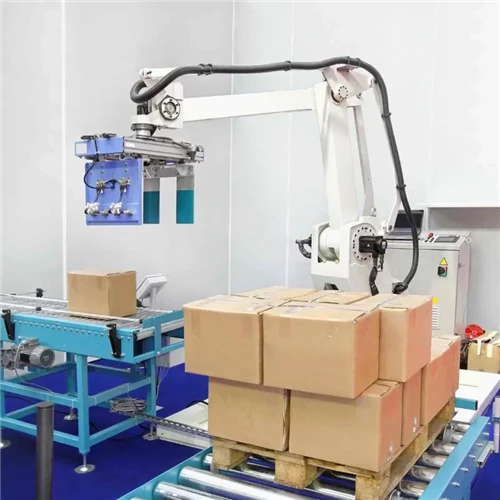
High-speed Food & Beverage (F&B) distribution lines require versatile automation capable of handling delicate glass bottles, flexible shrink-wrapped trays, heavy beverage cases, and temperature-sensitive cold chain environments. Deploying an automated robotic palletizing system in food and beverage distribution eliminates product breakage (reducing container loss to < 0.02%), supports complex mixed-case palletizing for beverage distribution, and boosts line throughput to 30+ cases per minute. By pairing 3D vision-guided pattern generation with custom soft-touch End-of-Arm Tooling (EOAT) and remote PLC diagnostics, an experienced food packaging palletizing robot manufacturer enables F&B plants to achieve a full CapEx payback within 12 to 15 months while resolving persistent labor shortages.

1. The Operational Bottleneck in Food & Beverage Distribution
Food and beverage manufacturing plants and regional distribution centers (DCs) operate under relentless margin pressures and strict fulfillment deadlines. While front-end processing and primary packaging (filling, labeling, and capping) have achieved high levels of speed and automation, end-of-line packaging and palletizing frequently remain operational bottlenecks.
Plant managers face three compounding challenges:
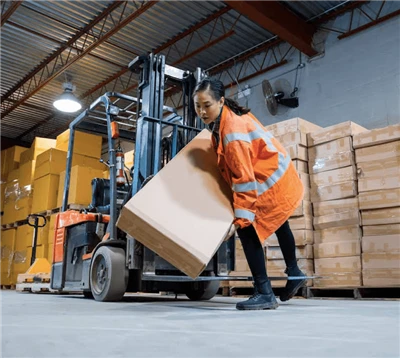
- Severe Labor Turnover in Harsh Environments: Manual palletizing requires lifting thousands of 10kg to 25kg cases per shift. In cold storage facilities (operating at -20℃ for frozen foods) or high-humidity beverage bottling plants, worker turnover routinely exceeds 40% annually, leading to constant retraining costs and ergonomic injury claims.
- High Cost of Product Breakage: A dropped case of glass beverage bottles or sauce jars does not just destroy that specific product; liquid leakage contaminates surrounding inventory, damages conveyor mechanics, and causes unscheduled line stoppages for manual cleanup.
- Shift Toward Retail-Ready Mixed-Case Orders: Retailers and supermarkets increasingly demand "rainbow pallets" (pallets built with multiple distinct SKUs) rather than full single-SKU pallets. Traditional high-level mechanical matrix palletizers cannot handle dynamic box dimensions on the fly.
Transitioning to a flexible food distribution palletizing robot addresses these challenges by replacing rigid mechanical pushers with multi-axis articulated arms driven by intelligent pattern-generation software.
2. Packaging Modality Engineering: Handling Glass, Cans, and Shrink-Wrapped Trays
An effective beverage case palletizer must adapt to a wide variety of secondary packaging formats without causing structural deformation or surface scuffing.
2.1 Glass Bottles & Jars (Minimizing Impact Deceleration)
Glass containers require ultra-smooth acceleration and deceleration curves. High-speed 4-axis industrial robots utilize S-curve motion profiling to prevent glass-to-glass clinking, micro-fractures, and tip-overs during rapid 180-degree slewing motions.
2.2 Shrink-Wrapped Trays & Unsupported Bundles
Handling shrink-wrapped bottle trays (where bottles sit on a thin cardboard tray wrapped in polyethylene film) is notoriously difficult. Standard narrow vacuum cups can tear the plastic film or cause the bundle to sag in the middle. Specialized custom EOAT for beverage cartons and bundles utilizes broad-surface foam vacuum grids or bottom-support side clamps that evenly distribute lifting pressure.
2.3 Corrugated Cartons & Tetra Pak Packaging
Liquid packaging cartons (such as milk or juice in Tetra Pak formats) are susceptible to edge crush and sidewall bulging. Robotic end-effectors must employ regulated pneumatic clamping forces, ensuring secure grip pressure without crushing the internal liquid barrier layers.
Read More: 《How To Reduce Downtime in Your Corrugated Box Plant: A Practical Guide》
3. Technology Comparison: Selecting the Right Palletizing Architecture for F&B
When evaluating automation options, engineering teams must weigh throughput requirements, available plant floor space, and SKU variability.
| System Architecture | Peak Throughput | Floor Space Required | Cold Storage & Washdown Suitability | Mixed-Case Capability | Typical Changeover Time |
| Traditional High-Level Mechanical Palletizer | 40–70+ cases/min | Large (60-100㎡) | Moderate (Complex mechanical linkages) | Very Low (Single-SKU only) | 15–45 minutes (Mechanical adjustment) |
| 4-Axis Articulated Industrial Robot | 20–35 cases/min | Medium (20-35㎡) | High (IP65/IP67 enclosures, cold-rated grease) | High (3D vision & dynamic layer software) | Instant (Recipe selection on HMI) |
| Collaborative Robot (Cobot) Cell | 6–13 cases/min | Compact (8-12㎡) | Moderate (Limited washdown options) | Moderate (Lower payload limits) | Instant (Drag-and-drop HMI) |
For medium-to-high-speed food processing plants, 4-axis industrial articulated robots provide the optimal balance between high CPM throughput, compact footprint, and multi-SKU flexibility.
4. End-of-Arm Tooling (EOAT) & Cold Chain Hygiene Standards
The gripper is the critical interface between the robotic arm and the F&B packaging. In food production, EOAT designs must meet stringent sanitation and environmental resilience standards.
Gripper Selection Matrix for Food & Beverage Applications
| Gripper Architecture | Primary F&B Application | Core Advantage |
| Large-Area Foam Vacuum Grid | Corrugated boxes, rigid trays, multi-case picking | Broad suction coverage without puncturing flexible packaging |
| Bottom-Support Clam-Shell | Heavy shrink-wrapped trays, loose bottle bundles | 100% mechanical bottom support eliminates drop risk |
| Pneumatic Side-Clamp | Sealed beverage crates, plastic totes, sturdy cases | Maximum lateral clamping stability during rapid multi-axis turns |
| Hybrid Multi-Function Gripper | Integrated case picking + slip-sheet + pallet handling | Single EOAT handles cases, pallets, and slip-sheets seamlessly |
4.1 Stainless Steel & Washdown Compliance (IP65 / IP69K)
In meat, dairy, and liquid beverage processing plants, equipment undergoes daily high-pressure chemical washdowns. Grippers installed on a food packaging palletizing robot must feature stainless steel construction, anodized aluminum components, hydrophobic vacuum filters, and IP67/IP69K-rated pneumatic actuators to withstand caustic cleaning agents.
4.2 Chilled Operations & Cold Chain Buffer Zones (0℃ to 8℃)
In fresh food, dairy, and beverage bottling plants, automated palletizers frequently operate in high-humidity chilled buffer zones (0℃ to 8℃). The system incorporates IP65-sealed electrical control cabinets, corrosion-resistant framing, and moisture-repellent pneumatic filtration to ensure continuous uptime. For specialized deep-freeze facilities operating below -20℃, an optional Low-Temperature Engineering Package is available, adding internal arm heating modules, cold-rated synthetic lubricants, and condensation control systems.
5. Mixed-Case & "Rainbow Pallet" Building via 3D Vision Software
Modern F&B distribution centers are moving away from traditional single-SKU manufacturing storage and toward dynamic direct-to-store order fulfillment.
Building a stable mixed-case pallet requires three integrated technologies:
- WMS/WCS Integration: The Warehouse Management System sends real-time order manifests to the robot cell controller.
- 3D Vision & Profiling Sensors: Overhead 3D sensors scan incoming cartons on the infeed conveyor to verify precise length, width, height, and orientation, flagging any damaged or bulging boxes before picking.
- Pattern Generation Algorithms: Advanced layer forming pattern software calculates the structural integrity of the pallet on the fly, placing heavier corrugated cases at the base and lighter shrink-wrapped items near the top while maintaining a square vertical center of gravity.
Read More: 《Paper Splicer ROI 2026: The Hard Financial Math Behind Automatic Roll Changes》
6. Real-World Financial Math: Simplified ROI Calculation
Calculating the financial payback of an automated robotic palletizing system in food and beverage distribution comes down to comparing total system investment against annual operational savings.
Simplified Payback Model (2-Shift Beverage Facility)
- Total Turnkey System Investment (CapEx): $220,000
(Includes 4-axis industrial robot, custom vacuum/clamp EOAT, safety enclosure, infeed conveyor, and installation)
- Net Annual Operational Savings (OpEx): $180,000 / year
(Direct labor savings of 3 operators across 2 shifts + elimination of product breakage and fluid spill cleanup)
Simple Payback Formula
After 14.6 months, the cell pays for itself completely, turning all subsequent operational savings directly into plant bottom-line profitability.
7. Strategic Implementation Checklist for Plant Managers
When issuing an RFP to a prospective food packaging palletizing robot manufacturer or system integrator, use this technical checklist to ensure long-term operational success:
- Define Full Infeed Packaging Array: Provide exact dimensions, weights, surface textures, and moisture levels for every SKU (corrugated boxes, shrink-wrapped trays, plastic totes).
- Verify Line Speed & Peak Inrush: Ensure the robot payload and cycle time handle peak upstream surging (e.g., 30 CPM sustained vs. 38 CPM surge).
- Specify Environmental Protection Ratings: Require IP65/IP67 rating for wet washdown zones or cold-pack heating kits for frozen environments below 0℃.
- Confirm Software Interoperability: Ensure the robot controller natively supports your plant's WMS/PLC communication protocols (EtherNet/IP, PROFINET, Modbus TCP).
- Require Secure Remote Diagnostic Access: Insist on an integrated IIoT VPN gateway inside the main electrical panel to enable 24/7 remote troubleshooting and motion profile tuning by OEM service engineers.
To learn how custom packaging and end-of-line robotics can elevate your production line throughput, visit our technical solution section on the Automatic Palletizing Robot page.