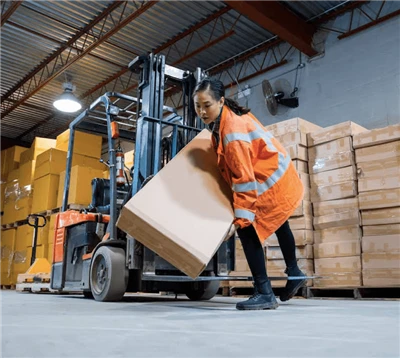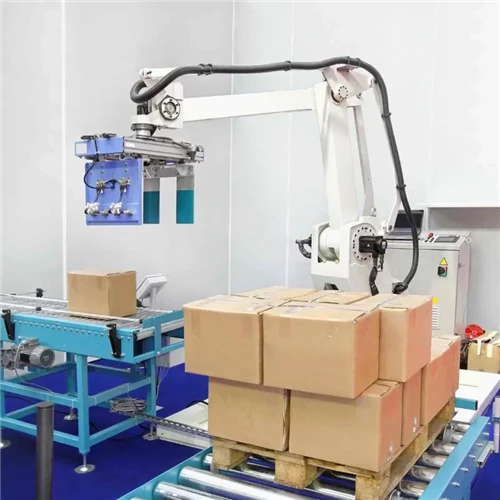
Palletizing flexible bulk packaging such as Polypropylene (PP) woven sacks and multi-wall paper bags presents unique automation challenges due to internal air entrapment, material creep, shifting bulk density, and stack instability. Transitioning from manual labor to an automated robotic bag palletizing cell requires a fully integrated mechanical ecosystem: pairing inline bag flatteners (conditioning conveyors) with bottom-support clam-shell grippers and dynamic PLC layer interleaving. Partnering with a specialized palletizing robots manufacturer allows packaging facilities to completely eliminate pallet stack collapse, prevent bag tearing, reduce operational labor overhead by up to 75%, and maintain stable palletizing throughput exceeding 20–30 bags per minute. Whether deploying a high-speed 4-axis industrial palletizing robot or integrating flexible universal robots palletizing architectures for low-headroom plants, mastering pre-conditioning and grip dynamics is the fundamental key to cross-border automation success.
1. Executive Comparison: Manual Bag Stacking vs. Automated Robotic Bag Palletizing
Bulk bag handling across chemical, agricultural, building materials, and food processing industries requires consistent layer stability. The physical characteristics of flexible packaging-such as uneven material distribution, rounded crown centers, and slick synthetic surfaces-make manual palletizing prone to structural failure during transit.
| Operational Metric | Manual Bag Stacking Line | Automated Robotic Bag Palletizing System |
| Sustained Throughput | 6–12 bags/min (degrades over shift due to fatigue) | 18–35+ bags/min (continuous 24/7 duty cycle) |
| Stack Collapse Risk | High (uneven layer density & human error) | Near Zero (precise positioning & bag flattening) |
| Bag Breakage Rate | 1.5%–3.0% (rough manual handling & drag) | < 0.05% (controlled clamp pressure & gentle EOAT) |
| Max Stacking Height | 1.2–1.4 meters (limited by reach ergonomics) | 1.8–2.4+ meters (utilizes full container/truck volume) |
| Direct Labor Requirement | 2–4 operators per line per shift | 0.5 operator (supervisory & pallet reloading) |
| Typical ROI Payback | N/A (Ongoing operational expense) | 12 to 22 months (based on 2-shift plant operation) |
2. The Physics of Bulk Bag Instability: Why Standard Vacuum Grippers Fail
Unlike rigid corrugated boxes or uniform plastic crates, bulk bags filled with powders, granules, or pellets behave as non-Newtonian fluids during high-speed acceleration. When a bag containing flour, plastic resin, titanium dioxide, or animal feed is picked up, the internal product shifts dynamically toward the lowest point of gravity.
When engineering an automated system, plant managers evaluating a palletizing robot China sourcing project must account for three primary physical failure modes:
- Air Entrapment and the "Pillow Effect": During high-speed form-fill-seal (FFS) or valve-bag filling, air is trapped alongside the bulk powder. If a bag is palletized immediately without mechanical air evacuation, it acts as a soft pillow. Under the heavy weight of upper tiers, the trapped air migrates, causing the stack to lean and eventually collapse inside storage warehouses or shipping containers.
- Synthetic Material Creep & Friction Coefficients: Laminated Polypropylene (PP) woven sacks feature extremely low surface friction coefficients. When subjected to horizontal inertial forces during transit, smooth PP bags slide off one another unless mechanically locked via pinwheel layer patterns and anti-slip interlayers.
- Bulging Crown Centers: Unconditioned bags develop a thick center core and thin, tapered edges. Stacking round-centered bags directly on top of each other creates a convex tower that inevitably tilts beyond its critical vertical center-of-gravity threshold.
Because paper bags can be porous and PP woven sacks have uneven woven textures, standard flat vacuum suction cups routinely suffer from vacuum pressure leakage, causing mid-air bag drops. Consequently, a heavy-duty industrial palletizing robot handling bulk bags must utilize specialized End-of-Arm Tooling (EOAT) engineered specifically for deformable loads.
Read More: 《How To Reduce Downtime in Your Corrugated Box Plant: A Practical Guide》

3. Bag Conditioning: The Critical Pre-Palletizing Phase
A successful robotic bag palletizing cell begins long before the robotic arm reaches down to pick up a bag. More than 70% of stack collapse issues stem from inadequate pre-conditioning before the pick zone.
3.1 Mechanical Bag Flatteners (Dual-Belt Compaction)
Before entering the robot pick station, every bag must pass through a motor-driven bag flattener. This conditioning conveyor consists of an adjustable upper pressure belt and a lower transport belt. As the bag travels between the converging belts, mechanical pressure squeezes out residual trapped air through micro-perforations or valve vents, forcing the granular material into a flat, rectangular brick shape of uniform thickness.
3.2 Square-Up and Orienting Conveyors
To ensure repeatable robot picking, bags must arrive at the pick station perfectly aligned against mechanical side guides or square-up stopper plates. Roller-bed orienting conveyors rotate incoming bags 90 degrees or 180 degrees when necessary to match the precise pick orientation dictated by the master PLC recipe.
3.3 Inline Checkweighing and Reject Systems
Under-filled or over-filled bags disrupt pallet levelness and violate commercial trade tolerances. Integrating a high-speed dynamic checkweigher immediately upstream of the bag flattener allows out-of-spec bags to be automatically diverted into a reject bin without interrupting the main industrial palletizing robot duty cycle.
4. End-Of-Arm Tooling (EOAT) Selection for Flexible Bag Handling
Selecting the optimal End-of-Arm Tooling is the single most critical hardware decision when consulting a palletizing robots manufacturer. The gripper must securely support the bag's shifting mass during rapid multi-axis movement while ensuring zero puncture or surface damage.
| Gripper Architecture | Operating Mechanism | Ideal Bag Material | Key Advantages & Limitations |
| Clam-Shell / Finger Gripper | Pneumatic mechanical fingers drive under the bag to support bottom weight. | PP Woven Sacks, Paper Bags, Jute Sacks (10–50 kg) |
Advantage: 100% mechanical bottom support; immune to bag porosity or dust. Limitation: Requires side clearance on infeed conveyor. |
| Vacuum Foam Grid (Foam Pad) | High-flow vacuum blower creates suction across dense sponge pad matrix. | Multi-wall Paper Bags, Non-Porous Plastic Valve Bags |
Advantage: Top-pick capability allows dense side-by-side placement. Limitation: High electrical consumption; vacuum loss on dusty woven bags. |
| Fork & Top-Clamp Combo | Comb-like forks slide underneath bag while a pneumatic top plate clamps upper surface. | Heavy Valve Bags, Fine Powders (25–50 kg) |
Advantage: High payload stability during 30+ CPM acceleration. Limitation: Heavier EOAT weight requires larger robot payload capacity. |
| Multifunction Hybrid EOAT | Combines bag clam-shell fingers, vacuum slip-sheet cups, and pallet-lifting hooks. | All Bag Types in Fully Automated Cells |
Advantage: Single robot handles empty pallets, slip-sheets, and bags. Limitation: Higher initial CapEx; increased maintenance complexity. |
For high-throughput industrial facilities, bottom-support clam-shell grippers remain the gold standard. By lifting the bag from underneath rather than relying solely on surface friction or vacuum suction, the risk of dropping a 25kg or 50kg bag during emergency stops is completely eliminated.
5. Layer Pattern Engineering & Interleaving Strategies
Building a rigid pallet column requires combining proper bag conditioning with intelligent mathematical pattern programming within the robot motion controller.
5.1 Pinwheel and Interlocking Layer Patterns
Stacking bags in identical column configurations (straight vertical columns) creates isolated towers that easily tip over. Modern PLC pattern software generates alternating pinwheel layers where each upper bag overlaps the seams of two lower bags. This intermingled structure locks the entire tier together into a single structural block.
5.2 Automatic Slip-Sheet and Layer Cardboard Placement
For smooth Polypropylene bags, inserting a kraft paper or polyethylene slip-sheet every 2 to 3 layers dramatically increases inter-layer friction. Hybrid grippers equipped with integrated auxiliary vacuum cups can automatically pick a paper slip-sheet from a side magazine and place it onto the pallet stack prior to starting a new bag layer.
5.3 Stretch Wrapping and Corner Post Integration
To maintain maximum stack integrity during transoceanic shipping, the bag palletizing cell should be directly connected to an automatic inline stretch wrapper. Wrapping the pallet with pre-stretched film under calibrated tension secures the bag stack against vibration and moisture during transit.
Read More: 《Paper Splicer ROI 2026: The Hard Financial Math Behind Automatic Roll Changes》

6. System Architectural Integration: Industrial Heavy-Duty vs. Collaborative Cells
Plant managers must choose between traditional heavy-duty 4-axis articulated robots and compact collaborative robot (cobot) systems based on throughput requirements, footprint availability, and safety infrastructure.
6.1 High-Speed Industrial Articulated Robots
For heavy-duty manufacturing facilities running 24/7 at speeds of 18 to 35 bags per minute, a 4-axis industrial palletizing robot (such as a 120kg to 180kg payload arm) provides unmatched speed and reach. These systems operate inside full safety enclosures fitted with interlocked light curtains, safety gates, and automatic multi-zone floor scanners.
6.2 Universal Robots Palletizing and Cobot Solutions
In low-headroom facilities, small-batch blending plants, or applications with strict floor space limits, implementing a universal robots palletizing setup offers distinct advantages. Collaborative systems utilize power and force limiting (PFL) sensors, eliminating the need for bulky perimeter fencing and reducing installation footprint by up to 45%.
While cobot systems typically operate at lower speeds (6 to 13 bags per minute with payloads up to 15–20kg), their ease of redeployment, intuitive drag-to-program user interfaces, and lower capital cost make them an ideal entry point for small-to-medium enterprises (SMEs).
6.3 Sourcing Strategy: Evaluating Palletizing Robot China Manufacturers
When selecting an overseas equipment partner, evaluating a reputable palletizing robot china manufacturer can deliver exceptional value. Top-tier Chinese automation OEMs combine global Tier-1 core components (such as Siemens PLCs, Shimpo reducers, and Schneider electrics) with world-class structural fabrication, offering complete automated turnkey cells at highly competitive CapEx thresholds.
7. Strategic Implementation Checklist for Plant Managers
When preparing your facility for a robotic bag palletizing integration, follow this systematic engineering checklist:
- Audit Bag Physical Specifications: Document minimum/maximum bag dimensions, filled bag weights, valve vs. open-mouth sealing type, and bag material composition (PP woven, multi-wall paper, PE film).
- Determine Bag Conditioning Requirements: Measure bulk density aeration to specify the exact pressing length and roller pressure required for the inline bag flattener.
- Select the Correct EOAT Architecture: Match the gripper type to your bag material. Specify clam-shell finger grippers for porous PP sacks and vacuum foam grids for non-porous flat paper bags.
- Define Plant Floor Footprint & Safety Zones: Decide whether your throughput demands a high-speed industrial palletizing robot with physical safety fencing or a compact universal robots palletizing cell.
- Verify Vendor Remote Diagnostic Capabilities: Ensure your chosen palletizing robots manufacturer embeds hardware-isolated IIoT VPN gateways inside the main electrical enclosure for instant remote PLC tuning and software troubleshooting.
To explore how custom end-of-line automation can transform your plant's throughput and protect your packaging quality, visit our comprehensive technical product section on the Robotic Palletizer page.