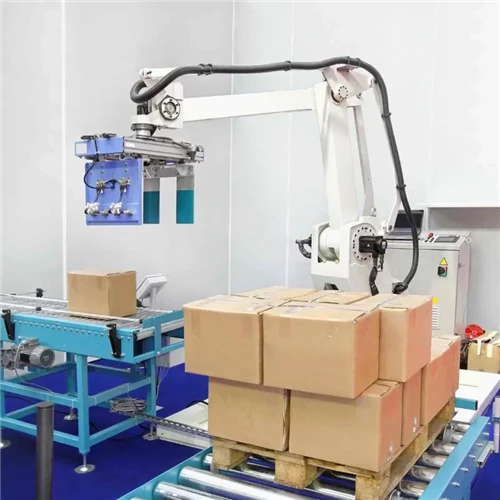
The geographical distance between overseas manufacturing plants and equipment suppliers in Asia no longer presents an operational bottleneck for industrial packaging lines.
By embedding secure, hardware-isolated Industrial IoT (IIoT) VPN gateways directly into the main control cabinets, a forward-thinking palletizing robots manufacturer can deliver real-time Programmable Logic Controller (PLC) diagnostics, remote servo trace optimization, and immediate software patch deployments across borders. This cloud-enabled after-sales framework reduces mean time to repair (MTTR) from days to minutes, guarantees 99%+ operational availability for heavy-duty systems, and eliminates the multi-thousand-dollar expense of emergency international technician dispatches.
Whether managing an advanced industrial palletizing robot cell, collaborative universal robots palletizing units, or a custom high speed robotic palletizer, remote PLC tele-diagnostics represent the modern benchmark for cross-border machinery reliability.
Executive Comparison: Legacy On-Site Support vs. Remote IIoT Diagnostics
| Support Metric | Legacy Cross-Border Service Model | Modern Remote PLC Diagnostic Framework |
| Initial Response Time | 24–72 hours (timezone delays, email back-and-forth) | < 15 minutes via automated cloud alerts & instant VPN handshake |
| Mean Time to Repair (MTTR) | 3–7 business days (awaiting international technician travel) | < 2 hours for code bugs, parameter drifts, or logic resets |
| Procurement Risk & Downtime Cost | $5,000–$25,000 per day in lost plant throughput | 90%+ reduction in unscheduled downtime costs |
| IT/OT Cybersecurity Profile | Unsecured remote desktop sessions or open port forwarding | 256-bit AES encrypted outbound VPN via hardware key switch |
| Root-Cause Accuracy | Trial-and-error physical component swapping on-site | Precision data logging via PLC signal trace and servo torque analysis |
1. The Global Evolution of Machinery After-Sales Infrastructure
For decades, purchasing heavy industrial packaging equipment internationally carried inherent operational risks. Plant managers evaluating a palletizing robot china solution often worried about post-installation technical support: What happens when a sensor fault halts the line at 2:00 AM? How long will it take for an automation engineer to fly across continents to debug a PLC bus conflict?
Historically, these concerns were valid. Legacy support relied heavily on physical travel, local third-party contractors with limited machine-specific knowledge, or cumbersome telephone troubleshooting that struggled to bridge technical language gaps.
Today, the rapid evolution of Industrial Internet of Things (IIoT) architectures, edge computing, and cloud telemetry has fundamentally transformed machinery support. Overseas equipment manufacturers now equip high-throughput machinery with integrated, secure remote diagnostic infrastructure before shipment.
When procuring an automated cell-whether a traditional 4-axis articulated arm, a collaborative universal robots palletizing workstation, or an ultra-fast continuous packaging line-the true capability of the machine depends directly on its digital remote support architecture. Remote PLC diagnostics bridge the geographical gap, enabling engineering teams in China to inspect ladder logic, adjust servo drive motion parameters, and update Human-Machine Interface (HMI) code in real time as if they were standing directly on your factory floor.
Read More: 《How To Reduce Downtime in Your Corrugated Box Plant: A Practical Guide》
2. Core Architecture of Remote PLC Diagnostic Systems
A robust remote diagnostic ecosystem relies on a dedicated, secure hardware and software architecture embedded directly within the machine's primary electrical enclosure.
2.1 Industrial IoT VPN Gateways and IT-OT Network Isolation
The backbone of modern remote support is a dedicated industrial security gateway (such as eWON Cosy, Secomea SiteManager, or Siemens SCALANCE) mounted directly on the control cabinet's DIN rail.
- Outbound-Only Encrypted Connections: The gateway establishes an outbound-only, 256-bit AES encrypted SSL/TLS VPN tunnel to a secure cloud server using standard web ports (HTTPS / Port 443 or MQTT). Because it makes outbound connections only, it requires no inbound open ports on the client's corporate firewall.
- Hardware-Level Physical Isolation: High-grade implementations feature a physical two-position key switch or digital input selector on the machine panel. Plant maintenance operators retain absolute authority: the remote VPN connection cannot be initiated unless local plant staff physically turn the key to "REMOTE ON."
- Strict OT Network Segmentation: The gateway isolates the machine's internal Ethernet subnet (connecting PLCs, servo drives, machine vision systems, and HMI panels) from the plant's enterprise LAN, preventing unauthorized access to corporate IT assets.
2.2 PLC Stack Integration and Protocol Support
Leading international automation suppliers engineer their software stack to support native remote engineering environments. Whether the cell utilizes Tier-1 controllers (Siemens S7-1500/1200, Allen-Bradley CompactLogix, Beckhoff Automation) or specialized motion controllers integrated with an industrial palletizing robot, remote access allows engineers to perform:
- Online Logic Monitoring: Real-time inspection of ladder logic, structured text (ST), or function block diagrams (FBD) to trace interlock conditions and sensor bit states.
- Servo Drive Trace Analysis: Real-time plotting of speed curves, torque limits, dynamic position errors, and current draw across multi-axis robotic joints.
- Virtual HMI Screen Mirroring: Full remote access to VNC/HTML5 web servers embedded inside the HMI, allowing engineers to view exact operator button presses, active error pop-ups, and recipe parameters.

3. Step-by-Step Technical Incident Resolution Workflow
When an operational anomaly occurs on an active production line-such as a cycle interruption on a high speed robotic palletizer-the remote diagnostic framework follows a rigorous, multi-stage engineering protocol.
- Step 1: Automated Alarm Generation & Cloud Telemetry Alerting
The machine's PLC detects an operational fault (e.g., servo position deviation limit exceeded on Axis 3 or a vacuum pressure drop during high-speed pick-and-place). The system logs the exact timestamp, error code, and active sensor states into the local HMI buffer and simultaneously transmits an encrypted push alert to the manufacturer's 24/7 technical support cloud.
- Step 2: Local Operator Authorization & Secure Handshake
The plant maintenance supervisor rotates the hardware key switch on the control cabinet to enable remote access. The remote IIoT gateway initiates an outbound handshake to the cloud server, generating an authenticated, session-tokenized VPN connection for authorized OEM engineers.
- Step 3: Remote I/O and Logic Inspection
The OEM automation engineer opens their native development software (e.g., TIA Portal, Studio 5000, or Roboguide) and connects to the machine over the secure tunnel. The engineer inspects the live digital and analog I/O status table to pinpoint physical hardware issues-such as a misaligned optical sensor, a stuck solenoid valve, or a damaged proximity switch.
- Step 4: Servo Drive Trace & Dynamic Motion Tuning
If the issue involves positioning errors or mechanical vibration, the engineer executes an oscilloscope trace directly on the servo drive parameters. Motion curves, acceleration ramps (m/s²), and PID gains are adjusted remotely to compensate for mechanical wear or changes in packaging material density.
- Step 5: Hot Program Patch & Parameter Deployment
If a logic edge-case or recipe parameter error caused the shutdown, the engineer writes and verifies a dynamic code patch in a simulated test environment. The updated software module is uploaded directly to the target PLC or robot controller without wiping master configuration files or historical recipe databases.
- Step 6: Live Operational Validation & Session Closure
The local operator resets the hardware E-stop circuit and executes a single-step dry run under remote engineering observation via live HMI screen mirror or video feed. Once smooth automatic operation is confirmed, the remote session is terminated, and the local maintenance operator returns the hardware switch to "LOCAL ONLY."

4. Comparing Remote Support Capabilities Across Manufacturer Tiers
Not all machinery suppliers provide identical remote engineering capabilities. When selecting a palletizing robots manufacturer, overseas buyers must evaluate the vendor's digital after-sales maturity alongside their physical mechanical engineering.
Technical Support Capability Matrix
| Feature / Standard | Basic / Low-Cost Tier | Advanced Engineering Tier | Industry Leader Standard |
| Remote Hardware | Unbranded consumer router or desktop software (TeamViewer) | Dedicated DIN-rail IIoT VPN gateway (eWON / Secomea) | Dual-WAN Industrial Gateway with integrated 4G/5G failover |
| Connection Security | Static open IP ports; unencrypted public internet | Outbound TLS/SSL tunnel with 256-bit AES encryption | Outbound TLS + 2-Factor Authentication (2FA) + Physical Key Switch |
| Diagnostic Depth | HMI screen view only; no access to underlying code | Full PLC ladder logic access and live I/O monitoring | Full PLC, Robot Motion Controller, Servo Trace & Vision System access |
| Data Logging & Telemetry | Local HMI storage only (cleared on power cycle) | On-board SD card logging for error history | Cloud-based edge computing with predictive analytics & trend logging |
| Remote SLAs | Best-effort email during vendor local business hours | 2–4 hour guaranteed response time via dedicated portal | < 1 hour guaranteed 24/7 global response SLA with dedicated team |
| Multilingual Support | Chinese-only support documentation | English HMI & translated user manuals | Native English/Spanish HMI with automated real-time translation logs |
When evaluating a palletizing robot china solution for demanding applications, verifying these technical remote support specifications ensures your plant receives continuous operational protection regardless of geographic time differences.
Read More: 《Paper Splicer ROI 2026: The Hard Financial Math Behind Automatic Roll Changes》

5. Overcoming IT Cybersecurity Concerns, Network Latency, and Language Barriers
While remote PLC diagnostics offer unmatched operational benefits, integrating cross-border machinery into a modern manufacturing facility requires addressing three key implementation concerns: enterprise cybersecurity, network latency, and cross-border communication.
5.1 Addressing Enterprise IT Cybersecurity Protocols
Plant IT departments are rightfully protective of corporate networks and often resist connecting third-party machinery to local enterprise LANs. A leading palletizing robots manufacturer overcomes these concerns through transparent security engineering:
- No Inbound Port Forwarding: The IIoT gateway acts strictly as a client, initiating outbound connections through standard encrypted ports (443 HTTPS). This eliminates the need to create pinholes or inbound port-forwarding rules on the company's corporate perimeter firewall.
- MAC / IP Address Whitelisting: The gateway is configured to communicate exclusively with specified, static IP addresses of the OEM's secure cloud servers, blocking arbitrary internet traffic.
- Hardware Key Control: Plant personnel maintain physical control of remote access. If the physical switch on the control panel is turned off, the remote gateway is physically disconnected from the machine network.
5.2 Managing Network Latency in High-Speed Applications
For complex machinery, such as a continuous high speed robotic palletizer running at 50+ cases per minute, high network latency across continents could theoretically disrupt real-time tuning.
- Local High-Speed Execution: All real-time safety, interpolation, and motion control loops are executed locally within microsecond cycle times on the physical PLC and motion controller.
- Asynchronous Diagnostic Data Streaming: Remote diagnostics stream telemetry data asynchronously. The remote engineer adjusts parameters, trajectories, and acceleration profiles, which are compiled and verified locally on the processor before activation, ensuring cross-border network jitter never compromises physical motion stability.
5.3 Bridging Technical Language and Operational Gaps
Effective remote support requires clear communication between overseas automation engineers and local plant technicians.
- Standardized Alarm Coding: HMIs are programmed with standardized fault codes (e.g., E-3402: Conveyor Infeed Timeout) linked directly to visual 3D mechanical diagrams on screen.
- Dual-Language HMI Toggle: HMIs feature an instant, single-touch language toggle between English, Chinese, Spanish, or German, allowing local operators and remote engineers to view identical operational parameters in their native languages simultaneously.
- Augmented Reality (AR) Guided Maintenance: For physical mechanical repairs-such as replacing a worn gripper seal on an industrial palletizing robot-engineers can send step-by-step visual overlays directly to the operator's mobile device or tablet.

6. Structuring a Water-Tight Technical Service Level Agreement (SLA)
To guarantee that remote PLC diagnostics translate into long-term plant uptime, procurement managers should negotiate a comprehensive Service Level Agreement (SLA) as an integral part of the equipment contract.
Essential SLA Clauses for Overseas Machinery Procurement
- Clause 1: Guaranteed Response Time Window
The contract must define explicit maximum response times based on incident severity. For critical Line-Stop (Severity 1) events, the supplier should guarantee an initial remote engineer connection within 30 to 60 minutes, regardless of time zone differences.
- Clause 2: Firmware Versioning & Program Ownership
Ensure the contract stipulates that the buyer retains full ownership rights to all customized PLC ladder logic, robot motion routines, and HMI recipe files. The manufacturer must supply non-encrypted source code backups following any remote modification or firmware patch.
- Clause 3: On-Site Wear-and-Tear Spare Parts Bundling
Remote diagnostics can instantly identify hardware failures, but restoring physical operation requires immediate access to replacement parts. Mandate that the machinery shipment includes a structured "First-Year Critical Spare Parts Package" containing replacement sensors, solenoids, relays, drive belts, and vacuum suction cups.
- Clause 4: Scheduled Telemetry Inspections & Preventive Maintenance
In corporate SLAs, mandate quarterly remote system health audits. The vendor's automation engineer should log into the system remotely every 90 days to review error logs, monitor servo motor thermal performance, check cycle time degradation, and perform preventative database defragmentation.
Preventive Maintenance & Telemetry Health Check Matrix
| Maintenance Frequency | Responsible Party | Verification Task | Technical Inspection Protocol |
| Daily | Local Operator | Visual Inspection & Sensor Cleaning | Inspect optical sensors, check pneumatic operating pressure (0.6-0.8 MPa), verify emergency stops. |
| Weekly | Plant Technician | Mechanical Drive & Lubrication Check | Inspect linear guide grease, check conveyor belt tension, clean vacuum generator intake filters. |
| Monthly | OEM Remote Engineer | Remote PLC & Servo Telemetry Audit | Log in via IIoT Gateway; inspect servo current draw curves, audit error buffers, verify memory allocation. |
| Quarterly | OEM Remote Engineer | System Firmware & Safety Circuit Audit | Test dual-channel safety relay trip times, check parameter drift across arm joints, backup full PLC source code. |
| Annually | Joint Engineering Team | Full Operational Optimization | Comprehensive virtual FAT-style performance test; audit wear-and-tear items; update HMI recipe libraries. |
Read More: 《Running Low-GSM Recycled Medium: Fine-Tuning Splicer Tension Dynamics To Prevent Web Tears》
7. Conclusion and Buyer Action Plan
The integration of secure, cloud-enabled remote PLC diagnostics has revolutionized cross-border equipment procurement. Overseas buyers are no longer forced to trade off competitive capital expenditure (CapEx) against after-sales operational risk.
By partnering with a technically advanced palletizing robots manufacturer that embeds robust IIoT gateways, open-architecture PLCs, and 24/7 remote diagnostic SLAs into their equipment, manufacturing plants can achieve world-class automation uptime while drastically reducing maintenance overhead.
Strategic Implementation Checklist for Buyers:
- Specify Industrial IIoT Hardware Requirements: Require DIN-rail industrial VPN gateways with hardware-level key switches in your initial machinery request for proposal (RFP).
- Mandate Open-Architecture Control Systems: Choose standardized PLC hardware (Siemens, Allen-Bradley, Beckhoff) to ensure long-term software maintainability and seamless remote connection.
- Verify IT-OT Security Protocol: Coordinate early with internal IT departments to approve outbound TLS/SSL gateway communication without compromising internal enterprise security.
- Contractually Lock SLA Metrics: Secure explicit 24/7 remote response window guarantees and include a dedicated, categorized spare parts kit with the initial machine shipment.
- Establish Routine Telemetry Inspections: Leverage remote diagnostics for scheduled quarterly health audits to prevent unscheduled maintenance events before they disrupt production.
To discover how state-of-the-art automated end-of-line systems can streamline your packaging operations with total peace of mind, explore our detailed machine specifications on the Robotic Palletizer product section.