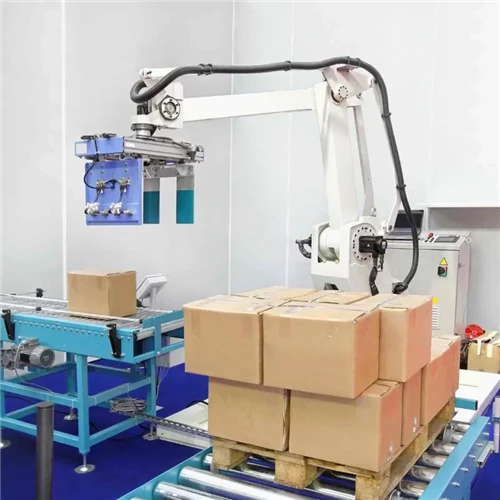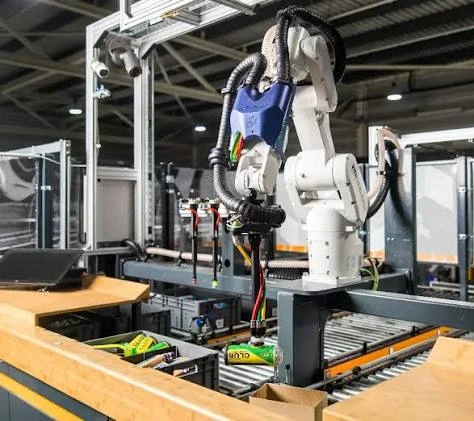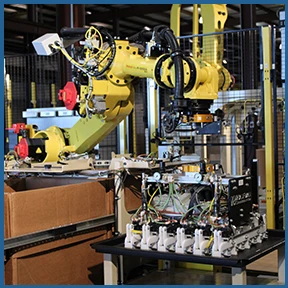
Sourcing a palletizing robot china solution remotely does not require an in-person facility visit if you implement a structured, data-driven technical verification protocol. By shifting your focus toward component bill-of-materials (BOM) transparency, rigorous digital Factory Acceptance Testing (FAT), robust after-sales service level agreements (SLAs), and secure remote PLC diagnostic access, overseas buyers can eliminate cross-border procurement risks. Whether your manufacturing facility requires a fully automatic robot palletizing system for rigid cartons, specialized robotic bag palletizing for bulk materials, high-speed hybrid robotic palletizing systems for mixed production lines, or versatile 4-axis robot arm palletizing cells, leveraging digital verification guarantees machine reliability, verified payload capacity, and long-term operational uptime.
Remote Manufacturer Evaluation Summary Matrix
|
Evaluation Pillar |
Primary Verification Method | Critical Documentation / Artifact | Risk Mitigation Target |
| Component Quality | Raw BOM inspection & electrical schematic audit | Namebrand certification (Siemens, SMC, Fanuc, Schneider) | Prevents sub-tier hardware swapping and premature component failure. |
| Performance Testing | Full-load, full-speed live virtual FAT via high-def camera | Multi-hour continuous run video + cycle time log | Validates throughput (packs/min) and payload limits prior to shipping. |
| Control & Software | Remote PLC architecture & IoT gateway test | Program code backup, remote access IP audit | Guarantees remote troubleshooting capability and software scalability. |
| After-Sales Support | Service Level Agreement (SLA) & spare parts packaging | Local parts kit list, 24/7 emergency response contract | Prevents extended plant downtime during unpredicted component failures. |
| Pre-Shipment Audit | Third-party physical inspection agency | SGS / TÜV pre-shipment inspection report | Ensures compliance with CE/UL wiring, structural paint, and packing standards. |
1. The Evolution of Remote Machine Procurement in Industrial Automation
Sourcing industrial automation equipment internationally has undergone a fundamental shift. Historically, purchasing an industrial palletizing robot china machine required costly cross-border travel, physical factory audits, and manual inspection of welding seams and assembly bays. Today, advanced digital engineering tools, industrial IoT connectivity, and standardized quality management frameworks allow international packaging and manufacturing plants to evaluate, select, and contract Chinese machinery manufacturers entirely remotely.
However, remote procurement introduces specific challenges that buyers must navigate carefully:
- Distinguishing Integrated Manufacturers from Trading Intermediaries: Overseas buyers often encounter brokers masking as original equipment manufacturers (OEMs). Identifying true engineering integrators requires auditing structural engineering capabilities, software programming resources, and direct component procurement channels.
- Preventing Component Sub-Tier Substitution: A common risk in cross-border equipment purchasing involves the substitution of premium electrical or pneumatic components with unbranded local alternatives after quote approval.
- Ensuring Long-Term After-Sales Support: Machine performance relies heavily on post-installation technical support. A reliable supplier must offer structured after-sales service protocols, clear warranty conditions, and fast spare part availability rather than relying solely on legacy physical factory reputation.
By implementing a systematic remote vetting methodology, plant managers can secure high-performance automated machinery while eliminating cross-border travel costs.
Read More: 《How To Reduce Downtime in Your Corrugated Box Plant: A Practical Guide》

2. The 5-Step Remote Verification Protocol for Overseas Buyers
To successfully procure a fully automatic robot palletizing system without visiting the manufacturing floor, buyers should execute the following five-step technical verification framework.
Step 1: Bill of Materials (BOM) & Electrical Component Auditing
A machinery manufacturer's reliability is directly reflected in its component selection and engineering design standards. Request a fully itemized Bill of Materials specifying brand names, model numbers, and country of origin for all critical sub-assemblies.
- Robot Arm & Motion Mechanics: Verify whether the system utilizes world-class robot articulated arms (e.g., FANUC, ABB, KUKA, Yaskawa) or high-grade domestic articulated arms. Audit the reducer gearboxes (RV reducers or harmonic drive systems) to ensure operational longevity under high torque conditions.
- Programmable Logic Controllers (PLC) & Servos: Demand Tier-1 automation controls, such as Siemens S7-1500/1200 series, Allen-Bradley CompactLogix, or Schneider Electric systems. Ensure servo drives and motors match the main PLC protocol (Profinet, EtherNet/IP, or EtherCAT).
- Pneumatics & End-of-Arm Tooling (EOAT): Confirm that vacuum valves, suction cups, pneumatic cylinders, and pressure sensors are supplied by established manufacturers such as SMC, Festo, or Schmalz.
- Safety Architecture: Verify dual-channel safety relays, light curtains, emergency stop circuits, and interlocked safety fencing adhering to ISO 13849-1 (Performance Level d/e) standards.
Step 2: High-Definition Virtual Factory Acceptance Testing (Virtual FAT)
Never authorize final balance payments or machine dispatch without conducting a live, high-definition Virtual FAT. A static video recording is insufficient; the testing protocol must be an interactive, real-time engineered trial.
- Full-Payload and Full-Speed Stress Testing: Require the manufacturer to run the palletizer continuously for a minimum of 2 to 4 hours using your exact product samples (or dimensionally identical mock-ups loaded with matching weights).
- Multi-Angle Camera Setup: The live stream must feature multiple camera angles-one fixed wide-angle view of the full cell, one close-up on the End-of-Arm Tooling (EOAT) grab/release sequence, and one screen-share view of the HMI interface showing real-time cycle speeds (picks per minute).
- Fault Simulation Protocol: Instruct the technician on-site to trigger intentionally engineered fault conditions during the live stream, such as breaking a safety light curtain, starving the incoming conveyor feed, or interrupting the compressed air supply. Observe how quickly the system halts, logs the error on the HMI, and recovers post-reset.
Step 3: Software Architecture & Industrial IoT Diagnostics Infrastructure
The long-term success of an overseas installation depends on the software code quality and remote access capabilities.
- Modular PLC Code & Recipe Management: Ensure the PLC software utilizes modular programming standards (such as IEC 61131-3). The HMI should feature intuitive, multi-lingual recipe management allowing plant operators to add new pallet patterns, box dimensions, or bag sizes without needing software engineers to rewrite source code.
- Encrypted Remote Diagnostic Gateways: Verify that the main electrical cabinet includes an industrial VPN gateway (e.g., eWON Cosy, Secomea, or Siemens Sinema Remote Connect). This infrastructure allows the manufacturer's automation engineers to perform remote PLC troubleshooting, monitor servo drive trace curves, and push software updates securely over the cloud.
Step 4: Structuring a Water-Tight After-Sales Service & Spare Parts Framework
When procuring equipment internationally, evaluating the vendor's post-installation support architecture is far more critical than auditing their physical factory assembly floor.
- Localized Spare Parts Strategy: Require the manufacturer to supply a categorized "First-Year Wear-and-Tear Kit" and a "Critical Electronics Back-Up Kit" shipped alongside the machine. These kits should include spare proximity sensors, vacuum pads, pneumatic solenoid valves, drive belts, and relay modules.
- Service Level Agreements (SLAs): Incorporate an explicit technical SLA into the sales contract defining mandatory response times (e.g., maximum 2-hour response window for remote engineering support, 24/7 availability via dedicated communication channels).
- Comprehensive Video Documentation & Manuals: Contractually stipulate that final documentation must include high-resolution HD tutorial videos covering daily maintenance, mechanical alignment procedures, EOAT seal replacement, and step-by-step PLC fault recovery.
Step 5: Third-Party Physical Pre-Shipment Inspection
If physical verification is necessary prior to container loading, hire an independent international inspection agency (such as SGS, Bureau Veritas, or TÜV Rheinland).
- Mechanical & Structural Audit: Inspectors verify frame steel thickness, paint finish, weld continuity, bolt torque markings, and physical dimensions against approved layout drawings.
- Electrical Safety & Wiring Audit: Inspectors check cabinet wire labeling, grounding continuity, phase protection, and CE/UL compliance stickers.
- Packing & Crating Inspection: Inspectors oversee the vacuum-sealing of electrical enclosures, anti-rust oil application on machined steel surfaces, and heavy-duty wooden crate fumigation (ISPM 15 compliance).
Read More: 《Paper Splicer ROI 2026: The Hard Financial Math Behind Automatic Roll Changes》

3. Matching Palletizing Technology to Application Needs
Selecting a supplier requires aligning their core technical specialization with your plant's specific packaging formats. A manufacturer skilled in lightweight carton handling may not possess the structural engineering expertise required for heavy-duty robotic bag palletizing or high-speed hybrid robotic palletizing systems.
Palletizing Technology Selection Overview
| Packaging Category | Primary Technology | Primary End-of-Arm Tooling (EOAT) | Speed Range | Key Application Advantage |
| Cartons / Rigid Boxes | Standard 4-Axis Robot Arm Palletizing | Vacuum Matrix / Side Clamp | 10–25 packs/min | Compact footprint, versatile layout, and gentle carton handling. |
| Bulk Bags / Sacks | Heavy-Duty Robotic Bag Palletizing | Clamshell / Fork Gripper | 8–18 bags/min | Integrated bag flattening, bottom-support lifting, and layer pressing. |
| High-Throughput Mixed Lines | Hybrid Robotic Palletizing Systems | Layer-Forming Infeed + Robotic Sweeper | 30–60+ packs/min | Maximum speed capability, continuous infeed, and zero product shock. |
3.1 Standard 4-Axis Articulated Robot Arm Palletizing
For traditional corrugated box, plastic crate, and rigid tray packaging lines, 4-axis robot arm palletizing cells provide an optimal balance of flexibility, footprint efficiency, and straightforward maintenance.
- Kinematic Efficiency: 4-axis articulated robots are engineered specifically for palletizing duties, keeping the payload parallel to the floor surface throughout the motion arc while eliminating unnecessary degrees of freedom.
- Payload Capacity: Standard systems range from 50 kg to 300 kg payload capabilities, accommodating single-box transfers or high-speed multi-pack pick-and-place routines.
- Tooling Versatility: Can be fitted with vacuum matrices, mechanical side-clamps, or combination grippers that handle both product units and slip-sheet placement.
3.2 Heavy-Duty Robotic Bag Palletizing Systems
Handling woven polypropylene (PP) sacks, multi-wall paper bags, or polyethylene valve bags containing powder, granules, or agricultural products requires specialized engineering.
- Bag Flattening & Conditioning Infeed: Prior to pick-and-place operations, a robotic bag palletizing system requires an integrated square-up conveyor and square roller press to level internal contents, creating uniform, flat bags.
- Clamshell / Finger Gripper EOAT: Vacuum tools are generally unsuitable for porous or shifting bag surfaces. Instead, heavy-duty mechanical clamshell or bottom-support fork grippers securely lift the bag from underneath, ensuring stable movement without tearing the substrate.
- Pallet Layer Squaring Plates: Integrated top-press plates and side-compacting guides press down on each completed bag layer, flattening the surface to guarantee stable, tight stack heights.
3.3 High-Speed Hybrid Robotic Palletizing Systems
When production line speeds exceed 30 to 40 cases per minute, standard single-arm pick-and-place cycles reach mechanical acceleration limits.
- Combined Layer-Forming and Robotic Placement: Hybrid robotic palletizing systems merge mechanical high-level layer-forming sweepers with high-speed articulated robot arms.
- Operational Mechanism: Incoming packs are swept and oriented into complete row layer patterns via continuous-motion feed belts, after which a high-capacity robotic end-effector transfers full or half layers onto the pallet lift station.
- Throughput Advantage: Reduces total robot cycle movements while dramatically increasing overall cases-per-minute performance without causing product shock or structural carton collapse.
To explore how advanced automated material handling can transform your packaging line, view our comprehensive equipment offerings on the Robotic Palletizer category page.

4. Technical Comparison and Vendor Evaluation Matrix
Use the technical evaluation matrix below to score candidate Chinese machinery manufacturers during your engineering RFP process.
| Engineering Parameter | Basic / Low-Tier Vendor | Advanced Engineering Supplier | Target Industry Standard |
| Primary Robot Arm Sourcing | Unbranded or refurbished domestic arms | Authorized partner: Fanuc, KUKA, ABB, or premium verified domestic arm | Certified new arm body with manufacturer factory warranty. |
| PLC Control & Programming | Proprietary or unbranded micro-PLC | Siemens S7-1500 / Allen-Bradley CompactLogix | Open-architecture IEC 61131-3 code compliance with full source rights. |
| Gripper / EOAT Engineering | Universal generic clamp | Custom-engineered per product sample (Vacuum, Clam, Comb) | Lightweight carbon fiber/aluminum alloy structure with quick-change couplings. |
| Virtual FAT Protocol | Unloaded, 5-minute pre-recorded video | 4-hour live HD stream under full load and real speed | Interactive fault testing, live HMI metrics, and multi-angle camera feeds. |
| Safety Certification | Self-declared basic CE sticker | Fully audited CE (MD/EMC) / UL compliant safety enclosure | Dual-channel safety relays, interlocked doors, light curtains (PL-d/e). |
| Remote Service Hardware | None (requires physical technician travel) | Pre-installed industrial IoT gateway (eWON / Secomea) | Secure 256-bit encrypted VPN tunnel for real-time remote diagnostics. |
| Documentation Package | Generic translated machine manual | Project-specific electrical schematics, 3D CAD, HD video guides | Complete BOM, step-by-step troubleshooting, and full spare part numbers. |
Read More: 《What Is A Corrugating Machine Splicer? A Pragmatic Introduction For Box Plant Managers》
5. Building a Water-Tight After-Sales Service and Maintenance Contract
Because physical factory visits are omitted, your commercial contract and technical Service Level Agreement (SLA) serve as your primary risk management instruments. Ensure your legal and procurement documentation incorporates the following technical clauses.
5.1 Remote Commissioning and Virtual Technical Supervision
- Pre-Commissioning Cable & Utility Audit: The manufacturer must supply comprehensive civil installation drawings, electrical drop requirements, pneumatic flow specs (NL/min), and anchor bolt locations 60 days prior to delivery.
- Live Guided Installation: The supplier provides dedicated automation and mechanical engineers to supervise your internal maintenance team via high-definition video tools during mechanical positioning, wiring interconnection, and sensor alignment.
- Virtual Fine-Tuning & Optimization: Once utilities are connected, the vendor's systems engineer accesses the fully automatic robot palletizing system remotely through the IoT gateway to upload final parameters, run servo calibration, and fine-tune trajectory speeds.
5.2 Structured Warranty and Spare Parts Procurement Terms
- 18-Month Comprehensive Warranty Period: Negotiate warranty coverage starting from the date of final operational sign-off at your facility, rather than the bill-of-lading (B/L) dispatch date.
- Guaranteed Spare Parts Pricing Lock: Include a 3-year fixed pricing schedule for critical replacement parts (e.g., replacement vacuum valves, suction pads, pneumatic cylinders, servo amplifiers) to prevent post-warranty price escalation.
- Express Component Replacement Commitment: The contract must state that in the event of a warranty-covered hardware defect, replacement components will be dispatched via international express air freight (e.g., DHL/FedEx) within 24 to 48 hours at the vendor's expense.
5.3 Preventive Maintenance Protocol for Automated Palletizing Cells
To maximize machine longevity and maintain continuous operation, mandate that the vendor provides a structured preventive maintenance schedule tailored to your operational environment:
Daily Checklist (Operator Level):
- Inspect vacuum cup wear surfaces and clean suction filters.
- Verify pneumatic supply pressure gauges meet system target specifications (0.6-0.8 MPa).
- Ensure safety light curtains and emergency stop buttons operate correctly.
Weekly Checklist (Maintenance Level):
- Inspect linear guide tracks and drive chains for adequate lubrication; clear accumulated paper dust or material debris.
- Check drive belt tension on infeed conveyors and layer-forming mechanisms using a sonic tension meter.
- Inspect EOAT pneumatic tubing for air leaks or friction wear points.
Monthly / Quarterly Checklist (Engineering Level):
- Check gear oil levels in robot arm joints and conveyor drive gearboxes; inspect for seal leaks.
- Verify terminal screw tightness inside main electrical cabinets to prevent thermal loose-connection risks.
- Perform full system backup of PLC software, HMI recipes, and robot axis calibration origin points.

6. Summary and Strategic Sourcing Checklist
Procuring a high-performance palletizing robot china system remotely is a practical, cost-effective strategy when supported by engineering rigor and structured verification protocols. By focusing on component quality, demanding live virtual FAT performance, establishing IoT-enabled remote diagnostic infrastructure, and securing comprehensive after-sales service agreements, overseas plants can deploy advanced automation with complete confidence.
Final Procurement Action Steps:
- Request an itemized BOM and verify Tier-1 component selections.
- Match the core technology (standard articulated arm, heavy-duty bag handling, or high-speed hybrid layout) to your exact product requirements.
- Mandate a live, multi-hour Virtual FAT operating under full load and speed conditions.
- Secure an integrated IoT gateway and comprehensive spare parts package within the procurement contract.
- Engage a third-party inspection agency for pre-shipment compliance validation prior to final balance release.
To learn more about optimizing your end-of-line packaging and automated material handling workflows, explore our detailed equipment specifications on the Robotic Palletizer category page.