Bottom Line Up Front: In high-speed Flexo Folder Gluer (FFG) operations running at 250 to 450 blanks per minute, folding misalignment (scissoring/fish-tailing) and glue flap crushing stem primarily from differential belt speeds, incorrect scoring depth relative to board caliper, and uneven adhesive pressure. By implementing systematic mechanical calibration, proper guide setup, and proportional adhesive pressure control, plants can consistently maintain folding tolerances within ±1.5mm, guaranteeing seamless downstream robotic palletizing.
Quick-Reference Defect & Corrective Action Matrix
| Primary Defect Type | Key Mechanical Root Cause | Recommended Solution / Target Calibration | Downstream Packaging Impact |
| Fish-tailing / Scissoring | Velocity mismatch between left & right lower folding belts | Equalize belt speeds via tachometer; set squaring plate pressure to 0.2 - 0.35 MPa. | Irregular pallet layer dimensions; jam risks on automatic bundle strappers and palletizers. |
| Glue Flap Crushing / Buckling | Excessive glue applicator pressure or misaligned folding shoe | Set entry compression roller gap to 80% of double-wall caliper; transition to non-contact extrusion systems. | Reduced joint shear resistance; glue joint failure under stack pressure. |
| Score Line Splitting | Clearance between male/female score profiles too tight; dry liner (< 6% moisture) | Set score wheel clearance to 0.8 × Nominal Board Caliper; adjust upstream misting units. | Loss of Box Compression Test (BCT) strength up to 15%. |
| Internal Glue Squeeze-Out | Adhesive pump pressure not tracking line speed proportionally | Enable speed-tied proportional pressure control; recalibrate compression roll gaps. | Internal box sticking (boxes fail to open at the end-user's case packer). |

1. Physical Mechanics of Folding Misalignment and Glue Flap Defects
In high-speed FFG operations, converting flat corrugated sheets into dimensionally square folded boxes requires precise mechanical synchronization. Minor variations in board caliper, scoring depth, or belt friction can cause structural defects during the high-speed folding phase.
1.1 Defect Classifications and Root Causes
Fish-tailing and Scissoring (Folding Misalignment)
- Physical Cause: Scissoring occurs when the left and right folding panels do not fold symmetrically along the primary score lines, causing the manufacturer's joint gap to vary along its length (e.g., 3 mm at the top and 8 mm at the bottom).
- Mechanical Cause: Linear velocity discrepancies between the left and right lower folding belts, asymmetrical wear on belt traction surfaces, or uneven score line depth imparted by upstream scoring wheels.
Glue Flap Creasing and Crushing
- Physical Cause: Mechanical creasing occurs when the glue flap (glue lap) experiences localized buckling or liner fracturing during the initial 90-degree fold.
- Mechanical Cause: Excessive nip pressure from glue applicator wheels, misaligned folding shoes striking the leading edge of the glue flap, or improper score line profile depth relative to board flute profile (A, B, C, or E flute).
Score Line Fracturing and Flute Crush
- Physical Cause: The outer liner paper ruptures along the fold line, reducing the Edge Crush Test (ECT) rating and overall box stackability.
- Mechanical Cause: Inadequate clearance between male and female score profiles, incorrect scoring wheel geometry, or excessively dry paperboard liner (moisture content below 6%).
Adhesive Migration and Squeeze-Out
- Physical Cause: Excess liquid adhesive transfers beyond the manufacturer's joint boundary onto internal box surfaces.
- Mechanical Cause: Inconsistent glue application pressure, non-proportional glue flow control during machine acceleration, or miscalibrated lap compression rollers.
1.2 Quantitative Analysis of FFG Converting Defects
| Defect Designation | Measurable Tolerance / Defect Threshold | Primary Mechanical Point of Origin | Downstream Processing Impact |
| Fish-tailing (Gap Variation) | Joint gap variation > 3.0 mm along manufacturer joint | Differential folding belt speed; worn belt traction layer | Irregular box dimensions; jam risks on automatic bundle strappers and palletizing lines. |
| Glue Flap Crushing | Board caliper loss > 25% on the glue lap zone | Over-adjusted applicator anvil pressure; improper shoe entry angle | Weakened joint bond strength; reduced shear resistance under stack pressure. |
| Score Line Splitting | Linear fracture of outer liner > 10 mm in length | Incorrect scoring profile clearance; excessive score wheel penetration | Visual defect; loss of vertical box compression strength (BCT loss up to 15%). |
| Inside Glue Squeeze-Out | Adhesive migration > 5 mm beyond joint edge | Non-proportional glue pump control; excessive compression roll gap | Internal box sticking (boxes fail to open at the end-user's case packer). |
Read More: 《How To Reduce Downtime in Your Corrugated Box Plant: A Practical Guide》
2. Mechanical Calibration and Belt Tension Optimization
Resolving folding misalignment requires systematically aligning and calibrating the mechanical components along the folding section. Because the corrugated blank transitions from a flat sheet to a folded structure while moving at high velocity, belt contact pressure and guide alignment must remain symmetrical.
2.1 Mechanical Alignment Protocols
Folding Belt Velocity Synchronization
- Procedure: Measure the surface speed of both left and right lower folding belts using a digital contact tachometer at multiple operating speeds (100, 200, and 300 m/min).
- Adjustment: Equalize belt speeds by adjusting the variable pitch pulleys or recalibrating independent drive gains to achieve zero velocity differential between left and right sides.
Forming Rail and Folding Shoe Setup
- Procedure: Set the entry angle and lateral clearance of the forming rails relative to the score lines.
- Adjustment: Establish a clearance equal to the single-wall board caliper plus 0.5 mm between the guide rails and the board panels. Ensure folding shoes contact the panel within the middle third of the blank length to prevent edge impact.
Squaring Section Bar Calibration
- Procedure: Align the primary squaring section (spanker plates or back-stop bars) at the exit of the folding section.
- Adjustment: Calibrate the stroke and timing of the mechanical squarers to strike the trailing edge of folded blanks while the adhesive is still tacky, forcing the manufacturer's joint into a parallel, 90-degree alignment.
Compression Section Roller Gap Adjustment
- Procedure: Check the gap along the compression belt section using feeler gauges or board sample strips.
- Adjustment: Set the entry compression roll gap to 80% of total double-wall thickness (or 85% of single-wall thickness) over the glue lap zone to ensure full adhesive contact without crushing surrounding flutes.
2.2 FFG Mechanical Calibration Parameters
| Machinery Component | Standard Setting / Parameter | Adjustment Increment / Tolerance | Target Engineering Value |
| Lower Folding Belt Tension | 1.2% to 1.5% static elongation | ±0.1% tension variance | Equal drag force across both folding belts. |
| Upper Guide Rail Clearance | Board thickness + 0.5 mm | ±0.2 mm lateral alignment | Zero board binding; zero lateral movement. |
| Scoring Profile Clearance | 0.8 × Nominal Board Caliper | ±0.05 mm vertical depth | Fully defined fold axis without liner fracture. |
| Squaring Plate Strike Pressure | 0.2 MPa to 0.35 MPa pneumatic supply | ±0.02 MPa proportional step | Elimination of fish-tailing gap variance below 1.5 mm. |
Read More: 《How to Maintain Mill Roll Stand Pneumatic Brake》
3. Adhesive Application Dynamics and Glue Flap Preservation
The glue application system must deposit a uniform, controlled adhesive bead onto the glue flap without causing mechanical damage or dimensional distortion to the flap structure.
3.1 Glue System Configuration and Pressure Control
Electronic Extrusion vs. Mechanical Glue Wheel Systems
- Extrusion Systems: Non-contact or contact extrusion systems utilizing high-speed electromagnetic or piezo-electric valves offer precise glue placement, eliminating physical contact forces that deform the glue flap.
- Wheel Systems: Mechanical wheel systems require precise doctor blade adjustments and controlled nip pressure against a lower anvil roller to prevent crushing the flap flutes.
Proportional Speed-Tied Pressure Tracking
- Mechanism: The glue controller reads encoder signals from the main drive shaft to automatically adjust adhesive pump fluid pressure in proportion to line speed.
- Engineering Function: Maintains a consistent adhesive film weight (g/m²) during machine acceleration and deceleration, preventing starved joints at high speeds and glue squeeze-out at low speeds.
Glue Flap Support and Deflection Control
- Mechanism: Adjustable lower anvil rollers or air-cushion support plates support the glue flap directly underneath the application point.
- Engineering Function: Prevents downward deflection of the glue flap under applicator pressure, ensuring accurate fold initiation at the score line.
3.2 Glue Application System Selection Matrix
| Operational Criterion | Non-Contact High-Pressure Extrusion | Contact Extrusion with Floating Head | Mechanical Wheel Applicator |
| Maximum Operating Speed | Up to 500 blanks/min | Up to 350 blanks/min | Up to 300 blanks/min |
| Flute Crush Risk | Zero physical contact force | Low (spring-compensated) | Moderate to High (fixed gap) |
| Adhesive Volume Accuracy | High (±2% volume control) | Moderate (±5% volume control) | Variable (dependent on viscosity) |
| Maintenance & Cleaning | Automated flush cycles | Manual nozzle wiping | Manual wash-up basin cleaning |
Read More: 《What Is A Corrugating Machine Splicer? A Pragmatic Introduction For Box Plant Managers》
4. Maintenance Schedules, Quality Assurance, and Downstream Integration
Preventing folding misalignment and glue flap creasing requires structured preventive maintenance practices alongside proper integration with downstream bundle handling, strapping, and palletizing machinery.
4.1 Preventive Maintenance Checklist for Folding & Gluing Sections
Daily Maintenance Operational Checklist
- Clean adhesive buildup from folding rails, forming shoes, and lower anvil rollers using warm water or specialized solvent.
- Inspect glue application nozzles for partial blockages; run automated water-flush routines on non-contact glue heads.
- Verify pneumatic pressure gauges on squaring plates and compression rollers match recipe specifications.
Weekly Maintenance Operational Checklist
- Check lower and upper folding belt tension using a sonic tension meter; adjust tracking mechanisms to prevent belt edge fraying.
- Inspect vacuum transport belts for dust buildup; clean suction holes using compressed air and industrial vacuums.
- Verify calibration of high-speed photo-eyes using a calibrated gauge sheet.
Monthly / Quarterly Maintenance Operational Checklist
- Measure thickness profiles of folding belts; replace belts if thickness varies by more than $0.8\text{ mm}$ across their width.
- Inspect guide rail bearings and linear drive screws for play or mechanical backlash.
- Check motor drive belts and timing pulleys for tooth wear and tension loss.
4.2 Impact on Downstream Automatic Palletizing Operations
Maintaining square box geometry and consistent manufacturer joint dimensions directly impacts downstream end-of-line packaging operations:
Bundle Handling and Strapping Reliability
- Boxes with fish-tailing or creased glue flaps create non-parallel bundle sides.
- Non-parallel bundles cause strap misalignment, leading to broken straps or corner damage during bundle transit.
Palletizing Layer Consistency
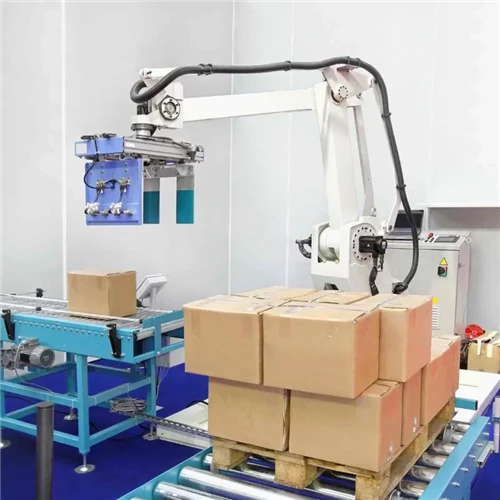
- When processed by an automatic robotic palletizer, dimensionally accurate cartons align cleanly against registration plates and side squarers.
- Properly folded boxes ensure predictable layer dimensions, preventing box overhang or internal gaps on the pallet pattern.
Vacuum Gripper Reliability
- Square boxes with flat top liners provide an optimal contact surface for vacuum end-effectors.
- Eliminating score line fractures and flap bulges ensures reliable pick-and-place cycles on high-speed robotic cell layouts.
To explore how consistent box converting quality enhances downstream automated material handling, explore our full machinery lineup on the Robotic Palletizer category page. Implementing disciplined maintenance and machine setup protocols ensures reliable production from raw corrugated sheets to finished pallet loads.
Read More: 《Running Low-GSM Recycled Medium: Fine-Tuning Splicer Tension Dynamics To Prevent Web Tears》