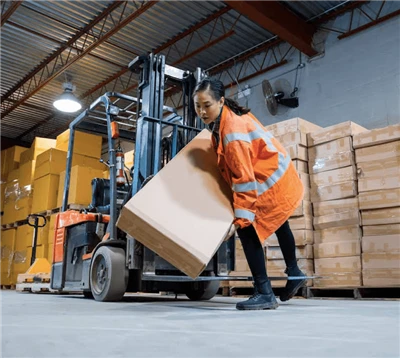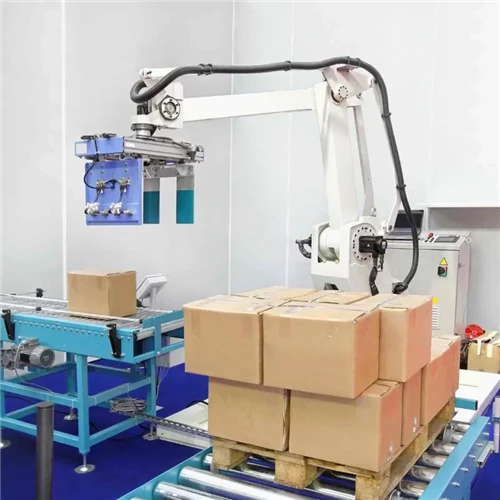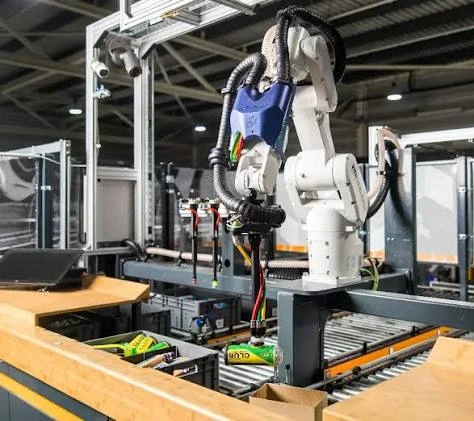
Robotic palletizing integrates automated articulated arms, high-precision End-of-Arm Tooling (EOAT), programmable logic controllers (PLC), and specialized conveyor systems to automate the stacking of heavy goods onto pallets before warehouse staging. Transitioning from traditional manual stacking to automated palletizing allows modern manufacturing plants to eliminate ergonomic injury risks, accelerate line throughput, ensure structural stack stability, and maximize profitability in high-demand production environments.
Performance & Strategic Value Matrix
| Advantage Area | Primary Operational Metric | Impact on Production Flow | Long-Term Strategic Value |
| Operational Efficiency | 98.5%+ Cell Uptime | Replaces variable human speed with continuous cycle pacing | Eliminates end-of-line bottlenecks |
| Worker Safety | Zero Lifting Injuries | Removes operators from high-risk heavy lifting zones | Lowers workers' compensation claims |
| Stacking Precision | ±1 mm Alignment Accuracy | Standardizes load distribution across all pallet layers | Prevents transit damage & product loss |
| Footprint Flexibility | Up to 45% Space Saving | Replaces lengthy mechanical lifts with compact cells | Maximizes valuable plant floor space |
| Product Versatility | Multi-SKU Program Recipes | Adapts instantly to mixed payload profiles via HMI | Reduces changeover downtime to zero |
Understanding the Transition to Automated Palletizing
Modern high-speed production lines-ranging from food and beverage packaging to consumer packaged goods (CPG) and heavy industrial manufacturing-generate massive output volumes every hour. However, the true capacity of a manufacturing plant is frequently constrained by downstream material handling bottlenecks. When manual labor serves as the primary mechanism for transferring finished goods from outfeed conveyors onto shipping pallets, human fatigue, physical limitations, and safety hazards create unpredictable operational delays.
Implementing robotic palletizing replaces isolated, manual stacking operations with a synchronized, automated workflow. By deploying multi-axis articulated robotic arms equipped with specialized grippers, manufacturers convert erratic end-of-line processes into highly predictable, repeatable, and cost-effective operations.

Case Study: Resolving Downstream Stagnation in Beverage Bottling
To observe the real-world operational transformational power of automated stacking, consider an end-of-line modernization project executed for a regional beverage container facility in North America.
Initial Operational Bottlenecks
The bottling plant operated three continuous high-speed canning lines, yielding a combined output exceeding 1,200 cases of finished goods per hour. Despite investing heavily in high-speed filler units, the plant suffered severe downstream congestion:
- Manual Handling Limits: Manual palletizing teams struggled to maintain pace during peak production shifts, forcing upstream canning lines to run at reduced capacity or undergo frequent emergency pauses.
- Elevated Injury Rates: Operators regularly lifted heavy 15 kg cases over multi-hour shifts, resulting in high rates of repetitive strain injuries, absenteeism, and rising workers' compensation insurance overhead.
- Product Damage & Unstable Loads: Inconsistent manual stacking patterns caused frequent carton crush and unstable pallet tiers, leading to product spills during forklift transit and customer delivery rejections.
System Implementation & Engineering Design
Engineering teams redesigned the facility's end-of-line layout by installing a dual-infeed robotic palletizing cell:
- Integrated Infeed Buffering: Zero-Pressure Accumulation (ZPA) roller conveyors were introduced to receive incoming cases without physical pressure, preventing carton edge deformation.
- Heavy-Duty Articulated Arm Deployment: A 4-axis industrial palletizing robot with a 180 kg payload capacity was positioned between the two main line feeds. Outfitted with a custom vacuum-foam matrix gripper, the arm handles dual-case pickups simultaneously.
- Automated Pallet Management: An integrated automatic pallet dispenser feeds empty wooden skids directly into the cell via motorized chain tracks, eliminating manual pallet placement.
Measured Operational Results
Following system commissioning, the facility recorded dramatic performance enhancements across all core operational benchmarks:
- Line Throughput Restoration: Upstream filling and canning lines achieved a 99.1% operating efficiency rating, completely resolving end-of-line pauses.
- Ergonomic Hazard Elimination: Repetitive motion and lifting injuries within the palletizing area dropped to zero.
- Scrap Reduction: Product damage stemming from dropped or improperly stacked cases dropped from 2.4% to under 0.02%.
- Rapid Investment Recovery: Accounting for labor reallocation, reduced product damage, and lower injury liability, full capital outlay was recovered within 14.2 months.

The Top 10 Advantages of Robotic Palletizing
Evaluating robotic palletizing requires looking beyond simple labor savings. Below are the ten primary operational, financial, and strategic advantages that make automated palletizing an essential component of modern manufacturing infrastructure.
- 1. Unmatched Speed & Throughput
- 2. Significant Labor Cost Savings
- 3. Rapid Return on Investment (ROI)
- 4. Decreased Damage to Products
- 5. Workplace Injury Reduction
- 6. Remarkable Payload & Product Versatility
- 7. Footprint Optimization & Space Efficiency
- 8. Consistent Pallet Quality & Stability
- 9. Reduced Operational Downtime
- 10. Seamless Integration with Plant Automation
1. Unmatched Speed and Continuous Line Throughput
Manual palletizing speeds naturally fluctuate throughout a shift as human operators experience physical fatigue. In contrast, an automated robotic palletizer operates continuously at predetermined cycle rates. Whether handling heavy rigid boxes, soft bags, or delicate trays, multi-axis robotic arms execute acceleration, rotation, and placement motions with millisecond repeatability. This continuous velocity eliminates end-of-line accumulation, allowing upstream processing equipment to run at peak capacity without risk of back-pressure stoppage.
2. Significant Reduction in Direct Labor Costs
Dependence on manual labor for repetitive, physically demanding tasks exposes plant managers to high turnover rates, recruitment expenses, and shifting labor availability. Automating the palletizing process dramatically lowers direct labor requirements per shift. Rather than deploying multiple workers to stack boxes manually, a facility can assign a single system supervisor to oversee multiple automated cells simultaneously. This shift relocates human capital from low-value, high-fatigue tasks to higher-value machine operations, quality inspection, and facility maintenance.
3. Rapid Return on Investment (ROI) and Low Total Cost of Ownership
While installing a robotic palletizing cell represents a capital expenditure, the financial metrics favor long-term automation. By combining direct labor savings, decreased workers' compensation claims, reduced product scrap, and gains in total line throughput, most manufacturing operations recover their initial capital investment within 12 to 24 months. Furthermore, modern articulated robots require minimal ongoing maintenance, offering low operating costs over operational lifespans that frequently exceed 10 to 15 years.
- Robotic Arm, EOAT Gripper Assembly & Controller
- Conveyors, Safety Enclosures & Interlocked Guarding
- Engineering Design, Freight, Installation & FAT Testing
- Electrical & Compressed Air Utilities
- Preventative Maintenance (Grease, Belts, Vacuum Pads)
- Spare Parts Inventory & Software Recipe Adjustments
4. Decreased Product Damage and Material Waste
Manual handling of cases, bundles, and bags often leads to dropped items, punctured packaging, and crushed edges. Robotic arms utilize specialized End-of-Arm Tooling (EOAT)-such as proportional pneumatic side-clamps, vacuum matrix plates, or bottom-support mechanical forks-designed to grip specific packaging materials gently. By regulating acceleration and deceleration profiles via servo controls, the robot ensures products are placed onto the pallet without impact damage, eliminating material waste and costly customer returns.
5. Workplace Injury Reduction and Improved Safety
Palletizing is inherently arduous. Repeating lifting, twisting, and reaching motions with heavy products exposes workers to severe musculoskeletal disorders (MSDs) and repetitive strain injuries. Introducing an automated palletizing arm completely removes human operators from the dangerous lift zone. Enclosed behind safety fencing equipped with light curtains and interlocked access doors, robotic cells ensure compliance with global occupational safety standards while drastically reducing injury liabilities.
6. Remarkable Payload and Product Versatility
Modern industrial robotic arms are capable of handling payloads ranging from 10 kg delicate cases to over 1,000 kg heavy industrial units. Furthermore, robotic cells are not limited to a single product geometry. Through advanced Programmable Logic Controllers (PLC) and user-friendly Human-Machine Interfaces (HMIs), operators can select pre-programmed recipe patterns with the push of a button. The robot can switch instantly between handling small cartons, large shipping crates, plastic totes, or multi-wall bags without requiring mechanical hardware overhauls.
7. Footprint Optimization and Space Efficiency
Traditional layer-style mechanical palletizers require extensive mechanical footprints, long incline conveyors, and elevated platform access. Articulated robotic arms, however, offer high power density within a compact footprint. A single 4-axis or 6-axis robot can be floor-mounted, inverted from overhead gantries, or positioned between multiple infeed lines. This space-saving footprint preserves valuable floor space for primary manufacturing operations and forklift transit aisles.
8. Consistent Pallet Quality and Structural Load Stability
An unstable pallet stack poses severe transit hazards, often leading to load tipping inside transport trailers or warehouse racking collapses. Robotic arms stack products with millimeter-level placement precision. The system calculates exact layer positioning, interlocked tie-patterns, and edge alignment every cycle. Consistent layer squareness ensures that stretch wrapping equipment can apply uniform film tension, resulting in rock-solid pallet loads that withstand long-distance shipping.
9. Reduced Operational Downtime and High Reliability
Industrial robots are engineered for heavy-duty industrial service, achieving Mean Time Between Failures (MTBF) ratings that span tens of thousands of operating hours. Unlike complex mechanical traditional palletizers with hundreds of shifting wear plates and chains, articulated arms feature sealed gearboxes and brushless AC servo motors. With routine preventative maintenance, robotic palletizing cells deliver consistent uptime ratings exceeding 98.5%, keeping facility operations moving without unexpected mechanical breakdowns.
10. Seamless Integration with Plant Automation & Industry 4.0
Robotic palletizers serve as an integrated component within modern smart factories. Connected via industrial Ethernet protocols (such as PROFINET or Ethernet/IP), the palletizer communicates directly with upstream case sealers, automated guided vehicles (AGVs), warehouse management systems (WMS), and enterprise resource planning (ERP) software. Real-time data logging tracks unit counts, SKU changes, and performance diagnostics, providing full operational visibility across the plant floor.

Quantitative Comparison: Manual Stacking vs. Robotic Palletizing
To highlight the operational advantages of upgrading to automated palletizing systems, review the comparative performance indicators below:
| Performance Metric | Manual Palletizing Operation | Robotic Palletizing Cell |
| Shift Labor Requirement | 2 – 4 Operators per Line / Shift | 1 Cross-Trained Supervisor (Multi-Cell) |
| Placement Accuracy & Alignment | Variable (Degrades over shift duration) | Consistent ±1.0 mm precision |
| Cycle Speed Capacity | 300 – 500 Units / Hour (Fatigue-limited) | Up to 1,800+ Units / Hour (EOAT dependent) |
| Safety & Ergonomic Risk | High exposure to strain and heavy lifting | Zero direct lifting hazards inside enclosure |
| Product Scrap Rate | 1.5% – 3.0% Average damage loss | Less than 0.05% Product damage |
| Product SKU Changeover Time | 15 – 30 Minutes manual adjustment | Instantaneous via HMI program select |
| Average Equipment Operating Life | Dependent on physical crew availability | 10 – 15+ Years continuous operation |
Step-by-Step Guide to Implementing a Robotic Palletizing Cell
Step 1: Conduct a Throughput and Payload Audit
Step 2: Select the Appropriate Robot Architecture and EOAT
Step 3: Design Integrated Material Handling and Safety Zones
Step 4: Execute Factory Acceptance Testing (FAT) and Commissioning
FAQ
1,Can a single robotic palletizing cell handle multiple production lines simultaneously?
Yes. By designing multi-infeed conveyor layouts, a single articulated robot positioned centrally can pick from two, three, or four separate product infeeds concurrently. The control system tracks individual line SKUs and builds distinct pallet loads on dedicated pallet stations within the same cell.
2,How does a robotic palletizer handle slip-sheets or pallet placement?
Modern End-of-Arm Tooling (EOAT) can be engineered with auxiliary vacuum cups or mechanical arms designed specifically to pick empty pallets from a stack and place slip-sheets or top-caps between product layers. This multi-function capability eliminates the need for standalone slip-sheet placement machinery.
3,What happens when a new box size or pallet pattern needs to be introduced?
New product recipes and pallet patterns can be added quickly using off-line pattern generation software or directly via the cell's HMI touchscreen interface. Operators simply input product dimensions, layer counts, and interlocking patterns, allowing the system to calculate optimized robot motion paths without complex manual re-programming.
Modernize Your End-of-Line Packaging Operations
Automating end-of-line palletizing is one of the most effective strategies for manufacturing plants looking to remove production bottlenecks, lower operational costs, and improve workplace safety. By replacing manual handling limits with high-speed articulated robotic arms, custom-engineered grippers, and synchronized controls, manufacturers establish a stable, continuous packaging workflow capable of supporting business growth.
To assess how robotic palletizing can optimize your factory floor, contact our team today to request a comprehensive factory audit and customized ROI analysis.