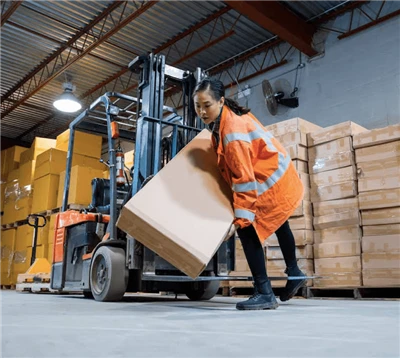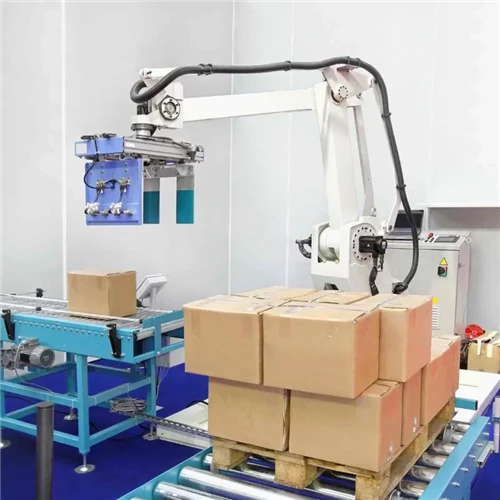
An increasing number of manufacturing plants, packaging lines, and logistics centers are turning to collaborative robots (cobots) to automate their palletizing operations. Unlike traditional industrial robots that require extensive safety enclosures, large physical footprints, and complex programming, cobot palletizers offer a flexible, compact, and human-friendly alternative. They enable businesses to overcome labor shortages, eliminate repetitive strain injuries, and scale production efficiency without overhauling existing facility layouts.
The Evolution of End-of-Line Palletizing: From Industrial Arms to Cobots
For decades, end-of-line packaging relied heavily on either manual labor or heavy industrial articulated robots. While traditional robots deliver high speeds and heavy payload capacity, they come with substantial trade-offs: massive floor space requirements, rigid safety fencing, high upfront installation costs, and dedicated automation engineering needs.
Cobot palletizers bridge the gap between human labor and traditional automation. Built with integrated force sensors, power and force limiting (PFL) technology, and intuitive user interfaces, collaborative robots can operate alongside human personnel without safety cages (subject to risk assessment). This paradigm shift makes automated palletizing accessible not only to large-scale operations but also to small-and-medium-sized enterprises (SMEs).
High Labor Risk / Bottlenecks
High Speed / Large Footprint
Flexible / Space-Saving / Safe
Core How-It-Works Mechanics of Cobot Palletizing
A turnkey cobot palletizing system operates through a synchronized workflow that balances mechanical precision with software simplicity:
1. Infeed Conveying & Signal Triggering
Products move from upstream case sealers or strapping equipment onto a specialized infeed conveyor. Photoelectric sensors detect the arriving box, bag, or tray, signaling the cobot system that a payload is ready for pickup.
2. Pattern Generation & Path Planning
Modern cobot palletizers feature drag-and-drop pattern generation software. Operators input box dimensions, pallet sizes, and layer interlock patterns via a touchscreen HMI. The controller automatically calculates optimal collision-free trajectories and payload orientations.
3. EOAT Gripper Acquisition
Depending on product type, the cobot's End-of-Arm Tooling (EOAT)-such as a vacuum sponge pad, mechanical clamp, or magnetic gripper-gently secures the package. Advanced systems utilize double-pick or multi-pick grippers to boost overall throughput.
4. Lift Column Extension & Layer Placement
Because cobot arms typically have a reach between 1.3 to 1.8 meters, integrated telescopic vertical lift columns extend the system's vertical reach, allowing the cobot to stack pallets up to 2.2 to 2.4 meters high.
5. Full Pallet Discharge & Continuous Operation
Dual-pallet cell layouts allow the cobot to seamlessly switch to an empty adjacent pallet once the first stack is complete. Operators remove the finished load without stopping the cobot, maintaining non-stop uptime.
Key Operational Benefits: Why Facilities Choose Cobot Palletizers
1. Footprint Optimization & Safety Fence Removal
Floor space in modern facilities commands a premium price. Traditional industrial palletizer cells require 15 to 30 square meters due to safety fencing and light curtains. Cobot cells can operate within a footprint as small as 4 to 6 square meters, fitting directly into existing packaging lines.
2. Rapid Deployment & No-Code Programming
Deploying a traditional industrial robot often takes weeks of specialized programming and electrical integration. Cobot systems feature intuitive, visual, block-based interfaces. Production workers can create new palletizing recipes in under ten minutes without writing a single line of code.
3. Total Elimination of Ergonomic Strains
Manual palletizing requires workers to lift thousands of kilograms per shift, leading to severe musculoskeletal disorders (MSDs), absenteeism, and high worker compensation claims. Cobots handle the heavy lifting continuously, allowing operators to transition into supervisory roles.
4. Low Total Cost of Ownership (TCO) & Fast ROI
Because cobots eliminate expensive safety infrastructure, complex civil engineering, and specialized programming fees, initial Capital Expenditure (CAPEX) is significantly lower. Most plants achieve full investment recovery within 10 to 18 months.
The 5 Best Cobot Palletizers in 2026
When evaluating cobot palletizers, plant engineers assess payload, reach, speed, software ecosystem, and cell adaptability. Below are the top five cobot palletizing solutions leading the industry in 2026.
1. Universal Robots UR20 / UR30 Palletizing Solution
Universal Robots (UR) remains a cornerstone in collaborative automation. The UR20 and UR30 models feature long reach (1750 mm) and heavy payload capacities (up to 30 kg), allowing them to pick multiple heavy corrugated cases or full layers simultaneously. Integrated with UR+ ecosystem software and telescopic columns, UR-based cells achieve stacking heights up to 2.2 meters at speeds up to 13-15 picks per minute.
2. FANUC CRX-25iA Palletizer
FANUC brings industrial-grade reliability to the cobot market with its CRX-25iA. Featuring a 25 kg payload capacity and a 1889 mm reach, the CRX series is known for IP67 environment protection and low maintenance requirements. It integrates seamlessly with FANUC's iRVision systems for automatic box alignment inspection and features a tablet TP for intuitive drag-and-drop recipe creation.
3. UnityRobots Integrated Cobot Palletizing Cell
UnityRobots delivers fully integrated, plug-and-play cobot palletizing solutions engineered specifically for fast deployment in FMCG, food and beverage, and industrial manufacturing environments. Combining heavy-payload cobot arms with intelligent vacuum grippers, motorized vertical pillars, and compact dual-station bases, UnityRobots enables factories to automate end-of-line packaging with minimal footprint and zero programming experience. Their software features built-in 3D pattern generation, allowing operators to configure new SKU patterns in under five minutes.
4. Doosan H2017 / H2515 Palletizing Series
Doosan's H-Series cobots are high-payload collaborative arms offering up to 25 kg capacity and built-in torque sensors on all six joints. This precise torque sensing delivers exceptional safety sensitivity and smooth trajectory control when handling heavy, awkward loads like unstrapped bags or fragile liquid containers.
5. ABB GoFa CRB 15000 Palletizing Solution
ABB's GoFa CRB 15000 series combines collaborative safety with industry-leading tool speeds up to 2.2 meters per second. Equipped with ABB's Wizard Easy Programming and FlexPendant HMI, GoFa palletizers are designed for quick line changes, making them an ideal choice for high-mix, low-volume contract packaging facilities.
Comparative Evaluation: Technical Specifications
| Cobot Palletizer Model | Max Payload | Reach Radius | Top Tool Speed | Primary Application Strengths |
| Universal Robots UR20 / UR30 | 20 kg – 30 kg | 1,750 mm | Up to 13–15 picks/min | Extensive software ecosystem & dual-case picks |
| FANUC CRX-25iA | 25 kg | 1,889 mm | Up to 12–14 picks/min | IP67 industrial durability & vision integration |
| UnityRobots Turnkey Cell | 20 kg – 25 kg | 1,700 mm – 1,900 mm | Up to 13–16 picks/min | Plug-and-play installation & dual-station continuity |
| Doosan H2515 | 25 kg | 1,500 mm | Up to 10–12 picks/min | High-precision joint torque sensing for delicate items |
| ABB GoFa CRB 15000 | 10 kg – 12 kg | 1,520 mm | Up to 14–18 picks/min | Fast cycle times for light-to-medium case loads |
End-of-Arm Tooling (EOAT) Selection Strategies
The success of a cobot palletizer depends significantly on choosing the right End-of-Arm Tooling (EOAT) for the target product:
- Vacuum Foam / Suction Grippers: Ideal for standard corrugated boxes, sealed cases, and shrink-wrapped trays. Foam pads conform to uneven cardboard surfaces to ensure strong vacuum seal retention.
- Mechanical Clamp / Fork Grippers: Essential for heavy bags (grain, cement, chemicals), open plastic crates, or unstrapped bundles where vacuum suction is ineffective.
- Combo / Slip-Sheet Grippers: Multi-functional tools equipped with built-in pneumatic suction cups designed to pick cardboard layer sheets or wooden pallets, enabling fully automated pallet building without secondary hardware.
Financial Evaluation: TCO & ROI Calculation
Plant managers must evaluate both upfront capital expenditure (CAPEX) and recurring operational savings (OPEX) when budgeting for cobot automation.
- Cobot Arm, Vertical Lift Pillar & EOAT Assembly
- Compact Base Frame, Infeed Conveyor & HMI Controller
- Freight, Installation & Initial Site Commissioning
- Electrical Power & Compressed Air Utility Costs
- Routine Preventive Maintenance (Joint Seals, Vacuum Pads)
ROI & Payback Calculation Formula
The financial payback period for a cobot palletizing system can be calculated using the following model:
Given typical multi-shift staffing costs, most facilities offset their initial expenditure within 10 to 18 months.
Step-by-Step Implementation Roadmap
Phase 1: Operational Audit & Payload Specification
Phase 2: Risk Assessment & Cell Design
Phase 3: Software Setup & Pattern Recipe Creation
Phase 4: Validation & Staff Training
FAQ
1,Do cobot palletizers require safety fencing?
Cobot palletizers are designed to operate without traditional perimeter fencing under ISO 10218/TS 15066 guidelines. However, a site-specific risk assessment is required. If heavy or sharp payloads are handled at maximum tool speeds, supplementary safety devices like area laser scanners or light curtains may be added to slow down operation when humans approach.
2,Can a cobot stack pallets as high as traditional industrial machines?
Yes. By adding an integrated electric vertical lift column (telescopic pillar) to the cobot base, the working height of the system expands, enabling cobots to build full-size pallets up to 2.2 to 2.4 meters high.
3,What happens if a box arrives misaligned on the conveyor?
Cobot palletizing cells use mechanical side-guides, optical sensors, or low-cost 2D vision sensors on the infeed line to align incoming packages before pickup, ensuring consistent stacking alignment.
Future-Proofing End-of-Line Packaging
Collaborative robot palletizers represent a transformative advance in end-of-line packaging automation. By offering quick deployment, compact footprints, intuitive interfaces, and rapid ROI, cobots allow manufacturing and logistics companies to overcome labor challenges, protect employee health, and scale production capacity smoothly. Evaluating payload requirements, cell layouts, and EOAT design ensures a reliable, future-proof automation investment.
To evaluate your multi-level facility's layout feasibility, contact our technical engineering team today. Provide your plant architectural drawings, floor-to-floor heights, converting line output rates, and target pallet specifications, and our team will prepare a custom 2D/3D CAD layout drawing and a complete technical feasibility analysis tailored to your site.