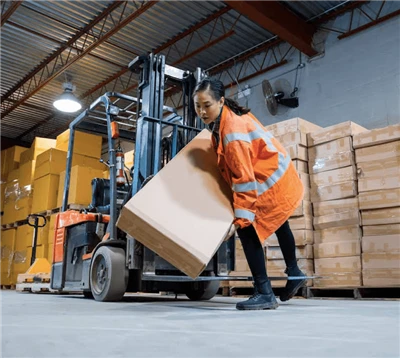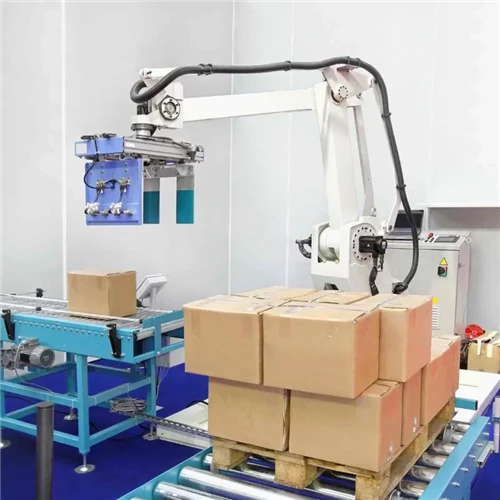
An automatic palletizer is a specialized industrial packaging system designed to stack containers, cartons, boxes, bags, or crates onto pallets automatically for warehousing, storage, and transport. Operating at the final stage of product manufacturing-commonly referred to as end-of-line (EOL) packaging-automatic palletizers accept incoming finished goods from upstream production lines, orient them into predetermined structural layouts, and stack them layer by layer onto a pallet.
By replacing manual stacking with automated mechanics, these systems eliminate heavy physical strain, ensure high operational throughput, and build stable, square pallet loads that remain secure during freight transit.

The Evolution of End-of-Line Packaging
For decades, standard packaging workflows relied heavily on manual labor to move products from outfeed conveyors onto wooden pallets. As manufacturing speeds accelerated and industrial safety standards tightened, manual handling emerged as a critical operational bottleneck.
Modern manufacturing demands continuous, high-volume production. Automatic palletizers bridge the gap between primary/secondary packaging equipment (such as fillers, sealers, and case erectors) and logistics management (such as stretch wrappers, automated guided vehicles, and warehouse management systems).
Core Operational Principles: How an Automatic Palletizer Works
While specific mechanical configurations vary depending on the chosen machinery, automatic palletizers follow a synchronized, step-by-step process flow to turn individual packages into secured cargo units.
Step 1: Infeed Accumulation & Product Orientation
Products enter the palletizing cell via an infeed conveyor-often a zero-pressure accumulation (ZPA) system-to prevent package crushing. Bump turners, inline rotators, or servo-driven turn tables orient each case or bag according to pre-programmed layer patterns (e.g., column stack, interlocked pattern, or pinwheel layout).
Step 2: Layer Formation (Pattern Generation)
In conventional high-level and low-level systems, products are pushed into row-by-row configurations on a pattern table until a complete layer (tier) is formed. In robotic systems, the articulated arm picks up individual items, multi-case groupings, or entire pre-formed layers directly using a specialized end-of-arm tool (EOAT).
Step 3: Layer Transfer & Stacking
- Conventional Systems: The formed layer is pushed onto split apron doors or a stripper plate. The plate opens or retracts, dropping or placing the layer gently onto the pallet positioned below.
- Robotic Systems: The multi-axis mechanical arm maneuvers the payload through 3D space, lowering it precisely onto the designated coordinates on the pallet.
Step 4: Slip-Sheet & Layer Pad Placement (Optional)
For fragile goods, bag goods, or multi-tier stabilization, an automated sheet feeder picks cardboard or plastic tier sheets from a magazine and inserts them between product layers to equalize weight distribution.
Step 5: Pallet Discharge & Conveying
Once the preset height or layer limit is met, the full pallet moves out of the palletizing zone on a heavy-duty powered roller or chain conveyor toward an integrated stretch wrapper. Concurrently, an automatic pallet dispenser loads a fresh empty pallet into the stacking position to continue the cycle without stopping.
Classification Matrix of Palletizing Technologies
Understanding the operational differences among palletizer types allows plant managers to choose the best machinery for their throughput, footprint, and budget constraints.
| Palletizer Category | Typical Speed / Throughput | Space / Footprint | Best Suited Applications | Key Mechanical Advantage |
| Automatic Palletizing Robot | 10 to 30+ picks/min (up to 1,800+ cases/hr) | Compact (~30% to 45% smaller) | Multi-SKU lines, heavy bags, rigid boxes | Exceptional flexibility & multi-line capability |
| High-Level Conventional | High (50 to 150+ cases/min) | Large footprint & overhead clearance | High-speed beverage & consumer goods | Unmatched speed for high-volume single SKUs |
| Low-Level Conventional | Moderate (10 to 40 cases/min) | Medium footprint (ground level) | Small-to-medium manufacturing plants | Easy floor-level access & lower initial capital cost |
| Gantry / Cartesian | Moderate (5 to 20 picks/min) | Variable overhead footprint | Very heavy payloads, large structural parts | Heavy payload capacity over extended rectilinear space |
| Cobot (Collaborative) | Low to Moderate (5 to 12 picks/min) | Ultra-compact (minimal safety guarding) | Light packaging, space-constrained cells | Rapid deployment, low safety barrier requirement |
Primary Types of Automatic Palletizers
1. Automatic Palletizing Robots
Automatic palletizing robots utilize 4-axis or 6-axis industrial articulated arms configured with specialized grippers. Rather than pushing rows of product together, robotic units pick up items from an infeed position and place them with high precision onto the pallet.
- End-of-Arm Tooling (EOAT): Robotic performance depends heavily on the gripper mechanism. Vacuum sponge pads excel at lifting corrugated cases; pneumatic side clamps handle crates; mechanical bottom forks or spatula grippers support heavy bags or unstrapped loads.
- Multi-Line Handling: A single heavy-payload automatic palletizing robot can service up to four infeed conveyors simultaneously, stacking different SKUs onto separate adjacent pallets within one safety enclosure.
2. High-Level (High-Infeed) Conventional Palletizers
High-level palletizers receive products on elevated conveyors positioned 8 to 12 feet above floor level. The machinery forms entire product layers at this upper elevation. Once a layer is fully swept onto a stripper plate, it lowers or deposits the tier onto the pallet stack beneath, which gradually lowers as layers build up.
- Advantages: Exceptionally high speeds (exceeding 100 to 150 cases per minute), making them standard in high-volume beverage bottling and canning plants.
- Disadvantages: Large physical footprint, requirement for elevated mezzanine platforms for maintenance access, and higher initial capital investment.
3. Low-Level (Low-Infeed) Conventional Palletizers
Low-level palletizers accept products at standard floor level (around 3 feet high). Products are grouped into rows and layers at floor height, then a mechanical hoist lifts the entire layer or plate assembly upward to place it on top of the growing pallet load.
- Advantages: Floor-level accessibility allows easy operator intervention, simplified routine maintenance, and lower structural ceiling height requirements.
- Disadvantages: Lower maximum operating speeds compared to high-infeed models due to the vertical cycle time required for the hoist mechanism.
4. Cobot Palletizing Systems
Collaborative robots (cobots) are compact, low-payload machines designed to work alongside human operators without traditional perimeter safety fences (subject to risk assessment). Integrated force sensors detect accidental contact and immediately stop motion.
- Advantages: Quick setup, intuitive drag-to-program user interfaces, extremely compact footprint, and easy relocation between production lines.
- Disadvantages: Lower speed (typically under 12 to 15 picks per minute) and payload limitations (generally under 20 to 25 kg).

Key Benefits of Implementing Automatic Palletizing
1. Maximized Throughput & Line Output
Manual palletizing is inherently subject to human fatigue, speed fluctuations, and shift changeover pauses. Automatic palletizing systems operate continuously at programmed cycle speeds, ensuring that high-speed upstream production lines never suffer from downstream packaging bottlenecks.
2. Total Elimination of Ergonomic Injury Risks
Repetitive lifting, twisting, and placing of heavy cases or 25-kg bags exposes workers to cumulative musculoskeletal disorders (MSDs) and severe strain injuries. Automating the palletizing process transfers these high-risk physical tasks to robust machinery, reducing workplace injury claims and lowering insurance costs.
3. Superior Load Stability & Reduced Product Loss
Inconsistent manual stacking leads to leaning pallets, overhang, and crushed corrugated boxes. Automated palletizers position every item with millimeter accuracy (often within ±1.0mm repeatability). Perfect layer alignment produces square, structurally sound loads that maximize truck cargo space and prevent product damage during transport.
4. Significant Direct Labor Cost Savings
Deploying an automatic palletizer allows factories to reallocate warehouse labor to higher-value operational tasks such as quality control, machine maintenance, or logistics planning. Instead of requiring multiple loaders per shift, a single operator can oversee several automated packaging lines simultaneously.
5. Seamless Multi-SKU & Recipe Adaptability
Modern packaging operations handle diverse product shapes, case sizes, and pallet configurations. Thanks to intuitive Human-Machine Interfaces (HMIs) and advanced Programmable Logic Controllers (PLCs), operators can change palletizing recipes with the press of a button, reducing changeover times from half an hour to less than two minutes.
Real-World Case Study: Resolving Beverage Plant Bottlenecks
To understand how an automatic palletizer transforms daily factory operations, consider the real-world example of a regional beverage packaging facility.
Initial Operational Bottlenecks
The facility ran three high-speed canning lines outputting over 1,200 cases per hour. Despite heavy investment in high-speed liquid fillers, downstream operations experienced severe delays:
- Manual Speed Limits: Manual stacking teams struggled to match outfeed speeds, forcing upstream filling machines to run at reduced capacity or stop frequently.
- High Injury Rates: Hand-stacking 15-kg beverage trays caused frequent repetitive strain injuries, high absenteeism, and elevated worker compensation costs.
- Load Instability: Uneven manual stacking caused tray crushing, resulting in pallet tipping inside freight trucks and customer returns.
System Engineering & Implementation
Engineering teams overhauled the plant's end-of-line packaging area by installing a dual-infeed automatic palletizing robot cell:
- Zero-Pressure Conveying: Installed ZPA roller conveyors to feed incoming beverage trays smoothly without edge deformation.
- Heavy-Payload Robotic Cell: Integrated a 4-axis industrial robot arm with a 180-kg payload capacity. The arm was equipped with a custom vacuum sponge EOAT capable of double-case picks.
- Automated Pallet Management: Integrated an automatic pallet dispenser that fed empty wooden pallets via powered chain conveyors directly into the cell.
Measured Operational Results
Following system commissioning, the facility achieved clear operational improvements:
- Line Output Recovered: Upstream filling lines achieved 99.1% operating efficiency, eliminating downstream backlogs.
- Ergonomic Safety: Workplace injuries due to heavy lifting dropped to zero within the palletizing zone.
- Scrap Reduction: Product damage rates fell from 2.4% to below 0.02%.
- Rapid Capital Recovery: Taking into account direct labor savings, scrap reduction, and lower insurance claims, the plant achieved full Return on Investment (ROI) within 14.2 months.

Financial Assessment: Total Cost of Ownership (TCO) & ROI
Evaluating an automatic palletizer requires looking beyond initial purchase price to consider Total Cost of Ownership (TCO).
- Palletizer Machinery, EOAT Gripper Assembly & Controller
- Conveyors, Safety Enclosures & Interlocked Guarding
- Engineering Design, Freight, Installation & FAT Testing
- Electrical Utilities & Compressed Air Supply
- Preventative Maintenance (Grease, Belts, Vacuum Pads)
- Spare Parts Inventory & Software Recipe Adjustments
ROI Calculation Formula
Most manufacturing plants operating multi-shift schedules achieve full capital recovery within 12 to 24 months.
Step-by-Step Implementation Guide
Upgrading a facility to automatic palletizing requires a structured engineering approach:
Phase 1: Throughput & Package Audit
- Measure maximum case outfeed rates during peak production hours.
- Record package dimensions, gross weights, surface porosity, and structural rigidity.
- Define required pallet footprint sizes (e.g., GMA 48x40 inch, Euro pallet) and maximum stack heights.
Phase 2: System Selection & Cell Design
- Select between robotic, conventional high-level, or low-level configurations based on space and speed needs.
- Select appropriate EOAT (vacuum pads for boxes, mechanical forks for bags, side-clamps for crates).
- Design conveyor layout with ZPA buffer zones to manage line surges.
Phase 3: Safety Guarding & Integration
- Design perimeter fencing, interlocked access doors, and light curtains meeting OSHA/ISO standards.
- Integrate system controls via Industrial Ethernet (PROFINET/EtherNet/IP) with upstream machinery and downstream stretch wrappers.
Phase 4: Testing & Commissioning
- Conduct Factory Acceptance Testing (FAT) at the integrator facility using actual product samples.
- Install equipment, verify emergency stop circuits, and calibrate sensor placement.
- Train plant operators and maintenance technicians on HMI controls, recipe creation, and preventative maintenance schedules.
FAQ
1,Can an automatic palletizer handle multiple product sizes simultaneously?
Yes. Automatic palletizing robots and modern conventional palletizers can store dozens of pre-configured stacking recipes in their PLC memory. Switching between different product sizes or layer patterns requires only a quick selection on the HMI screen.
2,What happens if a box is damaged or misaligned before entering the palletizer?
Modern automated systems include inline inspection sensors and vision systems. If a crushed box or open flap is detected, the system diverts the defective package off the main line before it reaches the palletizing cell, preventing jam-ups.
3,How much space is required for an automatic palletizer cell?
Space requirements depend on system architecture. Compact cobot cells require as little as 6 x 6 feet, while industrial robotic cells typically occupy 12 x 15 feet. High-level conventional palletizers require larger footprints, often exceeding 20 x 30 feet along with high ceiling clearances.
To evaluate your multi-level facility's layout feasibility, contact our technical engineering team today. Provide your plant architectural drawings, floor-to-floor heights, converting line output rates, and target pallet specifications, and our team will prepare a custom 2D/3D CAD layout drawing and a complete technical feasibility analysis tailored to your site.