Designing a zero-bottleneck end-of-line packaging layout requires integrating continuous modular conveyors, high-speed palletizing robot systems, dynamic accumulation zones, and automated stretch wrapping platforms to match the peak operational throughput of modern flexo printer slotters and folder gluers. By balancing infeed line speeds with automated material handling equipment, corrugated packaging plants eliminate floor-level staging delays, lower structural product damage, and ensure unbroken product movement from finishing units directly to loading docks.
End-of-Line Automation Architecture Comparison
| Layout Component | Equipment Type | Throughput Threshold | Primary Bottleneck Mitigation |
| Infeed Accumulation Zone | Zero-Pressure Accumulation (ZPA) Conveyors | Up to 18,000 sheets/hour | Absorbs transient stops from downstream wrapping without pausing converting lines |
| Robotic Stacking Cell | High-Payload Articulated Robotic Arm | Up to 1,200 bundles/hour | Eliminates human handling speed limits and manual pattern rotation delays |
| Pallet Handling System | Automated Chain/Roller Conveyors & Dispensers | 30+ full pallets/hour | Removes forklift entry risks inside active palletizing zones |
| Integrated Wrapping Station | Automatic Rotary Arm Stretch Wrapper | 45+ full pallets/hour | Ensures structural load stability before warehouse staging |
Read More: 《How Flexible Robotic Palletizing Systems Fit Small Or Irregular Box Plant Layouts》
Core Principles of Zero-Bottleneck Packaging Plant Layout Design
Modern corrugated converting machinery-such as high-speed flexo folder gluers and rotary die cutters-can output over 15,000 corrugated sheets per hour. However, overall plant efficiency is often restricted by end-of-line bottlenecks. When bundle stacking, pallet transfer, and load securing operations operate in isolation, downstream congestion forces upstream converting machinery to slow down or halt entirely.
To establish a continuous, zero-bottleneck material flow, plant designers focus on five engineering principles:
- Mass-Flow Synchronization: Downstream material handling capacities must exceed maximum upstream output rates by a minimum safety factor of 15% to 20%.
- Zero-Pressure Accumulation (ZPA): Infeed roller lines must feature zoned motor control to hold incoming bundles without physical compression, preventing bottom-sheet scuffing and edge crush.
- Decoupled Pallet Movement: Automated pallet dispensers and discharge roller beds must operate independently from the main arm movement, ensuring continuous stacking cycles without pausing for empty pallet loading.
- Integrated Safety Interlocks: Safety light curtains, interlocking fencing, and area laser scanners must allow localized entry for maintenance without triggering complete line shutdowns.
- Footprint Optimization: Compact cell footprints preserve vital transit aisles for forklift movement and staging access within existing facilities.
Case Study: Resolving End-of-Line Congestion in a High-Volume Packaging Facility
To observe how automated layout redesign resolves severe downstream congestion, consider a plant optimization project executed for a major corrugated box producer in Thailand.
Operational Profile & Initial Bottlenecks
The facility operated two high-speed flexo folder gluers and a rotary die cutter producing corrugated outer shipping cartons. While the converting lines operated at combined output speeds exceeding 22,000 sheets per hour, the facility suffered from severe end-of-line stagnation:
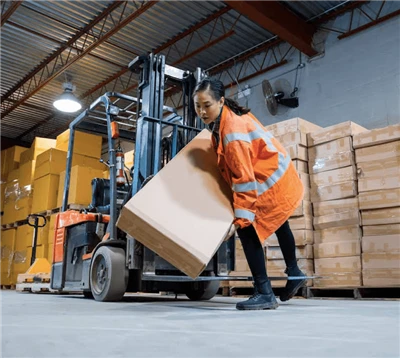
- Manual Stacking Congestion: End-of-line palletizing was performed manually by teams of operators working at the outfeed of each line. Workers struggled to match the speed of incoming bundles, causing frequent line pauses.
- Floor Transit Conflicts: Manual forklifts regularly crossed bundle transport zones to deliver empty wooden pallets and remove completed loads, creating safety hazards and traffic jams.
- Product Damage & Waste: Manual handling of heavy double-wall bundles led to edge-crush damage, resulting in a 2.8% product scrap rate.
Re-Engineering Strategy & Layout Implementation
Engineering teams executed a total layout redesign by replacing manual stacking bays with a centralized automated end-of-line system.
- Infeed Buffer Integration: High-speed Zero-Pressure Accumulation (ZPA) roller conveyors were installed directly downstream of the converting line outfeeds to provide up to 3 minutes of continuous buffering.
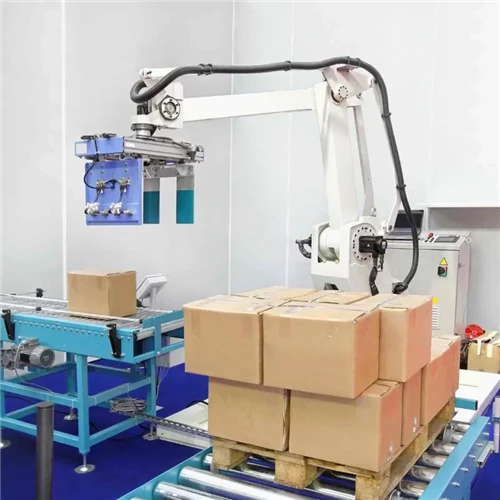
- Centralized Robotic Cell Installation: A heavy-duty industrial palletizing robot was positioned at a central convergence point. Equipped with custom multi-zone vacuum matrix grippers, the articulated palletizing robot arms handled dual-bundle pickups simultaneously, executing complex tier patterns at maximum speed.
- Automated Pallet Distribution: An automated pallet dispenser was installed alongside heavy-duty chain conveyors. This system delivers empty wooden pallets into the stacking cell automatically without operator intervention.
- In-Line Rotary Stretch Wrapping: Completed pallet stacks exit the cell via automated motor-driven roller tracks, proceeding directly into a high-speed rotary arm stretch wrapper with integrated top-sheet placement.
Measurable Operational Impact
Following the layout overhaul and commissioning, the Thailand plant recorded significant performance gains across all primary metrics:
- Line Speed Restoration: Converting lines achieved a 99.2% overall operational efficiency, completely eliminating downstream outfeed pauses.
- Labor Optimization: Reassigned 12 manual handling operators across three shifts to higher-value machine operation and quality assurance roles.
- Scrap Rate Minimization: Product damage from manual handling dropped from 2.8% to under 0.05%.
- Investment Payback: Considering equipment procurement, freight, installation, and commissioning, full investment payback was achieved within 11.8 months.

Financial & Operational Metrics: Manual vs Robot Palletize
When evaluating end-of-line layout upgrades, plant managers must compare long-term operational costs against upfront machinery outlays. Conducting a clear manual vs robot palletize assessment highlights the structural advantages of automation in high-throughput corrugated box facilities.
| Financial & Operational Parameter | Manual Stacking Operation | Automated Robotic Palletizing Cell |
| Shift Labor Requirement | 3 – 4 Workers per Line / Shift | 1 System Supervisor per Shift (Multi-Line) |
| Stacking Consistency & Pattern Accuracy | Variable; highly dependent on operator fatigue | 100% Precise pattern execution & corner alignment |
| Average Hourly Cell Output | 300 – 450 Bundles/Hour | 900 – 1,400 Bundles/Hour |
| Occupational Injury Risk | High (Repetitive strain, lifting, fatigue) | Zero direct human contact inside active cell |
| Product Edge Damage Rate | 2.0% – 3.5% Average | Less than 0.05% |
| Operational Uptime Ratio | ~75% (Includes break shifts, fatigue slowdowns) | ~98.5% (Continuous uninterrupted cycle) |
Equipment Engineering & Sourcing: TCO Evaluation
Procuring advanced packaging machinery-such as an automated case palletizer or heavy-duty articulated arm-from an established palletizing robot China manufacturer offers high capital efficiency, provided engineering teams conduct a thorough Total Cost of Ownership (TCO) evaluation.
- Robotic Arm, EOAT Vacuum Matrix & Servo Controls
- Automatic Pallet Dispensers & Heavy-Duty Conveyor Tracks
- Safety Enclosures, Interlocking Gates & Light Curtains
- Ocean Freight, Customs Duties, Installation & FAT Testing
- Electrical & Pneumatic Utility Consumption
- Preventative Maintenance (Grease, Vacuum Seals, Belts)
- Spare Parts Inventory & Remote Diagnostic Support
When analyzing a palletizing robot price proposal from overseas equipment suppliers, plant engineers must verify that the quotation covers all secondary integration components-including:
- End-of-Arm Tooling (EOAT): Multi-functional vacuum matrix or mechanical clamping grippers designed specifically for corrugated board grades.
- Conveyor Integration Controls: Centralized PLC hardware with Ethernet/IP or PROFINET protocols to sync upstream converting machinery with downstream stacking cells.
- Safety Compliance Systems: Complete physical guarding, interlocked access doors, and safety light curtains compliant with global machinery safety standards.
- Remote Diagnostic Modules: Integrated hardware allowing off-site engineering teams to perform software updates and diagnostic checks remotely.

Step-by-Step Layout Engineering: Implementing a Zero-Bottleneck System
To transition a plant from manual handling to a zero-bottleneck automated end-of-line layout, engineering teams should follow a structured four-stage design methodology.
Step 1: Conduct a Mass-Flow and Speed Balancing Audit
Measure the actual peak production rates of all converting equipment rather than relying on nominal machine ratings:
- Calculate total hourly bundle output, maximum tier heights, and load pattern variations across all product SKUs.
- Identify instantaneous surge speeds when converting lines operate at peak velocity.
- Dimension infeed accumulation conveyors to buffer at least 2 to 4 minutes of peak production volume.
Step 2: Establish Layout Zoning and Material Access Lanes
Divide the end-of-line floor space into clear functional zones to eliminate transit conflicts between machinery and plant traffic:
- Production Zone: Dedicated exclusively to bundle conveying, stacking, and pallet transport.
- Forklift Interface Zone: Positioned outside active safety enclosures for staging empty pallets and picking up finished stretch-wrapped loads.
- Maintenance & Operator Corridor: Clear, interlocked access paths allowing safe inspection without stopping main production lines.
Step 3: Select and Integrate End-of-Arm Tooling (EOAT)
Select gripper technology capable of handling variable box sizes, unstrapped bundles, and interlocked tier patterns without causing surface damage:
- High-Flow Vacuum Sponge Grippers: Ideal for handling porous corrugated sheets, unstrapped bundles, and top-cap sheets without changing mechanical tools.
- Pneumatic Mechanical Side-Clamps: Best suited for heavy outer shipping cases requiring positive mechanical holding during high-speed rotation.
Step 4: Execute Unified PLC Integration & Factory Acceptance Testing (FAT)
Ensure all end-of-line machines communicate across a single control network:
- Synchronize infeed conveyor speeds with robotic arm picking sequences via centralized PLC programming.
- Conduct rigorous Factory Acceptance Testing (FAT) at the machinery manufacturer's plant using customer-supplied corrugated bundles before shipment.
- Validate all emergency stop sequences, safety curtain interlocks, and automated restart protocols prior to final plant commissioning.
FAQ
1,How much floor space is required for an automated robotic palletizing cell?
A standard single-line robotic palletizing cell typically requires a footprint of approximately 16 to 22 square meters. This includes the articulated arm, safety enclosure, infeed conveyor, automated pallet dispenser, and pallet discharge track. Multi-line cells servicing several converting lines simultaneously generally require 30 to 45 square meters.
2,Can a single robotic arm handle output from multiple converting lines simultaneously?
Yes. By designing a multi-infeed layout with centralized accumulation conveyors, a high-payload articulated robotic arm can service two or three separate converting lines concurrently. The central controller manages incoming SKUs, selecting appropriate tier patterns and pallet destinations automatically.
3,How do automated end-of-line layouts handle different pallet sizes?
Modern automated pallet dispensers and roller tracks feature adjustable guide rails and programmable PLC recipes. When switching between standard pallet sizes (e.g., 1200x1000mm, 1200x800mm, or custom corrugated skid dimensions), operators simply select the corresponding product recipe on the HMI touchscreen, and the system auto-adjusts width parameters accordingly.
Contact our technical engineering team to request your Free End-of-Line Layout Evaluation. Submit your floor plan drawing, machine output specifications, and target box dimensions, and our engineering team will provide a customized 2D/3D CAD layout proposal and detailed ROI calculation tailored to your facility.