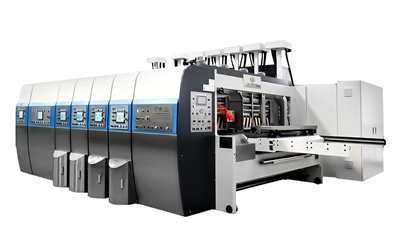
Installing palletizing robot systems across multi-story factory layouts enables high-volume corrugated packaging facilities to transport finished goods vertically between conversion lines and elevated loading docks using synchronized hydraulic lifters, continuous vertical conveyors, and motor-driven transfer shuttle cars. By linking ground-floor converting machinery directly to second-story staging platforms via integrated vertical elevator shafts, plant engineers can automate end-of-line stacking without sacrificing valuable primary floor area or altering existing warehouse infrastructure.
Vertical Integration Configurations For Multi-Story Box Plants
| Layout Configuration | Core Mechanical Components | Vertical Handling Limit | Primary Operational Advantage |
| Ground-to-Mezzanine Lift | Articulated arm, hydraulic vertical platform, safety interlock gates | Up to 6.5 meters | Bypasses ground-floor transit aisles by moving finished pallets directly to upper storage |
| Overhead Bundle Conveyor | Incline slat elevator, overhead roller track, elevated receiving cell | Up to 12.0 meters | Transfers individual unstacked bundles across high-clearance factory spans above machinery |
| Dual-Stage Reciprocating Cell | High-speed continuous elevator, twin shuttle cars, central PLC | Up to 18.0 meters | Manages high-throughput multi-floor production lines feeding a single loading dock |
| High-Bay Cargo Shaft Link | Enclosed vertical hoist, pneumatic floor hatch, laser position sensors | Multi-level (3+ floors) | Connects isolated vertical manufacturing floors in urban industrial facilities |
Engineering Vertical Workflows in Multi-Level Packaging Plants
Corrugated converting operations in densely populated industrial regions frequently operate across multi-story facilities due to limited real estate footprints. In these plants, heavy conversion equipment-such as flexo printer slotters and rotary die cutters-is typically positioned on the ground floor to absorb vibration and structural load. Conversely, raw material storage, staging yards, or truck bays often reside on secondary elevated floors or elevated loading platforms.
Moving heavy corrugated bundles or completed pallet stacks across vertical elevations presents distinct mechanical challenges:
- Elevator Shaft Bottlenecks: Standard freight elevators require manual operator entry, slow door cycles, and continuous forklift loading, creating severe downstream congestion for high-speed lines.
- Vertical Stability Hazards: Transporting loose corrugated bundles or tall palletized loads vertically risks bundle slippage, board deformation, or stack collapse if acceleration curves are not precisely controlled.
- Structural Payload Limits: Mezzanines and upper concrete floor slabs impose strict weight limitations per square meter, requiring careful distribution of heavy mechanical equipment.
Integrating an industrial palletizing robot with dedicated vertical elevation mechanisms eliminates these logistics friction points. Rather than relying on manual forklift transport or slow batch elevators, automated vertical integration establishes a continuous, closed-loop flow between production floors.
Practical Application Case Study: Retrofitting a Multi-Story Box Plant in Vietnam
To evaluate how automated vertical elevation resolves multi-floor logistical constraints, consider an installation engineered for a corrugated box manufacturer operating in Ho Chi Minh City, Vietnam.
The Operational Bottleneck
The client operated a multi-level packaging plant producing heavy double-wall outer shipping boxes for domestic appliance manufacturers. The facility's primary converting line-a high-speed flexo folder gluer operating at 14,000 sheets per hour-was anchored on the ground floor. However, due to urban site boundaries, the plant's main shipping container loading bay was situated on the second floor, 5.8 meters above the production line.
The facility originally relied on two manual freight lifts and four dedicated material handling workers per shift. As finished corrugated bundles exited the folder gluer, workers manually loaded them onto hand trucks, wheeled them into the freight lift, rode up to the second floor, and manually stacked the boxes onto pallets near the loading dock.
This process generated severe operational liabilities:
- Throughput Constriction: Freight lift wait times caused frequent production line shutdowns because the ground-floor outfeed area reached maximum holding capacity within minutes.
- High Labor Overhead: Operating the vertical manual handling process required eight workers across two shifts, incurring high labor overhead and frequent fatigue-related injuries.
- Product Damage: Manual handling of heavy double-wall bundles led to high edge-crush rates, resulting in a 3.5% scrap rate from damaged outer linerboards.
The Engineering Solution
To resolve the vertical transport bottleneck without undertaking major structural demolition, an integrated vertical elevator and robotic stacking cell was engineered utilizing three core systems:
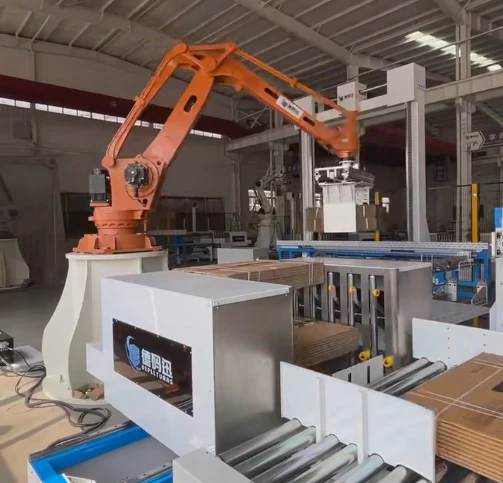
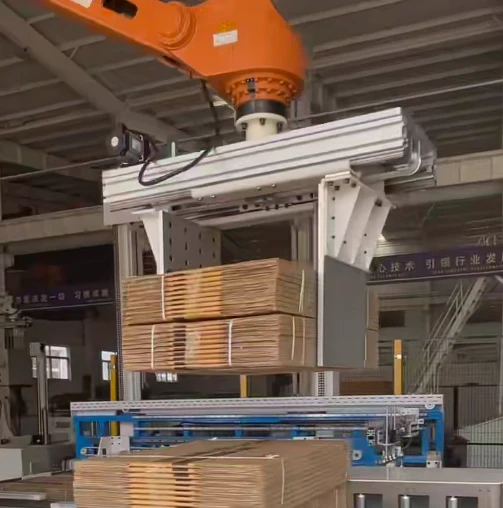
- Ground-Floor Stacking Cell: A heavy-duty palletizing robot arms unit with a 210 kg payload capacity was installed at the outfeed of the flexo folder gluer on the ground floor. Equipped with a dual-zone mechanical clamp gripper, the arm builds interlocked pallet loads directly onto an integrated heavy-duty roller bed.
- Heavy-Duty Continuous Vertical Elevator (CVE): An enclosed, motor-driven vertical cargo hoist was installed adjacent to the robotic cell, passing through a reinforced 2.2m x 2.2m floor penetration cut into the second-story concrete slab.
- Upper-Level Shuttle Transfer Track: A 12-meter motor-driven shuttle car track was installed on the second floor, running from the elevator discharge port directly to the staging area for container loading.
System Execution & Operational Flow
Under the redesigned multi-story workflow, finished corrugated bundles exit the folder gluer and enter the ground-floor robotic cell. The articulated arm receives the bundles, executes layer pattern calculations, and builds a completed 1.8-meter-tall pallet stack.
Once the pallet load is completed, the automated sequence proceeds as follows:
- The central PLC verifies via photoelectric sensors that the vertical elevator carriage is stationary and aligned at ground level.
- Motorized chain conveyors transfer the completed 1,100 kg pallet horizontally into the elevator carriage.
- Heavy-duty pneumatic clamps lock the pallet in place inside the carriage to prevent movement during vertical travel.
- The variable-frequency drive (VFD) hoist lifts the load 5.8 meters vertically to the second floor at a smooth travel speed of 0.8 meters per second.
- Upon reaching the second floor, the elevator safety doors open, and an integrated roller conveyor discharges the pallet onto the upper shuttle car.
- The shuttle car delivers the pallet load to the designated container loading dock, where a single forklift operator stages it directly into shipping containers.
Measured Financial & Operational Results
By implementing this space-adapted vertical automation strategy, the Ho Chi Minh City facility transformed its downstream operations:
- Complete Line Balance: The flexo folder gluer achieved 98% operational uptime, completely eliminating downstream outfeed pauses.
- Labor Redirection: All eight manual transport workers were reassigned to higher-value machine operation and quality inspection roles.
- Scrap Reduction: Product damage caused by manual handling fell from 3.5% to below 0.1%.
- Rapid Investment Recovery: Considering complete machinery procurement, sea freight, structural floor coring, and commissioning, the calculated payback period was achieved in 13.5 months.
Technical Dynamics Of Vertical Lifting Equipment
Achieving seamless multi-story automation requires selecting vertical lifting hardware capable of handling high structural loads while maintaining precise alignment with horizontal conveyor tracks.
Reciprocating Vertical Lifts (RVLs)
Reciprocating vertical lifts utilize heavy-duty guide columns paired with motor-driven chain or wire-rope hoists. They move pallet loads or bundle batches up and down between fixed floor stops in a two-direction motion.
- Payload Capacity: Standard configurations handle loads from 500 kg to over 2,500 kg per carriage.
- Leveling Precision: Proximity switches and laser distance sensors ensure floor-level alignment within ±2 mm, allowing smooth pallet transfers without mechanical jolting.
- Structural Enclosures: Fully enclosed with steel mesh or sheet metal casing equipped with safety interlock doors to prevent operator access during vertical movement.
Continuous Vertical Conveyors (CVCs)
For ultra-high-throughput operations where reciprocating lifts create timing delays, continuous vertical conveyors utilize a series of platform flights attached to continuously looping heavy-duty drive chains.
- Constant Throughput: Capable of elevating up to 30 individual bundles or small pallets per minute in a continuous upward stream.
- Compact Footprint: Requires significantly less floor area than inclined belt conveyors or long ramp systems.
- Unidirectional Flow: Ideal for dedicated bottom-to-top or top-to-bottom transportation paths.
Mechanical Gripper Specifications For High-Load Stacking
Handling heavy corrugated bundles or variable-sized outer shipping cases at high speeds requires specialized End-of-Arm Tooling (EOAT). The robotic arm must secure the payload firmly to prevent shifting during rapid acceleration and deceleration cycles.
Dual-Zone Pneumatic Clamp Grippers
Pneumatic clamping grippers use parallel side plates to apply controlled lateral pressure against the outer edges of corrugated bundles or case loads.
- Proportional Pressure Valves: Allow operators to adjust clamping force based on board grade (e.g., lower pressure for light E-flute boxes; higher pressure for heavy double-wall shipping cases) to eliminate crush marks.
- Bottom-Support Flaps: Pneumatic support fingers extend beneath the load to provide positive vertical support during high-speed arm rotation.
High-Flow Vacuum Matrix Grippers
Vacuum sponge matrix grippers utilize a dense array of check-valve suction ports backed by high-output vacuum blowers.
- Pattern Versatility: Handles individual boxes, full bundle layers, or corrugated top-cap sheets without changing mechanical tooling.
- Self-Sealing Valves: Uncovered suction ports close automatically, maintaining full vacuum pressure on the portion of the foam pad making contact with the corrugated surface.
Cost-Benefit Framework: TCO And Equipment Procurement
Investing in multi-level automation requires balancing upfront capital outlays against long-term operational savings. Sourcing specialized hardware-such as a case palletizer or heavy-duty vertical lift-from an established palletizing robot China manufacturer offers significant cost efficiencies, provided plant managers conduct a thorough Total Cost of Ownership (TCO) evaluation.
- Robotic Arm & EOAT Gripper Assembly
- Shuttle Cars, Track Rails & Vertical Elevators
- Safety Fencing, Light Curtains & Interlocks
- Shipping, Import Duties & Engineering Design Fees
- Electricity & Compressed Air Consumption
- Preventative Maintenance (Grease, Belts, Sensors)
- Operator Training & Spare Parts Inventory
Financial Metric Comparisons By System Layout
The table below provides comparative investment and performance benchmarks for automating vertical and multi-story end-of-line packaging operations.
| System Parameter | Standard Single-Level Cell | Reciprocating Elevator Cell | Multi-Story Continuous System |
| Typical Equipment Capital Range | $50,000 – $75,000 USD | $85,000 – $135,000 USD | $140,000 – $210,000 USD |
| Installation Footprint (Ground Floor) | 16 m² | 22 m² | 28 m² |
| Vertical Lifting Capability | N/A (Single Floor) | Up to 8.0 meters | Up to 18.0 meters |
| Estimated Payback Period | 9 – 13 Months | 12 – 16 Months | 15 – 22 Months |
| Maximum Pallet Throughput | Up to 15 pallets/hour | Up to 25 pallets/hour | Up to 40 pallets/hour |
When evaluating a palletizing robot price proposal from overseas equipment suppliers, plant engineers must verify that the quotation covers all secondary integration components-including vertical elevator shaft enclosures, floor penetrations, interlocked safety gates, upper-level shuttle cars, and remote PLC communication hardware.
Step-By-Step Engineering Guide: Implementing Multi-Story Automation
To successfully integrate vertical elevation hardware with downstream robotic stacking equipment, engineering teams should follow a structured four-stage evaluation process.
Step 1: Conduct Structural and Floor Load Analyses
Before installing heavy mechanical equipment on secondary floors or cutting floor penetrations for elevator shafts, consult a certified structural engineer:
- Verify that upper-floor concrete slabs can support dynamic live loads from loaded shuttle cars and stacked pallets (typically 1,500 kg/m² minimum).
- Identify structural floor beams and tension cables before coring floor openings for vertical elevator shafts.
- Ensure overhead clearances on all levels comply with local machinery safety codes.
Step 2: Calculate Vertical Mass-Flow Requirements
Determine the total volume of material requiring vertical transport at peak production speeds:
- Calculate total hourly output in bundles, cases, and finished pallet loads.
- Determine whether individual bundles should be elevated before stacking, or if complete pallet loads should be built on the ground floor prior to vertical lifting.
- Select vertical hoist speeds and elevator motor drive ratings that exceed peak production rates by a minimum 25% safety margin.
Step 3: Integrate PLC Control Architecture and Safety Interlocks
Multi-level automated systems require unified control systems to prevent equipment collisions and material jams across isolated building zones:
- Install a centralized Programmable Logic Controller (PLC) with Ethernet/IP or PROFINET communication protocols to synchronize the robotic arm, vertical lift carriage, and upper-level shuttle cars.
- Position optical sensors at every transfer boundary to verify load alignment before triggering horizontal or vertical conveyance.
- Wire physical Emergency Stop (E-Stop) buttons and safety light curtains across all floors to a single master safety relay.
Step 4: Execute Factory Acceptance Testing (FAT) and Commissioning
Prior to final shipment and installation, conduct a comprehensive Factory Acceptance Test (FAT) at the equipment manufacturer's facility:
- Test the complete operational cycle using customer-supplied corrugated boxes, verifying layer pattern execution, clamping force, and stack stability.
- Simulate vertical lift stop alignments, load transfer sequences, and emergency stop recovery procedures under maximum payload conditions.
- Verify remote PLC diagnostic access modules to ensure off-site engineering teams can troubleshoot software timing remotely post-installation.

FAQ
1,Is it better to stack boxes into pallets on the ground floor or elevate individual boxes to stack them on the upper floor?
Building complete pallets on the ground floor is generally preferred if structural floor ratings on the upper level permit. Ground-floor stacking keeps the primary robotic arm anchored on a solid concrete foundation, reducing vibration and structural stress on upper-floor slabs. However, if upper floor loading capacities are limited, individual bundles can be elevated via a lightweight vertical conveyor to an upper-level stacking cell.
2,What safety mechanisms prevent vertical elevators from falling during power failures?
Industrial vertical lifts utilize redundant mechanical safety systems. These include motor-mounted electromagnetic failure-brakes, heavy-duty safety catch wedges that mechanically lock onto guide rails in the event of cable tension loss, and hardware-interlocked safety switches that prevent carriage movement if doors are open.
3,How are multi-story robotic palletizing systems maintained remotely?
Modern systems are equipped with secure VPN remote diagnostic modules connected to the main PLC. If a timing fault or sensor misalignment occurs on an upper floor or inside the elevator shaft, engineers can securely log into the system remotely, analyze real-time I/O status, adjust servo motor parameters, and guide local maintenance technicians through resolution without requiring on-site service visits.
Streamlining Multi-Level Packaging Operations
Multi-story plant layouts no longer present an insurmountable barrier to modernizing downstream packaging lines. By linking high-performance articulated robotic arms with continuous vertical elevators and motorized transfer shuttles, corrugated packaging producers can fully automate material handling across multiple floor levels, eliminate manual transport bottlenecks, and significantly increase total plant productivity.
To evaluate your multi-level facility's layout feasibility, contact our technical engineering team today. Provide your plant architectural drawings, floor-to-floor heights, converting line output rates, and target pallet specifications, and our team will prepare a custom 2D/3D CAD layout drawing and a complete technical feasibility analysis tailored to your site.