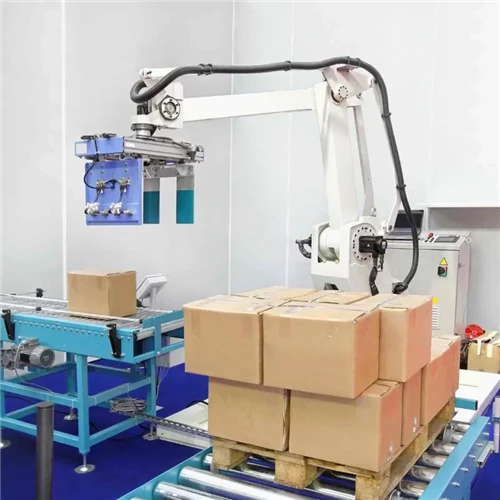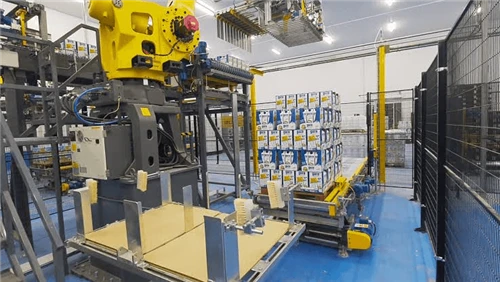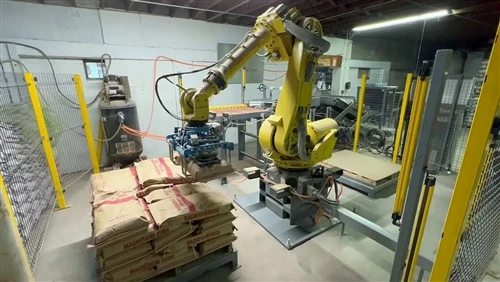
While manual palletizing requires lower initial capital expenditure, high labor turnover, rising wages, worker compensation claims, and freight damage make it increasingly unsustainable. Transitioning to a fully automatic robot palletizing system reduces labor dependency by up to 85%, increases end-of-line throughput by 40% to 60%, and drastically lowers product damage rates. A comprehensive Total Cost of Ownership (TCO) evaluation shows that a modern warehouse palletizer robot achieves full capital payback within 12 to 18 months, converting operational expenses into long-term bottom-line profitability.

1. Introduction and the Evolving Palletizing Robots Market
End-of-line material handling is undergoing a rapid industrial transformation. Historically, logistics centers and manufacturing facilities relied heavily on human labor to stack boxes, bags, crates, and trays onto pallets. However, shifting macroeconomic conditions, severe labor shortages, and skyrocketing customer expectations regarding delivery speed have reshaped the global packaging landscape.
The growth of the palletizing robots market is largely propelled by the need to automate repetitive, physically demanding tasks. Plant managers and operations executives can no longer view end-of-line packaging as a simple manual labor task. Instead, stacking is now recognized as a critical operational node that directly impacts overall equipment effectiveness (OEE), workplace safety compliance, and shipping logistics efficiency.
When conducting a rigorous financial analysis of robotic palletizers vs manual systems, focusing solely on initial machinery purchase costs yields a misleading picture. A true financial evaluation requires analyzing the Total Cost of Ownership (TCO) over a 5-to-10-year equipment lifecycle. This guide breaks down the capital, operational, and hidden financial variables necessary to evaluate manual stacking against an automated warehouse palletizer robot.
2. Defining the Contenders: Manual Operations vs. Fully Automatic Systems
To evaluate Total Cost of Ownership, engineering teams must first establish clear operational definitions for both manual stacking workflows and automated robotic cells.
2.1 Manual Palletizing Operations
Manual palletizing relies entirely on human operators positioned at the end of an outfeed conveyor line. Workers manually lift incoming packages, align them according to pre-determined tier patterns, and stack them onto wooden or plastic pallets.
Key operational characteristics of manual stacking include:
- High Physical Strain: Operators repeatedly bend, twist, and lift payloads ranging from 5 kg to 25 kg throughout an 8-hour shift.
- Variable Throughput Speed: Human stacking speeds inevitably decay over time due to muscle fatigue, resulting in end-of-line bottlenecks during peak production hours.
- Inconsistent Load Stability: Stacking quality varies significantly depending on individual operator skill, leading to uneven pallet tiers, shifting loads during transit, and potential product crushing.
2.2 Fully Automatic Robot Palletizing Systems
A fully automatic robot palletizing system integrates mechanical, electronic, and software components into a self-contained, high-speed stacking cell.
The architecture of an automated cell typically comprises:
- High-Payload Articulated Robot Arms: Industrial 4-axis or 6-axis palletizing robot arms engineered for continuous duty, fast cycle times, and heavy load capacities ranging from 100 kg to 500 kg.
- Custom End-of-Arm Tooling (EOAT): Specialized grippers-such as large-area vacuum foam plates, mechanical side-clamps, or bottom-support forks-designed to pick individual boxes, complete rows, or full product tiers without damaging contents.
- Infeed Conveyors and Pattern-Forming Stations: Servo-driven conveyor units that sequence, turn, and group incoming cartons into optimal layer configurations prior to robotic pickup.
- Peripheral Automation: Automatic empty-pallet dispensers, slip-sheet inserters, and integrated stretch wrappers that handle raw materials and finish pallet loads without human intervention.
- Safety Interlocks and Enclosures: Light curtains, interlocked safety fencing, and area scanners compliant with international machinery safety standards (ISO 10218 / ANSI/RIA R15.06).
Read More:《Stitching Machine ROI Analysis: Labor Savings, Waste Reduction, And Payback Period》
3. The Total Cost of Ownership (TCO) Evaluation Framework
Evaluating TCO requires looking beyond upfront invoices. Total Cost of Ownership encompasses every direct, indirect, and hidden expense incurred from system acquisition through installation, daily operation, maintenance, and eventual decommissioning.
TCO Calculation Formula:
TCO = Capital Expenditure (CapEx) + Direct Operational Expenditure (Direct OpEx) + Indirect Operational Expenditure (Indirect OpEx) - Residual Asset Value
Total Cost Breakdown Categories
- Capital Expenditure (CapEx):
Initial Machinery and Robot Arm Purchase
Custom EOAT Gripper Engineering and Fabrication
Line Integration, Conveyors, and PLC Programming
Delivery, Installation, and Facility Utility Upgrades
- Direct Operational Expenditure (OpEx Direct):
Operator Wages, Benefits, and Payroll Taxes
Electrical Power Consumption
Routine Mechanical Maintenance and Spare Parts
Software Licensing and Controller Firmware Updates
- Indirect Operational Expenditure (OpEx Indirect):
Workers' Compensation Claims and Medical Insurance Premiums
Employee Recruitment, Onboarding, and Retraining Expenses
Transit Freight Damage, Product Scrap, and Repacking
Unplanned Line Downtime and Bottleneck Costs

4. Financial and Operational Comparison Matrix
The table below outlines the core differences across technical, financial, and operational parameters when comparing manual palletizing against an automated fully automatic robot palletizing system.
| Evaluation Parameter | Manual Palletizing Operation | Fully Automatic Robot Palletizing System | Strategic & Financial Impact |
| Initial Capital Expenditure (CapEx) | Low ($0 – $15,000 for basic turntables) | Moderate to High ($180,000 – $400,000 turnkey) | Higher initial investment for automation |
| Direct Labor Requirement | 1–2 Operators per line, per shift | 0.1–0.2 Supervisors (1 operator manages 5 lines) | 80%–90% reduction in direct labor hours |
| Peak Throughput Capacity | 6–10 cases/min (Fades over shift) | 15–30+ cases/min (24/7 continuous operation) | Up to 3x higher throughput per footprint unit |
| Load Consistency & Quality | Variable; prone to human error and leaning towers | Precision placement within ±0.5 mm | Eliminates transit load collapse and claims |
| Floor Space Requirement | Large (Requires staging area for multiple workers) | Compact (15 – 30 sq. meters enclosed cell footprint) | Reclaims up to 40% valuable shop floor space |
| Ergonomic & Safety Risk | Extremely high (Sprain, strain, repetitive motion) | Zero direct ergonomic hazard (Enclosed cell) | Dramatically lowers insurance premiums |
| Operating Hours Flexibility | Requires overtime, extra shifts, or temporary labor | Instant 24/7 scalability without additional labor cost | Maximizes operational agility during peak seasons |
| Useful Lifespan | N/A (Continuous labor turnover) | 10–15 Years (80,000+ hours MTBF) | Long-term capital asset appreciation |
5. Comprehensive TCO Mathematical Model: 5-Year Case Study
To quantify the financial impact when analyzing robotic palletizers vs manual systems, let us evaluate a representative regional manufacturing and distribution facility.
5.1 Baseline Operational Parameters
- Operating Schedule: 2 Shifts/Day, 5 Days/Week, 50 Weeks/Year (4,000 operational hours/year).
- Production Speed: 18 cases/minute on a continuous outfeed line.
- Manual Staffing: 2 operators per shift (4 operators total across 2 shifts) dedicated to manual stacking.
- Fully Burdened Labor Rate: $32.00/hour (includes base wage, payroll taxes, medical benefits, and insurance).
- Annual Direct Labor Cost Calculation: 4 workers x 2,000 hours x $32.00/hour = $256,000/year.
5.2 Manual System Cost Profile (5-Year Horizon)
Over a 5-year period, manual labor rates do not remain static. Assuming a conservative 4% annual wage inflation rate, direct labor costs compound steadily.
Direct Labor Expenses:
- Year 1: $256,000
- Year 2: $266,240
- Year 3: $276,890
- Year 4: $287,965
- Year 5: $299,484
- Subtotal Direct Labor: $1,386,579
Indirect & Hidden Manual Costs:
- Recruitment and Retraining Costs: High turnover in manual palletizing (averaging 35% annually) requires onboarding ~1.4 new workers per year at an estimated recruitment/training cost of $6,000 per hire.
5-Year Total: $42,000
- Workers' Compensation and Ergonomic Claims: Musculoskeletal disorder (MSD) claims in packaging lines average $28,000 per incident, with an average frequency of one major claim every two years.
5-Year Total: $70,000
- Product Damage and Freight Claims: Inconsistent manual stacking results in crushed lower tiers and load shifts during transit, costing an estimated 0.15% of total product shipment value (~$18,000/year).
5-Year Total: $90,000
Total 5-Year Cost of Manual Operations: $1,588,579
5.3 Fully Automatic Robot Palletizing System Cost Profile (5-Year Horizon)
Now let us examine the financial profile of installing a turnkey fully automatic robot palletizing system.
Initial Capital Investment (CapEx):
- High-payload 4-axis warehouse palletizer robot arm: $95,000
- Custom multi-zone vacuum/clamp EOAT gripper: $35,000
- Infeed conveyor sequencing, pallet dispenser, and safety fencing: $85,000
- Controls engineering, PLC programming, and WMS integration: $45,000
- Delivery, mechanical installation, and commissioning: $25,000
- Total Turnkey CapEx: $285,000
Direct Operational Expenses (OpEx):
- Supervisory Labor: The cell requires approximately 0.1 FTE (15 minutes per shift) for film loading, pallet reloading, and supervisory oversight.
5-Year Supervisory Labor: $64,000
- Electrical Energy Consumption: The cell consumes an average of 12 kW/hour. At an industrial electricity rate of $0.12/kWh across 20,000 operating hours over 5 years:
Calculation: 12 kW x 20,000 hours x $0.12/kWh
5-Year Energy Cost: $28,800
- Preventative Maintenance & Spare Parts: Scheduled lubrication, vacuum pad replacements, belt tensioning, and software updates estimated at 2.5% of equipment CapEx annually (~$7,125/year).
5-Year Maintenance Cost: $35,625
- Product Damage Rates: Reduced by 95% due to soft-touch gripping and dynamic load distribution.
5-Year Product Damage Cost: $4,500
Total 5-Year Cost of Automated Robotic System: $417,925
5.4 Payback Period and Net Present Value (NPV) Analysis
Comparing the two financial trajectories highlights a stark divergence in operational expenditure.
- 5-Year Net Operational Savings Formula: 5-Year Manual Cost - 5-Year Automated Cost
- 5-Year Net Operational Savings: $1,588,579 - $417,925 = $1,170,654
Payback Period Calculation:
- Annual Net Operating Savings: $1,170,654 / 5 years = $234,131 / year
- Payback Period Formula: Initial Capital Investment (CapEx) / Annual Net Operating Savings
- Payback Period: $285,000 / $234,131 ≈ 1.22 Years (approx. 14.6 Months)
Using a 7% discount rate, the 5-Year Net Present Value (NPV) of transitioning to an automated warehouse palletizer robot exceeds $850,000, demonstrating that delaying automation incurs a substantial opportunity cost.
Read More:《Palletizers Vs. Manual Labor:Choosing The Right Solution For Your Business Storage Pallet Racking》

6. Strategic and Operational Advantages Beyond Financial ROI
While financial metrics provide a compelling case for automation, logistics executives must also evaluate qualitative and strategic operational benefits when comparing robotic palletizers vs manual systems.
Strategic Benefits Breakdown
- Operational Resilience:
Uninterrupted 24/7 production capability without operator fatigue
Complete immunity to regional labor shortages and absenteeism
Rapid rate scaling during peak seasonal demand surges
- Quality and Brand Protection:
Uniform tier alignment and high-precision box placement
Elimination of transit load collapses and torn packaging
Reduced customer chargebacks and damaged freight claims
- Shop Floor Optimization:
Compact cell footprint frees up valuable floor space for production
Reduced forklift traffic near packaging line outfeeds
Clean, ISO-compliant industrial workplace environment
6.1 Predictable Throughput and Line Stabilization
In manual operations, end-of-line packaging is vulnerable to human fatigue, meal breaks, shift changes, and absenteeism. A single absent operator on the packing line can force upstream manufacturing equipment to run at reduced speeds or stop entirely.
A fully automatic robot palletizing system acts as a reliable line stabilizer. Once integrated into the master Programmable Logic Controller (PLC) architecture, the robot arm runs continuously at designated cycle speeds, eliminating upstream backpressure and maintaining consistent factory output.
6.2 Elimination of Ergonomic Health Hazards
Musculoskeletal injuries caused by manual stacking represent one of the highest safety liabilities in warehousing and manufacturing. Lifting thousands of kilograms per shift leads to chronic back injuries, repetitive strain disorders, and costly workers' compensation claims.
Deploying palletizing robot arms removes operators from hazardous lifting zones. Human workers can be upskilled into higher-value roles, such as quality control technicians, machine operators, or inventory managers, boosting staff morale and employee retention.
6.3 Precision Load Building and Space Optimization
Modern robotic stacking cells utilize precise position control to build perfectly squared, highly stable pallet loads. Precision placement ensures that box corners align vertically, maximizing the structural stacking strength of corrugated containerboard.
Stable, uniform pallets offer critical down-stream advantages:
- Maximized Trailer Volume: Perfectly square pallets can be loaded tightly into freight trailers without overhang, maximizing cube utilization and lowering transport costs.
- Seamless Automated Warehouse Storage: Uniform pallets prevent overhang jams when entering High-Bay Automated Storage and Retrieval Systems (ASRS).
Read More:《Your Guide To Automatic Palletizer Maintenance: Maximizing Reliability And ROI》

7. Key Technical Considerations for System Selection
When transitioning from manual operations to an automated cell, engineering teams must evaluate specific technical requirements to ensure the selected machinery matches facility goals.
7.1 Robot Arm Kinematics: 4-Axis vs. 6-Axis
Selecting the correct mechanical configuration for palletizing robot arms depends on product variety and motion requirements.
- 4-Axis Articulated Robots: The standard workhorse of the palletizing robots market. 4-axis robots feature mechanical parallel linkages that keep the payload parallel to the floor at all times. They offer high payload capacity (up to 300 kg), rapid cycle times (12–25 picks/minute), and simple programming architecture.
- 6-Axis Articulated Robots: Provide full 3D spatial rotation. 6-axis arms are selected when incoming products must be tilted, flipped, re-oriented in tight spaces, or picked from complex multi-conveyor arrangements.
7.2 End-of-Arm Tooling (EOAT) Customization
The EOAT gripper is the critical interface between the robot arm and the product. Selecting an improper gripper design can result in dropped packages, torn corrugated paper, or crushed contents.
- Vacuum Foam Grippers: Utilize high-flow vacuum blowers and check-valve foam plates. Ideal for open-top containers, porous corrugated boxes, and variable package sizes.
- Mechanical Side-Clamps: Utilize pneumatic or servo-driven clamping jaws to securely hold rigid plastic crates, heavy wooden boxes, or smooth containers.
- Combo Grippers: Integrate vacuum suction pads, mechanical side clamps, and bottom-support fingers alongside pneumatic slip-sheet vacuum cups. This allows a single robot arm to handle empty pallets, product cases, and tier slip-sheets within a single unified cycle.
7.3 Control Systems and Software Integration
A modern warehouse palletizer robot must seamlessly communicate with upstream packaging equipment and warehouse software.
- Industrial Fieldbus Protocols: High-speed communication protocols-such as EtherNet/IP, PROFINET, or EtherCAT-ensure real-time synchronization between conveyor drives, vision sensors, and the robot controller.
- Warehouse Management System (WMS) Interface: Direct bi-directional communication via REST APIs, OPC UA, or MQTT allows the robotic cell to download dynamic layer recipes, update inventory balances, and generate shipping labels automatically.

8. Technical Specifications: Manual Stacking vs. Automated Cells
Engineering teams evaluating capital projects can reference the technical specifications below when preparing equipment proposals and internal justification reports.
| Engineering Specification | Manual Palletizing Station | Standard 4-Axis Robotic Cell | Heavy-Duty 6-Axis Robotic Cell |
| Maximum Payload Capacity | 25 kg (OSHA recommended single-person lift limit) | 100 kg – 250 kg | 180 kg – 500 kg |
| Pick Cycle Rate | 6–10 cases/min | 12–25 picks/min | 8–18 picks/min |
| Maximum Stacking Height | 1,600 mm – 1,800 mm | Up to 2,400 mm (Including pallet) | Up to 2,800 mm (Including pallet) |
| Placement Accuracy | ±15.0 mm (Human error margin) | ±0.5 mm | ±0.2 mm |
| Communication Protocols | N/A | EtherNet/IP, PROFINET, OPC UA | EtherNet/IP, PROFINET, Modbus TCP |
| Safety Compliance | Manual Ergonomic Guidelines | ISO 10218-1/2, ANSI/RIA R15.06 | ISO 10218-1/2, ANSI/RIA R15.06 |
| Operating Temperature Range | 15°C to 30°C (Human comfort limits) | 0°C to 45°C (Cold storage options available) | -25°C to 50°C (Deep freeze IP67 models) |
9. Strategic Implementation Roadmap for Operations Managers
To execute a smooth transition when deploying a fully automatic robot palletizing system, project engineers should follow a structured execution plan.
- Conduct a Comprehensive Package Audit: Catalog 12 months of packaging data, capturing minimum, maximum, and average box dimensions, gross weights, carton burst strengths, and required hourly throughput rates.
- Evaluate Upstream Line Speed and Accumulation: Ensure upstream conveyors feature adequate accumulation buffer capacity so that momentary downstream pallet swaps do not stop production.
- Define End-of-Arm Tooling Requirements: Work closely with equipment OEMs to perform vacuum testing and mechanical clamping trials on actual product samples.
- Audit Electrical and Pneumatic Infrastructure: Verify that the facility provides adequate electrical service (480V AC, 3-phase, 30–50 A) and clean, dry compressed air (6 bar, low dewpoint) at the installation site.
- Establish Clear Factory Acceptance Testing (FAT) Criteria: Require the equipment manufacturer to demonstrate full-speed continuous operation, automatic layer pattern changes, and failure-mode recovery prior to shipping the equipment.
- Deploy IIoT Remote Diagnostic Architecture: Ensure the primary control panel includes an industrial VPN router, allowing OEM support engineers to provide 24/7 remote PLC troubleshooting, motion calibration, and firmware updates.
To learn how high-speed robotic palletizing automation can transform your end-of-line packaging operations and deliver reliable financial payback, visit our dedicated solution page for Automatic Palletizing Robots.