In the high-stakes world of industrial manufacturing and logistics, the efficiency of your facility is often defined by its final stage: the palletizing process. Whether you are managing a boutique cosmetic line or a massive corrugated box production plant, how you stack, secure, and prepare your goods for transport dictates your bottom line.
The choice between traditional manual labor and advanced palletizers is no longer just a financial calculation; it is a strategic decision that affects worker safety, brand reputation, and long-term scalability. This guide explores the nuances of manual, robotic, and hybrid systems to help you navigate the transition toward a more streamlined supply chain.

What Is Manual Palletizing?
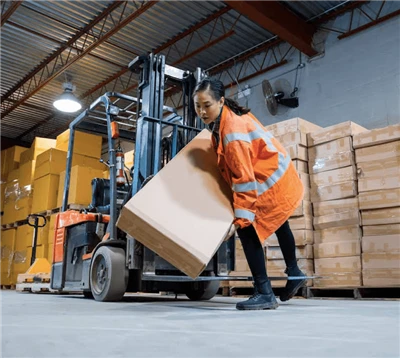
Manual palletizing is the traditional method of stacking finished goods-such as cartons, bags, or crates-onto a pallet by hand. In this setup, human operators are responsible for lifting each unit from a conveyor or floor space and arranging them in a specific pattern to ensure stability during transit.
For decades, this was the industry standard. Even in 2026, it remains a common sight in facilities with low production volumes or highly irregular product shapes. Industries such as craft glass bottling, luxury furniture, and small-batch woodworking often rely on the tactile judgment of a human worker to ensure that fragile or uniquely shaped items are handled with care.
The Advantages of the Human Touch
While automation is the trend, manual labor persists because it offers several distinct benefits that are difficult for machines to replicate without significant investment.
- Unrivaled Flexibility: A human worker does not need to be "reprogrammed" to handle a new box size. If a shipment of oversized displays arrives, the worker simply adjusts their grip and placement instantly.
- Minimal Upfront Capital: For a startup or a small business, the "equipment" required for manual palletizing is essentially a pallet jack and a pair of safety gloves. This low barrier to entry allows companies to preserve cash flow during their early growth phases.
- Ease of Integration: You can implement manual palletizing in an afternoon. There is no software to install, no safety cages to bolt down, and no specialized electrical requirements. It fits into any existing floor plan immediately.
The Growing Challenges of Manual Labor
Despite its flexibility, manual labor carries inherent risks and limitations that can cripple a growing business.
- The Ergonomic Crisis: Palletizing is one of the most physically demanding jobs in a warehouse. Constant bending, lifting, and twisting lead to high rates of Musculoskeletal Disorders (MSDs). This results in expensive worker compensation claims and a high turnover rate, as few employees want to perform such grueling tasks long-term.
- Inconsistency and Instability: Humans are prone to fatigue. A pallet stacked at the end of a double shift is rarely as neat or stable as one stacked in the morning. These inconsistencies can lead to "product lean," causing collapses in high-bay racking or damage during ocean freight.
- Scalability Roadblocks: You cannot simply tell a human to move 30% faster to meet a holiday rush. To scale a manual operation, you must hire, train, and manage more people, which increases your administrative overhead and physical footprint.

What is Robotic Palletizing?
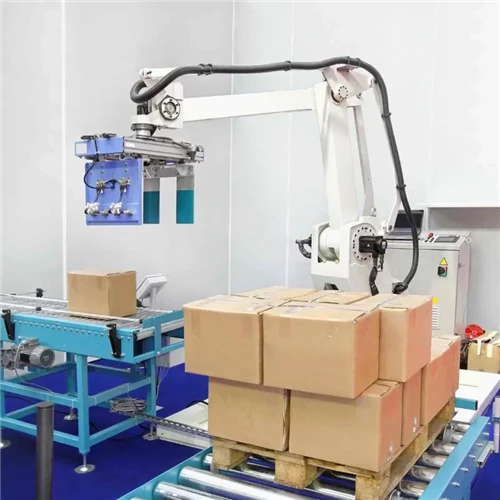
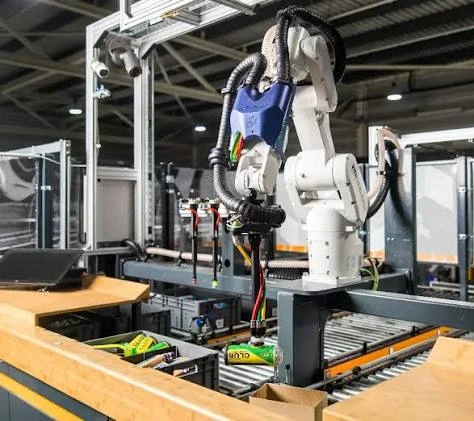
Robotic palletizing represents the modern evolution of the automatic box palletizer. These systems utilize a multi-axis robotic arm-often equipped with sensors, vacuum grippers, or mechanical clamps-to pick up products from a conveyor and place them onto a pallet.
Unlike conventional machines, a robotic automatic case palletizer is driven by software and Programmable Logic Controllers (PLCs). This allows the robot to handle complex tasks, such as creating precise gaps for ventilation or picking multiple units at once. These systems are the gold standard for industries requiring high precision and 24/7 reliability, such as the automotive, pharmaceutical, and food sectors.
Advantages of Robotic Palletizing
Modern palletizers offer a level of discipline that manual labor simply cannot replicate.
- Increased Efficiency: These machines work continuously without breaks, lunches, or sick days. This provides a fixed, predictable throughput that allows you to calculate your daily output to the single unit.
- Enhanced Precision: Robots consistently stack items with millimeter-level precision. This creates "perfectly square" pallets that maximize space in shipping containers and perform flawlessly in automated high-bay warehouses.
- Reduced Labor Costs: Once you install an automatic box palletizer, you significantly reduce your dependency on a fluctuating labor market. The machine pays for itself through the elimination of multiple-shift wages.
- Improved Safety: By automating the most grueling part of the job, you remove workers from the "danger zone" of heavy lifting, virtually eliminating repetitive strain injuries (RSIs).
Challenges of Robotic Palletizing
Even though automation can boost efficiency, there are specific challenges that managers must prepare for.
- High Initial Investment: The upfront costs are substantial. You are not just buying a machine; you are investing in software, hardware, and safety infrastructure like light curtains and interlocked fencing.
- Complex Setup: These systems require professional programming and integration to ensure they communicate correctly with your existing upstream conveyors and downstream stretch wrappers.
- Technical Dependency: If the system is not maintained, a breakdown can halt production. You trade the need for "muscle" for the need for "technical skill," requiring your staff to be trained in basic robot operation.

Key Considerations for Your Choice
Before choosing between manual and robotic palletizers, you must audit your specific operational needs:
1. Production Volume: If you process fewer than 5–10 cases per minute, manual may suffice. If you exceed this, an automatic case palletizer is usually necessary to maintain flow.
2. Cost Considerations: Contrast the high initial CapEx of a robot against the high ongoing OpEx of manual labor. Most automated systems see a Return on Investment (ROI) within 18 to 24 months.
3. Space and Layout: Robotic systems are compact but require a dedicated "safety zone." Manual systems are more fluid but require more "walking room" for staff and pallet jacks.
4. Labor Availability: If you struggle with high turnover or labor shortages, an automatic box palletizer ensures your business remains operational regardless of the hiring market.
Manual vs. Robotic Palletizer: Which One Should You Choose?
The final decision comes down to your unique business stage:
-
Choose Manual Palletizing if: You are a small business with limited capital, low production volume (less than 300 boxes per hour), or handle highly irregular products that require human judgment.
-
Choose Robotic Palletizing if: You run high-volume, multi-shift operations and need to reduce labor costs. It is the best choice for those seeking high-density, stable pallets and long-term scalability.
-
Choose Hybrid or Cobot if: You are a mid-sized business looking for a balance between automation and flexibility without the massive footprint or complexity of a traditional industrial robot.
Whether you choose manual or robotic solutions, the goal is to bolster your logistics and improve your supply chain management. Manual palletizing may be the best starting point for smaller warehouses, but as volume grows, the transition to an automatic box palletizer or automatic case palletizer becomes a fundamental requirement for staying competitive in the modern market.