High-speed corrugated board manufacturing lines and NC transverse slitter-scorers frequently encounter severe end-of-line bottlenecks during manual or semi-automatic sheet handling. An automatic corrugated sheet downstacker resolves these production constraints by integrating synchronized multi-zone elevator platforms, variable-speed shingling conveyors, and active servo-driven squaring units. Operating without damaging vacuum suction pads or mechanical clamp jaws, modern downstackers achieve continuous stacking speeds exceeding 250 to 300 meters per minute while eliminating corner crushing, flute deformation, and ink smudging on high-graphics sheets.

1. Introduction and Industry Context
In contemporary corrugated packaging manufacturing, facility efficiency is strictly constrained by the slowest mechanical unit across the production line. Modern corrugator lines, computer-controlled transverse cutters (NC Cutters), and high-speed flexo folder-gluers are capable of producing hundreds of precision-cut sheets per minute. However, handling, decelerating, squaring, and stacking these high-velocity sheets at the outfeed represents one of the most demanding operational challenges in modern paper converting plants.
An automatic corrugated sheet downstacker is a heavy-duty, inline material handling and stacking system positioned immediately behind the transverse cutter of a corrugator line or converting machine. Its core engineering objective is to receive high-speed cut corrugated boards, safely dissipate their kinetic energy, arrange them into precise overlapping streams, square their edges into immaculate rectangular blocks, and discharge full pallet stacks onto downstream roller conveyors-all without requiring the upstream line to pause, decelerate, or interrupt continuous sheet production.
Unlike articulated industrial robots or gantry pick-and-place systems designed for handling individual folded boxes, a downstacker operates on a continuous, gravity-assisted layer-stacking principle. It is engineered to process raw, flat, unformed corrugated boards ranging from delicate micro-flutes (such as E, F, and N flutes) up to heavy-duty double-wall (5-ply) and triple-wall (7-ply) structural boards. For plant directors, operations managers, and packaging engineers, understanding the mechanical architecture, operational parameters, and long-term financial payback of automatic downstackers is essential for unlocking dormant plant capacity.
2. Operational Vulnerabilities of Manual and Conventional Stacking
Operating a high-capacity corrugated board line without an automated inline downstacker creates immediate operational vulnerabilities that degrade Overall Equipment Effectiveness (OEE), inflate raw material scrap rates, and increase labor liability.
2.1 Flute Structural Damage and Corner Crushing
When cut corrugated sheets exit an NC cross-cutter at linear speeds between 180 and 300 meters per minute, they possess substantial kinetic energy. In manual receiving setups or basic static catcher tables, incoming sheet headers slam directly into rigid mechanical backstops. This impact causes severe crushing of the leading edge, corner deformation, and localized flute collapse. Damaged board edges create severe feeding errors when sheets are subsequently processed through automatic folder-gluers or die-cutters, triggering frequent machine jams, unplanned downtime, and wasted production cycles.
2.2 Ink Smudging and Cosmetic Scrap Rates
In flexo printing and inline converting applications, the ink or protective varnish applied to the top linerboard of the corrugated sheet is often not fully dried or cured at the moment of discharge. Traditional manual handling or aggressive mechanical clamping arms exert localized pressure across the sheet surface. Friction, finger pressure, or suction cup marks slide across the wet ink, causing scuffs, smears, and visible cosmetic scratches. In high-graphics retail packaging applications, even minor surface blemishes result in rejected lots and total material scrap.
Human operators face physical limits regarding how fast they can manually lift, align, and stack heavy corrugated sheets. As sheet dimensions or line speeds increase, manual crews quickly become overwhelmed. To prevent catastrophic jams at the outfeed, plant supervisors are routinely forced to throttle down high-speed corrugators to 50% or 60% of their rated design capacity. This artificial speed limitation wastes millions of dollars in capital equipment investment and dramatically increases energy consumption per thousand square meters (MSF) of produced board.
2.4 Ergonomic Hazards and Labor Liabilities
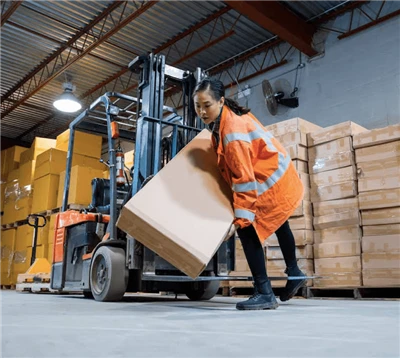
Manual sheet stacking requires workers to perform repetitive lifting, twisting, and reaching motions thousands of times per shift. Handling heavy double-wall sheets places extreme biomechanical stress on the lumbar spine and shoulders. This manual intensity leads to high worker turnover, chronic repetitive strain injuries (RSIs), elevated absenteeism, and increased workers' compensation insurance premiums.
3. Core Mechanical Architecture and Sub-Assemblies
An automatic corrugated downstacker is a multi-axis electro-mechanical system consisting of five heavily integrated sub-assemblies operating under master PLC control.
Shingling Conveyor
Alignment Unit
Stacking Platform
Conveyor System
3.1 Multi-Stage Infeed and Shingling Conveyor System
The infeed conveyor receives individual, end-to-end cut boards directly from the transverse knife. To manage high entrance velocities, the infeed is partitioned into multiple conveyor zones driven by Variable Frequency Drives (VFDs) or AC servo motors.
- Zone 1 (Gap Creation): Runs slightly faster than line speed to pull physical separation between consecutive cut boards.
- Zone 2 (Shingling/Deceleration): Runs at a fraction of line speed, causing incoming board leading edges to gently slide under preceding trailing edges, forming a continuous, overlapped "shingled" stream. This shingling effect reduces linear transport speed by up to 70% while maintaining identical mass throughput, preventing high-speed board impact.
- Vacuum Assistance: High-volume vacuum blowers beneath perforated synthetic belts hold sheets flat, preventing light-weight micro-flute boards from lifting or drifting due to aerodynamic air resistance.
3.2 Active Servo-Squaring and Alignment Unit
To build perfectly squared, brick-like pallet loads, the downstacker incorporates an active side and end squaring mechanism.
- Side Alignment Paddles: Pneumatic or servo-driven lateral plates perform continuous, gentle, high-frequency tapping against the sides of the falling board stack.
- Motorized Backstop: An adjustable, heavy-gauge steel backstop absorbs the remaining forward momentum of the shingled stream. The backstop position automatically adjusts via motor drive according to the active order sheet length programmed in the controller.
- Multi-Out Splitters: For orders running multi-out (e.g., two or three side-by-side sheet ribbons cut simultaneously across the paper width), independent lane separators and middle squaring plates extend automatically to keep adjacent stacks separated and perfectly aligned.
3.3 Scissor-Lift Elevator Stacking Platform
The foundation of the stacking zone is a heavy-duty scissor-lift platform raised and lowered by high-torque servo motors or heavy hydraulic cylinders.
- Load Capacity: Built with reinforced structural steel channels to support continuous static loads ranging from 3,000 kg to over 5,000 kg.
- Photo-Electric Height Tracking: An array of optical laser sensors monitors the precise top position of the accumulating board pile. As new sheets enter, the platform lowers incrementally in micro-steps.
- Minimal Drop Height: By keeping the distance between the discharge belt and the top of the stack under 50 mm, air entrapment between sheets is eliminated, preventing sheets from floating, sliding, or sloughing off-alignment.
3.4 High-Speed Non-Stop Intercept Apron (Catch Grid)
To enable uninterrupted continuous production during stack discharge or order changes, the downstacker employs a pneumatic or servo-actuated intercept apron (also called catch fingers or temporary receiver grid).
- When a stack reaches its target height or sheet count, the catch fingers extend horizontally in under 0.5 seconds into the stacking chamber.
- Incoming shingled sheets accumulate on top of the intercept apron while the main scissor platform rapidly descends to floor level, ejects the finished stack onto the outfeed line, and rises back up to accept the growing pile.
- The catch fingers then retract, seamlessly transferring the temporary pile onto the main elevator platform without reducing corrugator operating speed for a single second.
3.5 Powered Outfeed Roller and Chain Conveyors
Once the elevator reaches its lowest position, integrated motorized chain or heavy-duty steel roller conveyors drive the completed stack horizontally out of the stacking cell. The load is seamlessly transferred to peripheral transport systems heading toward automatic strapping, stretch wrapping, or warehouse staging areas.

4. Downstacker vs. Robotic Arm Palletizer: Technical Comparison
Plant engineering teams frequently evaluate the functional differences between an inline automatic downstacker and an articulated robotic arm palletizer. While both systems automate material handling, they serve entirely different positions and functional roles within a corrugated converting facility.
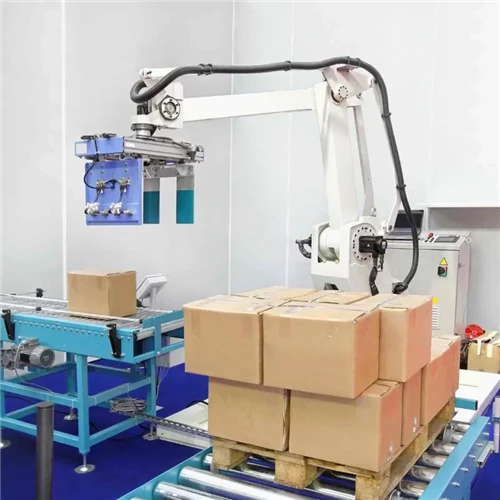
While an automatic downstacker is engineered specifically for handling raw, flat corrugated sheets directly behind the corrugator or cutter, facilities processing packed, finished RSC boxes downstream often deploy dedicated automatic robotic palletizers at the end of their folding and gluing lines.
| Engineering Parameter | Inline Automatic Downstacker | Articulated Robotic Arm Palletizer | Strategic Manufacturing Impact |
| Primary Material Handled | Raw, flat, unformed corrugated sheets; multi-out paper ribbons | Sealed RSC shipping boxes, folding cartons, plastic totes | Downstacker handles raw sheet stock; Robot handles finished boxes |
| Handling Mechanism | Continuous gravity-assisted layer stack with active squaring | End-of-arm vacuum plates, mechanical side clamps, or forks | Downstacker eliminates surface clamping pressure and suction marks |
| Maximum Operating Speed | Up to 250 – 300 meters/minute (continuous stream flow) | 10 – 25 pick-and-place cycles per minute | Downstackers provide dramatically higher volumetric throughput |
| Surface Defect Risk | Zero vacuum or clamp contact; full bottom belt support | High suction or clamping forces applied directly to surfaces | Downstacker prevents ink scuffing on wet flexo-printed sheets |
| Stack Edge Precision | Active side-tapping maintains squared stacks within ±1.0 mm | Placement repeatability within ±0.2 mm to ±0.5 mm per pick | Downstacker builds perfectly square blocks for automatic gluers |
| Payload Capacity | Heavy scissor tables handle continuous loads up to 5,000 kg | End-of-arm tooling payload limited to 100 kg – 300 kg per motion | Downstacker effortlessly manages large, high-tonnage sheet loads |
| Footprint Requirement | Linear inline layout (12 to 22 meters length depending on width) | Enclosed safety cell (15 to 30 square meters) | Downstacker integrates directly in-line with cutter outfeeds |
| Maintenance Complexity | Heavy industrial VFDs, AC servos, pneumatics, hydraulics | Precision planetary gearboxes, multi-axis motion controllers | Downstackers can be serviced by standard plant maintenance staff |
5. Comprehensive Step-by-Step Operational Workflow
Understanding the precise sequence of mechanical operations illustrates how a modern downstacker achieves fault-tolerant reliability at maximum line velocity.
- Sheet Infeed & Separation: Cut sheets leave the NC cross-cutter at full line speed (up to 300 m/min). The first infeed conveyor zone accelerates slightly to pull an intentional gap between sheets.
- Shingling & Deceleration: Sheets enter the secondary deceleration zone where belt speeds decrease. The leading edge of each sheet slides smoothly under the trailing edge of the preceding sheet, forming an overlapping shingled stream.
- Vacuum Stabilization: Overhead or under-belt vacuum chambers apply negative pressure to keep lightweight or warped sheets flat and stable on the belts.
- Controlled Layer Deposition: The shingled stream glides off the delivery nose and drops gently onto the elevator platform or wooden pallet base.
- Continuous Active Squaring: Servo-driven side paddles perform continuous lateral tapping against the pile edges while the front leading edge rests against the motorized backstop, locking alignment to within ±1.0 mm.
- Height Tracking & Step-Lowering: Laser photo-sensors continuously measure stack buildup, triggering the elevator platform to lower in smooth micro-increments to preserve a constant drop height (<50 mm).
- Stack Completion Trigger: Upon reaching the programmed sheet count or stack height limit (e.g., 1800 mm), the master PLC initiates the automatic order-change sequence.
- Catch Finger Insertion: High-speed pneumatic intercept fingers shoot forward under the infeed nose in under 0.5 seconds, catching incoming sheets without pausing the corrugator line.
- Rapid Stack Discharge: The main elevator descends rapidly to ground level at 0.25 m/s. Integrated roller beds activate, driving the finished stack onto the outfeed transport conveyor in under 6 seconds.
- Platform Reset & Cycle Resume: The elevator platform ascends at high speed, engages the underside of the temporary stack held by the catch fingers, and lifts it slightly. The catch fingers retract, restoring normal elevator stacking operation.
6. Engineering Specifications and Selection Parameters
When specifying an automatic downstacker for a corrugated plant upgrade or greenfield installation, engineering teams must evaluate several critical parameters to match machine capabilities with facility demands:
6.1 Working Width (Machine Format)
The machine width must match or exceed the maximum trim width of the upstream corrugator. Common standard widths include:
- 1800 mm (70 inches) & 2200 mm (86 inches): Standard sizes for medium-width converting lines and specialty micro-flute corrugators.
- 2500 mm (98 inches) & 2800 mm (110 inches): Heavy-duty formats for high-volume containerboard manufacturing plants.
- 3300 mm (130 inches): Ultra-wide formats designed for jumbo corrugators producing large-format industrial packaging sheets.
6.2 Multi-Out Stacking Capabilities
Modern corrugators regularly run multiple order widths across a single paper web. A high-performance downstacker must feature independent multi-lane squaring dividers (capable of 2-out, 3-out, or 4-out stacking) with motorized transverse positioning to handle split sheet flows simultaneously.
6.3 Elevator Drive Architecture: Hydraulic vs. All-Servo Drive
- Hydraulic Scissor Lift: Utilizes heavy hydraulic cylinders and fluid power units. Provides immense load-lifting capacity at lower initial capital cost, but requires ongoing fluid maintenance, oil leak containment, and temperature monitoring.
- All-Servo Mechanical Drive: Utilizes heavy-duty timing belts or lifting chains driven by precision AC servo motors. Delivers zero risk of oil contamination (critical for food-grade packaging facilities), consumes up to 35% less electrical power, and offers superior positioning accuracy.

7. Financial Justification and 5-Year Total Cost of Ownership (TCO) Model
To justify the capital expenditure (CapEx) for an automatic downstacker, plant management must construct a detailed financial model reflecting direct labor savings, scrap reduction, and expanded line throughput.
7.1 Baseline Plant Assumptions
- Operational Schedule: 2 shifts per day, 5 days per week, 50 weeks per year (4,000 operational hours/year).
- Current Bottleneck Speed: Corrugator speed capped at 130 meters/minute due to manual offloading constraints.
- Post-Automation Speed: Line speed increased to 220 meters/minute with an inline downstacker.
- Manual Staffing: 3 manual offloading operators per shift (6 operators total across 2 shifts) at a fully burdened labor cost of $30.00/hour per operator.
7.2 Financial Impact Breakdown
Direct Labor Reduction:
-
An automatic downstacker requires only 0.5 operator equivalent per shift (a single supervisor monitoring two adjacent automated lines).
-
Annual Hours Saved: 5 operators x 2,000 hours/year = 10,000 direct labor hours saved annually.
-
Annual Direct Labor Savings: 10,000 hours x $30.00/hour = $300,000 / year.
Material Scrap and Defect Reduction:
-
Eliminating edge crush and ink smudging reduces plant sheet scrap rates from 2.5% down to 0.5%.
-
For a corrugator facility generating $5,000,000 in annual raw material output, a 2.0% waste reduction yields $100,000 / year in saved linerboard and medium costs.
Capacity Expansion Value:
-
Increasing line speed from 130 m/min to 220 m/min represents a 69% increase in total square meter output without increasing factory footprint or adding primary equipment.
5-Year Total Cost of Ownership (TCO) Comparison
|
Financial Category |
Manual Stacking Operation (5-Year Total) |
Automatic Downstacker System (5-Year Total) |
|
Initial Capital Investment (CapEx) |
$15,000 (Basic Catcher Tables) |
$260,000 (Turnkey Machine & Infeed) |
|
Direct Labor Costs (4% Annual Inflation) |
$1,950,000 |
$325,000 (Allocated Monitoring) |
|
Material Scrap & Defect Costs |
$625,000 |
$125,000 |
|
Preventive Maintenance & Spare Parts |
$20,000 |
$45,000 |
|
Electrical Energy Consumption |
$10,000 |
$30,000 |
|
5-Year Total Cost of Ownership (TCO) |
$2,620,000 |
$785,000 |
Payback Period Calculation:
-
Turnkey System CapEx: $260,000
-
Annual Net Operating Savings: $300,000 (Labor) + $100,000 (Scrap) - $9,000 (Maintenance/Energy Difference) = $391,000 / year
-
Simple Payback Period: $260,000 / $391,000 = 0.66 Years (approx. 8.0 Months)
8. Industry 4.0 Integration, Safety Standards, and Maintenance
Achieving long-term operational reliability requires integrating the downstacker into the plant's digital ecosystem while maintaining strict safety and maintenance protocols:
8.1 Industrial Control Systems and MES Communication
Modern downstackers operate as intelligent nodes on the factory network.
- Fieldbus Protocols: Communicates via PROFINET, EtherNet/IP, or EtherCAT with upstream NC knives and corrugator main controllers to instantly synchronize belt speeds during line acceleration and deceleration.
- Automatic Order Setup: Integrates directly with the plant's Manufacturing Execution System (MES) or ERP software. When a new job starts, target stack heights, sheet dimensions, multi-out lane configurations, and order quantities download automatically, eliminating manual operator setup errors.
- End-of-Line Integration: While the inline downstacker handles high-speed sheet stacking directly behind the corrugator knife, plant managers aiming for complete facility automation can pair this process with downstream robotic carton palletizing systems at final box packaging stations.
8.2 Safety Compliance (CE / OSHA Standards)
Because downstackers involve heavy moving elevator platforms and high-speed mechanical components, strict safety systems are mandatory:
- Safety Light Curtains: Multi-beam optical light curtains surround the stack discharge area, automatically pausing machine motion if a human operator breaks the perimeter.
- Mechanical Safety Interlocks: Dual heavy-duty safety latches lock the scissor-lift platform mechanically whenever maintenance personnel enter beneath the elevator frame.
- E-Stop Integration: Emergency stop circuits are hardwired into the master safety relay loop across the entire corrugator line.
8.3 Structured Preventive Maintenance Schedule
A rigorous preventive maintenance plan prevents unexpected downtime and extends machinery service life:
- Daily Inspection (Operator Level): Clean dust and paper debris off optical height sensors and laser reflector plates using compressed air. Inspect pneumatic pressure regulators and oil-water separators.
- Weekly Maintenance: Check tension, tracking, and surface wear on shingling belts and vacuum suction belts. Blow out dust accumulation inside side-squaring mechanism linear rails.
- Monthly Maintenance: Apply high-performance grease to elevator drive chains, scissor-lift pivot bushings, and main bearing blocks. Inspect hydraulic fluid levels, hose connections, and filter indicators (for hydraulic models).
- Quarterly/Annual Audit: Perform a complete PLC project backup. Check calibration on all servo encoder axes, measure brake wear on elevator motors, and verify proper operation of all safety interlocks and light curtains.
Upgrading to an automatic corrugated sheet downstacker transforms a severe material handling bottleneck into a highly automated, high-output operational asset. By preserving sheet structural integrity, protecting printed surfaces, and maintaining continuous production speeds during order changes, modern downstackers deliver unmatched production output and rapid capital payback for modern corrugated converting operations.