In modern FMCG, corrugated box converting, and food and beverage manufacturing, end-of-line packaging lines represent the final critical link in operational efficiency. While high-speed fillers, folder-gluers, and case sealers can output thousands of containers per hour, handling, layer-forming, and stacking those finished cartons onto pallets often creates a major operational bottleneck. Plant managers and packaging automation engineers evaluating facility upgrades must choose between two dominant technological architectures: Articulated Robotic Arm Palletizers and High-Level (Layer/Conventional) Mechanical Palletizers.
Deploying an industrial palletizing robot allows facilities to handle complex multi-line setups with high spatial flexibility, whereas high-level mechanical palletizers offer sheer volumetric speed on dedicated single-SKU lines. Partnering with an established robot automatic palletizing machine manufacturer ensures that plant layout constraints, payload requirements, and downstream logistics are properly aligned. This engineering guide provides a detailed technical comparison, operational breakdown, and Total Cost of Ownership (TCO) analysis to assist packaging teams in selecting the optimal end-of-line solution.

1. Architectural Overview of End-of-Line Automation
Automated palletizing involves receiving singular, sealed corrugated shipping cartons or secondary packages from an inline conveyor, orienting them into pre-programmed pattern layers, and building stable pallet stacks for warehousing or transportation.
Articulated Robotic Palletizer
- Pick-and-Place Kinematics
- Servo End-of-Arm Tooling (EOAT)
- Compact, Multi-Line Flexibility
High-Level Mechanical Palletizer
- High-Speed Infeed Elevator
- Pattern-Forming Layer Table
- Continuous Apron Drop System
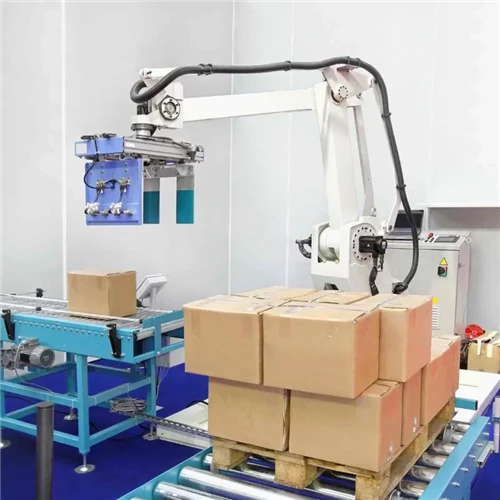
An articulated robotic palletizer utilizes a 4-axis or 6-axis mechanical arm powered by AC servo motors. The robot is typically mounted in a stationary position or on a linear transfer track inside a safety-fenced cell. At the core of a modern fully automatic robot palletizing system is the end-of-arm tooling (EOAT), which uses vacuum foam plates, mechanical side-clamps, or bottom-support forks to pick up individual cartons or entire rows and deposit them onto a pallet.
Beyond rigid corrugated boxes, many articulated arms can be dual-purposed or reconfigured as an automatic robot bag palletizing machine when handling bulk sacks, flexible pouches, or corrugated totes alongside cartons. This multi-material versatility makes robotic systems the preferred choice for co-packers and flexible manufacturing environments.
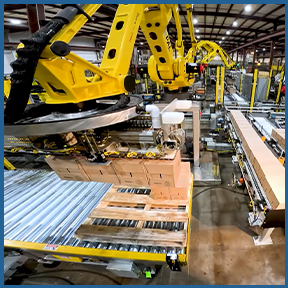
A high-level (or upper-infeed) conventional mechanical palletizer operates on a continuous layer-building principle. Cartons are elevated to an upper deck (typically 2.5 to 3.5 meters above floor level), where turning devices and pop-up dividers arrange them into a complete layer. Once a layer pattern is formed, a wide sweep plate pushes the entire layer onto a two-piece apron table. The apron opens over the pallet chamber, dropping the complete layer onto the waiting pallet below before retracting.
2. Deep-Dive: Articulated Robotic Arm Systems
Articulated robotic palletizers have revolutionized material handling due to their programmable motion profiles and compact physical footprint.
Kinematics and Motion Profile
The performance of a fully automatic robot palletizing system depends heavily on its EOAT design:
-
Vacuum Grippers: Utilize high-flow vacuum blowers or multi-zone Piab suction cups. Ideal for closed, rigid top flaps on corrugated boxes.
-
Mechanical Clamp Grippers: Apply controlled lateral pressure to securely hold heavy cartons or unsealed boxes from the sides.
-
Fork-Style Bottom-Support Grippers: Slide mechanical fingers beneath the carton or bag load. Essential for heavy products or fragile packaging where top-suction is impossible.
Because grippers can be engineered for quick-change tool attachments, a facility can run rigid RSC shipping boxes on Shift 1 and then retool the arm to function as an automatic robot bag palletizing machine on Shift 2 for bulk powdered ingredients or flexible packaging.
Multi-Line Handling Capability
One of the distinct structural advantages of an articulated arm is multi-line servicing. A single robot situated at the junction of two or three independent conveyor lines can pick cartons from Line A, Line B, and Line C simultaneously, building three distinct pallets with different layer patterns inside a single safety cell.

3. Deep-Dive: High-Level Mechanical Palletizers
High-level conventional palletizers remain the benchmark for continuous, ultra-high-volume manufacturing lines where single-SKU speed is paramount.
Layer-Forming Mechanism
Unlike pick-and-place robots, high-level mechanical machines receive cartons in a continuous stream at high elevation.
- Infeed and Metering: Cartons pass through inline spacing belts that create precise gaps between units.
- Orientation: Electronic bump turners or high-speed turning pegs rotate cartons 90° or 180° on the fly according to the programmed layer recipe.
- Pattern Sweeping: Servo-driven pusher bars slide rows of cartons onto a polished steel layer-forming table.
- Compressor Squaring: Mechanical side plates and backstops compress the formed layer from all four sides, ensuring extremely tight, square layer blocks before discharge.
Throughput Capabilities
Because high-level mechanical machines move entire layers simultaneously rather than individual boxes, their output speed is dictated by layer cycles rather than item counts. High-speed models easily achieve throughputs exceeding 100 to 180 cartons per minute (or 6 to 10 full layers per minute), far exceeding the single-pick limits of standard articulated arms.
4. Head-to-Head Technical Comparison
Selecting between these two technologies requires evaluating key engineering parameters against plant operational targets.
| Engineering Metric | Articulated Robotic Palletizer | High-Level Mechanical Palletizer | Strategic Manufacturing Impact |
|---|---|---|---|
| Maximum Throughput | 10 – 30 CPM (single pick); up to 60 CPM (multi-pick) | 60 – 180+ CPM (continuous layer stream) | Mechanical systems dominate ultra-high-speed single lines |
| Operational Flexibility | High (handles multi-SKU, multi-line, complex patterns) | Low (designed for dedicated, single-line high-volume output) | Robots offer superior agility for contract packagers |
| Footprint Requirements | Compact (15 – 25 m2 per cell) | Large (40 – 80 m2 including upper catwalks) | Robots fit easily into tight, low-ceiling plant spaces |
| Infeed Elevation | Low-level floor infeed (0.8 m – 1.2 m) | High-level upper infeed (2.5 m – 3.8 m) | Mechanical systems require vertical incline conveyors |
| Tooling Versatility | Handles cartons, trays, crates, bags, and pails | Strictly limited to rigid rectangular cartons and trays | Dual-use flexibility favors the industrial palletizing robot |
| Changeover Time | Instantaneous via HMI recipe selection (<1 minute) | Mechanical guide and pusher adjustments (5 – 15 minutes) | Robotic systems maximize uptime during frequent SKU shifts |
| Layer Squaring Quality | Relies on precise EOAT placement accuracy | Active 4-side mechanical layer compaction plates | Mechanical systems build flatter, squarer bulk pallet stacks |
Integrating a fully automatic robot palletizing system offers unparalleled adaptability, whereas high-level mechanical machines deliver unmatched sheer volumetric capacity. Unlike specialized machinery designed purely for boxes, a unit equipped as an automatic robot bag palletizing machine accommodates varying product geometries, making it a resilient long-term capital investment when product lines evolve over time.
5. Total Cost of Ownership (TCO) and Financial ROI
Evaluating capital equipment requires analyzing both upfront capital expenditure (CapEx) and 5-to-10-year operating expenditure (OpEx).
5-Year Total Cost of Ownership (TCO) Breakdown
- Initial Machinery Purchase
- Facility Integration & Safety Fencing
- Freight & System Commissioning
- Electrical Energy Consumption
- Preventive Maintenance & Wear Parts
- After-Sales Technical Support & Spare Parts
- Labor Allocation (Operator Supervision)
Capital Investment (CapEx)
- Robotic Cell: Lower initial machine cost for a single-line robotic cell ($150,000 – $280,000 turnkey). However, adding multi-pick grippers, complex conveyor junctioning, or track systems can increase investment.
- High-Level Mechanical: Higher initial machine cost ($300,000 – $550,000+ turnkey) due to heavy structural steel framing, overhead catwalks, complex pattern tables, and integrated high-level infeed elevators.
Operating Expenditure (OpEx)
- Energy Efficiency: A 4-axis industrial palletizing robot consumes significantly less electrical power (typically 8 kW to 15 kW) compared to a heavy mechanical palletizer with multiple large gearmotors, blowers, and pneumatic actuators (consuming 25 kW to 45 kW).
- Mechanical Wear: High-level machines feature hundreds of moving parts, including chains, sprockets, turn-pegs, layer plates, and pneumatic cylinders, requiring routine lubrication and replacement. Robotic arms feature sealed gearboxes requiring fluid changes only every 10,000 to 20,000 operating hours, keeping overall maintenance overhead minimal.
- After-Sales Service and Support: Working with a certified robot automatic palletizing machine manufacturer guarantees access to comprehensive after-sales service, spare parts inventory, remote PLC diagnostics, and routine maintenance support, safeguarding plant operations against extended downtime.
6. Step-by-Step Decision Framework
To determine the correct technology for your packaging facility, apply the following step-by-step decision tree:
Step 1: Evaluate Line Speed Demands
- If Line Speed < 30 Cartons/Minute: An industrial palletizing robot is the most cost-effective, space-saving solution.
- If Line Speed = 30 to 50 Cartons/Minute: Evaluate carton dimensions and picking patterns. A robot with a multi-case vacuum gripper (picking 2 or 3 boxes at once) can handle this range efficiently.
- If Line Speed > 60 Cartons/Minute on a single dedicated line: A High-Level Mechanical Palletizer is required to match continuous line output without risking bottlenecks.
Step 2: Assess Packaging Diversity
Facilities running mixed-packaging lines that include both rigid shipping boxes and flexible bags benefit from an automatic robot bag palletizing machine due to its ability to swap gripper profiles electronically. Mechanical layer palletizers cannot handle loose, shifting bags or irregular soft packages.
Step 3: Analyze Floor Space and Ceiling Constraints
- Low Ceiling Height (< 4.5 meters) or Compact Floor Area: A robotic cell has a small footprint and operates at standard floor-level conveyor heights.
- High Overhead Clearance & Ample Floor Space: A high-level mechanical machine takes advantage of vertical height, elevating conveyors above forklift traffic aisles.
Step 4: Determine Multi-Line Infeed Potential
If your plant operates two or three parallel packaging lines running at moderate speeds, installing a single fully automatic robot palletizing system positioned between the lines eliminates the need for three separate machines, delivering a dramatic reduction in capital expenditure.
Selecting between an articulated robotic arm and a high-level mechanical palletizer comes down to balancing line speed against layout flexibility. High-level mechanical systems remain unmatched for single-product, high-volume production lines where maximum speed is mandatory. Conversely, robotic palletizers deliver high versatility, minimal maintenance, lower energy usage, and seamless multi-line handling. Consulting with an experienced robot automatic palletizing machine manufacturer helps balance CapEx against long-term operational goals, ensuring your end-of-line packaging automation achieves maximum uptime, stack stability, and financial return.