I. Introduction
Choosing between a fully automatic and a semi‑automatic folder gluer is one of the most consequential investment decisions a corrugated box plant can make. The wrong choice can lock you into high labor costs, slow changeovers, and missed growth opportunities for years. The right choice can cut per‑box costs by 35–40% and deliver full payback in under two years.
This guide provides a data‑driven comparison of the two automation levels. We will examine initial investment, labor requirements, speed, changeover time, energy consumption, waste, and total cost of ownership. By the end, you will have a clear framework to decide which configuration delivers the strongest ROI for your specific production profile.
For a fundamental introduction to folder gluers, read our guide: 《What Is a Flexo Folder Gluer?》.
II. Understanding the Core Differences
Before comparing ROI, it is essential to understand how these two machine types operate.
Semi‑Automatic Folder Gluer
A semi‑automatic folder gluer requires manual feeding. An operator places each box blank onto the feed table, and the machine handles folding, gluing, and sometimes squaring. The operator also monitors quality and removes finished boxes. This configuration is common in smaller shops or as a backup line for larger plants.
Key characteristics:
- Manual feeding with automated gluing and folding
- Operator involvement throughout the production cycle
- Lower upfront capital investment
- Greater flexibility for short runs and frequent design changes
Fully Automatic Folder Gluer
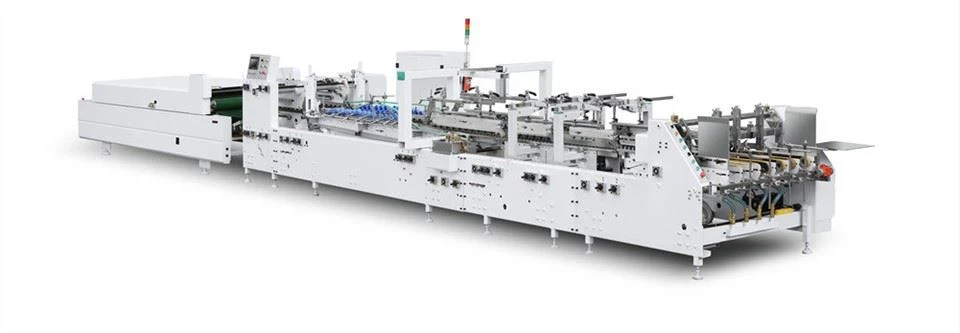
A fully automatic folder gluer integrates a feeder system that automatically separates, aligns, and feeds box blanks. Operators monitor the machine but do not physically feed each piece. The entire process-from feeding to folding to gluing to stacking-runs continuously with minimal intervention.
Key characteristics:
- Fully automated workflow from sheet feeding to final box output
- Minimal human intervention, maximizing production efficiency
- Higher upfront investment but significantly lower operating costs
- Consistent quality across all shifts, independent of operator skill
For a detailed classification of folder gluer types by mechanism and speed, read more: 《Types of Folder Gluer Machines: Straight‑Line, Crash‑Lock, Rotary, and High‑Speed Models Explained》.
III. Initial Investment Comparison
The most obvious difference between the two configurations is the purchase price. However, focusing only on this number is a mistake-the real value of automation is found in the ongoing costs it eliminates.
Semi‑Automatic Investment Range
| Configuration | Typical Price Range (USD) | What's Included |
|---|---|---|
| Entry‑level semi‑automatic | $5,000 – $20,000 | Basic folding and gluing, manual feeding |
| Mid‑range semi‑automatic | $20,000 – $50,000 | Digital readouts, some motorized adjustments |
| High‑end semi‑automatic | $50,000 – $120,000 | Enhanced ergonomics, improved quick‑change systems |
Source: Industry data indicates entry‑level semi‑automatic carton folder gluers are typically priced between $5,000 and $20,000, suitable for small businesses or startups with limited production requirements. Mid‑range models range from $20,000 to $50,000, while high‑end semi‑automatic machines with advanced features can reach $50,000–$120,000.
Fully Automatic Investment Range
| Configuration | Typical Price Range (USD) | What's Included |
|---|---|---|
| Entry‑level fully automatic | $150,000 – $250,000 | Automatic feeder, basic CNC controls |
| Mid‑range fully automatic | $250,000 – $400,000 | Full servo drives, job memory, auto‑register |
| High‑speed fully automatic | $400,000 – $500,000+ | Rotary folding, integrated stacker, Industry 4.0 connectivity |
Source: Fully automatic folder gluers typically cost 2–3 times more than semi‑automatic models, ranging from $250,000 to $500,000 for modern automated systems. According to a 2025 cost comparison analysis, automated folder gluers cost $250,000–$500,000 versus $50,000–$120,000 for semi‑automatic machines.

IV. Side‑by‑Side Operational Comparison
The table below summarizes the typical differences between semi‑automatic and fully automatic folder gluers based on current industry data.
| Factor | Semi‑Automatic | Fully Automatic |
|---|---|---|
| Feeding method | Manual, operator places each blank | Automatic feeder with vacuum or belt |
| Operating speed | 80–200 boxes/minute | 300–600 boxes/minute |
| Setup time | 20–40 minutes (manual adjustments) | 5–15 minutes (CNC‑automated adjustments) |
| Operators required | 1 per machine | 1 operator can manage 2–3 machines |
| Labor cost reduction vs. semi‑auto | Baseline | 40–60% lower |
| Energy consumption (kWh/10k boxes) | 25–30 kWh | 18–22 kWh (15–20% less) |
| Glue waste | Higher (manual application variability) | 25–30% less (precision vision systems) |
| Maintenance cost/year | $3,000 – $5,000 | $8,000 – $12,000 |
| Changeover time | 20–40 minutes | 5–15 minutes |
| Quality consistency | Operator‑dependent | Consistent, vision‑verified |
Source: Speed data indicates semi‑automatic machines operate at 80–200 boxes/minute while fully automatic machines reach 300–600 boxes/minute. Setup time for semi‑automatic is 20–40 minutes versus 5–15 minutes for fully automatic. Fully automatic machines reduce labor costs by 40–60% and consume 15–20% less power. Maintenance costs for fully automatic are $8,000–$12,000 per year compared to $3,000–$5,000 for semi‑automatic.

V. The Real‑World Impact: Production Volume Scenarios
The ROI calculation changes dramatically based on your daily production volume and shift structure.
Scenario 1: Low‑Volume Operation (Under 20,000 boxes/day)
For plants running less than 20,000 boxes per day, semi‑automatic machines may be preferable. These operations typically have:
- Space constraints for large automatic feeder systems
- Frequent design changes requiring manual adjustments
- Lower labor costs in their region
- Seasonal or fluctuating demand
Source: Industry analysis confirms that for mid‑to‑low volume operations under 20,000 boxes per day, semi‑automatic models may be preferable, particularly for smaller facilities with space constraints and frequent design changes.
Scenario 2: Medium‑Volume Operation (20,000–50,000 boxes/day)
This is the transition zone. Plants at the lower end may still find semi‑automatic acceptable, but as volume approaches 50,000 boxes per day, the labor savings and speed advantages of fully automatic become compelling.
Key consideration: If you run more than 3–4 changeovers per shift, the faster changeover time of a fully automatic machine (5–15 minutes vs. 20–40 minutes) alone can justify the upgrade.
Scenario 3: High‑Volume Operation (50,000+ boxes/day)
For high‑volume operations exceeding 50,000 boxes per day, fully automatic folder gluers dominate. These plants achieve:
- Faster ROI (12–18 months vs. 24–36 months for semi‑automatic)
- Consistent quality meeting e‑commerce standards
- Easier integration with smart factory systems
- 24/7 operation capability
Source: For high‑volume operations above 50,000 boxes per day, automated gluers dominate with faster ROI of 12–18 months compared to 24–36 months for semi‑automatic models.

VI. The 5‑Year Total Cost of Ownership (TCO) Model
The most accurate way to compare these two options is through a 5‑year TCO analysis that includes capital cost, labor, energy, maintenance, waste, and downtime.
TCO Assumptions (Mid‑Sized Plant Example)
- Operating schedule: 2 shifts per day, 240 days per year
- Production volume: 30,000 boxes per day (7.2 million boxes annually)
- Labor rate (fully burdened): $35/hour
- Energy rate: $0.12/kWh
- Glue cost: $0.003 per box
- Box value: $0.50
5‑Year TCO Calculation
| Cost Category | Semi‑Automatic | Fully Automatic | Difference (Auto Advantage) |
|---|---|---|---|
| Initial capital | $80,000 | $350,000 | –$270,000 |
| Labor (5 years) | $840,000 (2 operators × 2 shifts × 240 days × $35/hr × 8hr × 5 years = $268,800 × 5) | $420,000 (1 operator × 2 shifts × 240 days × $35/hr × 8hr × 5 years = $134,400 × 5) | +$420,000 |
| Energy (5 years) | $31,104 | $20,736 | +$10,368 |
| Maintenance (5 years) | $20,000 | $50,000 | –$30,000 |
| Glue waste (5 years) | $86,400 (10% higher waste: 7.2M × $0.003 × 1.1 × 5) | $108,000 (7.2M × $0.003 × 5) | –$21,600 |
| Total 5‑Year TCO | $1,057,504 | $948,736 | +$108,768 |
Key insight: Despite costing $270,000 more upfront, the fully automatic folder gluer delivers $108,768 lower total cost over five years - and the gap widens further with higher volumes or additional shifts.
Source: The 35‑40% lower per‑unit cost for automated systems at volumes above 5 million boxes annually is documented in a 2025 cost comparison analysis. The 1 operator can manage 2‑3 machines statistic is from an automated vs. semi‑automatic comparison. Energy savings of 15‑20% and glue waste reduction of 25‑30% are cited in the same source.

VII. ROI Calculation: How to Build Your Business Case
Step 1: Calculate Annual Labor Savings
Step 2: Calculate Annual Energy Savings
Step 3: Calculate Annual Waste Savings (Glue)
Step 4: Calculate Annual Maintenance Cost Difference
Step 5: Calculate Total Annual Net Savings
Step 6: Calculate Payback Period

VIII. Factors That Accelerate or Delay ROI
Factors That Shorten Payback Period
| Factor | Impact |
|---|---|
| Three‑shift operation | Fully automatic runs continuously, displacing more labor hours |
| High labor cost region | Higher wages mean faster labor savings payback |
| Frequent changeovers (6+ per shift) | Faster CNC changeover saves 20–35 minutes per change |
| Existing upstream automation | Removing the folder gluer bottleneck unlocks upstream capacity |
| High waste from manual gluing | Vision‑guided precision glue savings compound quickly |
Factors That Lengthen Payback Period
| Factor | Impact |
|---|---|
| Single‑shift operation | Fewer labor hours to replace |
| Very low production volume (<10,000 boxes/day) | May not justify capital investment |
| Low labor cost region | Labor savings are less significant |
| Limited in‑house technical support | Higher reliance on external service |
The same ROI framework applies to end‑of‑line palletizing equipment. Read more: 《Robotic Palletizer ROI Guide 2026》.

IX. Real‑World ROI Case Study
Company: Mid‑sized corrugated box plant in the Midwestern United States
Previous setup: Two semi‑automatic folder gluers, 2 operators per shift, 2 shifts
New setup: One fully automatic CNC folder gluer, 1 operator per shift
| Metric | Before | After | Change |
|---|---|---|---|
| Daily output | 22,000 boxes | 36,000 boxes | +64% |
| Operators per shift | 4 (across two machines) | 1 | –75% |
| Changeover time | 35 minutes | 8 minutes | –77% |
| Annual labor cost | $537,600 (4 × $35 × 16 × 240) | $134,400 (1 × $35 × 16 × 240) | –$403,200 |
| Annual glue waste | $28,600 | $19,800 | –$8,800 |
| Total annual savings | - | - | $412,000 |
Investment: $380,000 (fully automatic folder gluer)
Payback period: 11 months
This real‑world example demonstrates that when labor savings, waste reduction, and throughput gains are all captured, the payback period can be substantially shorter than the 2‑year estimate in our model.
X. Common ROI Calculation Mistakes to Avoid
| Mistake | Why It Is Costly |
|---|---|
| Counting only labor substitution | Ignores waste reduction, energy savings, and throughput gains-typically 40–60% of total savings |
| Using peak speed instead of sustained speed | Overestimates actual production capacity |
| Ignoring changeover time savings | For high‑mix plants, changeover savings often exceed running speed savings |
| Underestimating installation and training costs | These can add 10–15% to total investment |
| Overlooking the cost of doing nothing | Rising labor costs and competition will erode margins regardless |
For a detailed framework to select the right automation level for your folder gluer, read more: 《Fully Automatic Folder Gluer Selection Guide: 5 Key Specs to Compare Before Buying》.

XI. Which One Should You Choose?
Choose a Semi‑Automatic Folder Gluer If:
|
Condition |
Explanation |
|---|---|
|
Daily volume under 15,000–20,000 boxes |
Fully automatic capacity would be underutilized |
|
Fewer than 3 changeovers per shift |
Changeover time savings are less critical |
|
Labor costs are low in your region |
The labor savings equation shifts |
|
Capital budget is constrained |
Semi‑automatic requires 1/4 to 1/3 the upfront investment |
|
You run highly customized, short‑run boxes |
Manual adjustments may be easier for frequent design changes |
Choose a Fully Automatic Folder Gluer If:
|
Condition |
Explanation |
|---|---|
|
Daily volume exceeds 20,000–30,000 boxes |
Fully automatic capacity is fully utilized |
|
More than 3–4 changeovers per shift |
Fast CNC changeover delivers significant time savings |
|
Labor costs are high or skilled operators are scarce |
Labor savings alone often justify the investment |
|
You serve e‑commerce or retail markets |
Consistent quality and traceability are required |
|
You plan to integrate with palletizing automation |
Fully automatic lines integrate seamlessly with robotic palletizers |
For guidance on finishing method selection beyond automation level, read: 《Folder Gluer vs. Stitching Machine: Which One Do You Need?》.
XII. Conclusion
The choice between a fully automatic and a semi‑automatic folder gluer is not about which technology is "better" in absolute terms-it is about which fits your production volume, shift structure, labor market, and growth trajectory.
| Production Profile | Recommended Configuration | Expected Payback (vs. Semi‑Auto) |
|---|---|---|
| Under 15,000 boxes/day | Semi‑automatic | Not applicable |
| 15,000–30,000 boxes/day | Transition zone-calculate TCO | 3–5 years |
| 30,000–50,000 boxes/day | Fully automatic | 2–3 years |
| Over 50,000 boxes/day | Fully automatic (high‑speed) | 12–18 months |
The data is clear: for plants running more than 20,000 boxes per day with multiple shifts, the fully automatic folder gluer delivers lower total cost of ownership, higher throughput, and faster payback despite its higher upfront price. The 40–60% labor cost reduction, 15–20% energy savings, 25–30% glue waste reduction, and 60–80% faster changeovers add up to a compelling business case.
However, for smaller operations, startups, or plants with very low labor costs, the semi‑automatic machine remains a viable and cost‑effective entry point.
Before making a decision, document your actual production volume, changeover frequency, labor costs, and waste rates. Run your own TCO calculation using the framework in this guide. And remember: the most expensive machine is not the one with the highest price-it is the one that does not fit your production profile.