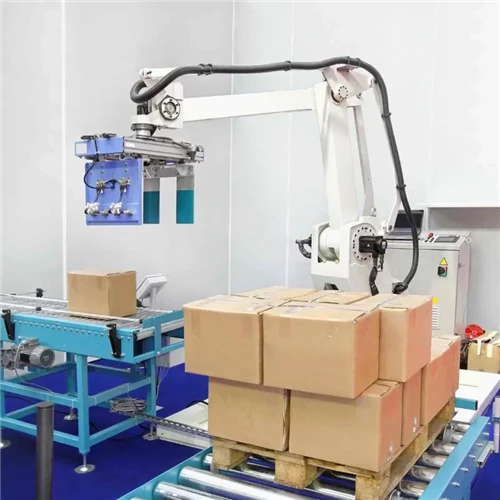
Selecting End-of-Arm Tooling (EOAT) for industrial palletizing robot installations in corrugated packaging facilities depends on bundle integrity, line speed, sheet moisture, paper porosity, and physical footprint constraints. For strapped or bundled corrugated boxes exiting high-speed converting equipment, pneumatic mechanical side-clamp grippers equipped with servo-driven bottom-support forks provide maximum structural security, high payload stability under rapid arm acceleration, and immunity to ambient paper dust. Conversely, vacuum foam-pad EOAT configurations excel in tight floor-space layouts where zero lateral clearance between incoming bundles prevents physical clamping, provided that linerboard porosity and vacuum filter maintenance are strictly controlled. In modern continuous-converting operations, hybrid combination tooling-integrating lateral clamping, bottom-support fingers, and top-press plates-serves as the industry benchmark for handling unstrapped, un-cured corrugated bundles without causing box-edge crushing or load deformation.

1. Physical Mechanics of Corrugated Bundles at End-of-Line
Designing efficient End-of-Arm Tooling (EOAT) for palletizing robot systems requires analyzing the physical properties of corrugated paperboard bundles as they exit converting machinery. Unlike rigid plastic crates, sealed wooden crates, or solid metal containers, corrugated paper bundles exhibit non-linear physical behaviors influenced by flute geometry, paper grade, bundle strapping tension, and environmental humidity.
| Bundle Variable | Physical Characteristic | Impact on End-of-Arm Tooling Performance |
| Linerboard Porosity | Air permeability of outer recycled kraft/testliner sheets. | Affects vacuum hold; highly porous recycled testliner causes vacuum pressure drop. |
| Residual Moisture | Water content from fresh starch glue joints exiting converting lines. | Lowers box stiffness and increases friction coefficients during physical clamping. |
| Strapping Condition | Tight PP/PET strapping versus loose/unstrapped bundle feeds. | Loose or unstrapped bundles require bottom support to prevent bottom-sheet sagging. |
| Edge Crush Test (ECT) | Vertical wall compression limit of the corrugated board structure. | Limits maximum lateral clamping force before sidewall crushing or creasing occurs. |
Paper Porosity and Air Leakage Factors
Corrugated linerboards-particularly recycled testliner and medium grades-possess varying levels of air permeability. When evaluating vacuum-based EOAT, air pulled through the outer linerboard sheet creates localized pressure drops across the suction interface.
If the vacuum generator cannot maintain a continuous volumetric airflow rate to compensate for paperboard porosity, the pressure differential drops below the minimum threshold required to overcome dynamic inertial forces during robot arm rotation.
Bundle Distortion and Bottom-Sheet Sag
Unstrapped bundles exiting Flexo Folder Gluers (FFG) or Rotary Die Cutters (RDC) depend entirely on friction between adjacent box surfaces to maintain bundle alignment. During high-speed robot arm motion, lateral inertia forces individual boxes outward.
Without mechanical bottom support or proportional side clamping, the lowest sheets in an unstrapped bundle sag downward, altering the finished stack height and causing interlocking errors during pallet pattern placement.
Ambient Paper Dust and Adhesive Contamination
Corrugated converting facilities generate significant quantities of airborne paper dust, starch adhesive residues, and trimming fragments. Dust accumulation affects EOAT operational reliability through specific mechanical pathways:
- Vacuum Systems: Dust clogs suction pad micro-pores, coats vacuum check valves, and fills intake filter elements, reducing effective vacuum airflow over operational shifts.
- Mechanical Systems: Abrasive paper dust penetrates linear bearings, guide rods, and pneumatic cylinder seals, requiring dust-proof seals, wipers, and centralized lubrication ports.
Read More: 《How Much Does An Automatic Robotic Palletizer Cost in 2026?》
2. Mechanical Clamping Grippers: Engineering Principles and Performance
Mechanical clamping grippers secure corrugated bundles by applying controlled compressive force to the lateral exterior walls or by positioning mechanical support fingers beneath the payload.
Operating Principles of Side-Clamping Mechanisms
Side-clamping EOAT utilizes opposing parallel plates driven by pneumatic cylinders or digital servo drives mounted to precision linear motion guide rails. To prevent box edge damage, side plates incorporate vulcanized nitrile rubber padding, closed-cell polyurethane foam, or textured silicone friction sheets.
- Pneumatic Force Control via Proportional Valves: Standard directional solenoid valves apply uncontrolled system air pressure (6 bar), which can crush lightweight micro-flute (E-flute or F-flute) corrugated boxes. Industrial integration standards utilize electronic proportional pressure regulators controlled via PLC analog outputs (0--10V or 4--20 mA) or fieldbus protocols (PROFINET/EtherNet/IP). This allows dynamic clamping force adjustments based on pre-programmed box recipe data.
- Servo-Electric Clamping Drives: Advanced palletizing robot arms utilize secondary servo axes integrated into the robot controller to drive the gripper mechanism. Servo clamping provides precise position feedback, programmable clamping stroke speeds, and exact torque limits, eliminating air consumption while providing bundle width verification prior to lifting.
Bottom-Support Mechanical Forks (Under-Fork Assemblies)
To handle heavy bundles or unstrapped boxes without exerting excessive side clamping force, mechanical grippers incorporate retractable bottom-support forks.
- Pneumatic Actuation: Double-acting pneumatic cylinders swing or slide steel/aluminum fork fingers under the bundle once the side plates stabilize the payload.
- Mechanical Interlocking Logic: The robot PLC verifies that the bottom forks are fully extended using inductive proximity sensors or magnetic reed switches before permitting high-speed vertical arm movement (Z-axis).
- Payload Transfer Dynamics: The bottom forks absorb 80%--90% of the total vertical gravitational load, reducing the required lateral clamping pressure to a minimal stabilization level. This preserves box structural integrity on low-ECT corrugated stocks.
Advantages and Limitations of Mechanical Clamps
| Engineering Evaluation Criteria | Operational Advantages | Engineering Limitations |
| Material Flexibility | Insensitive to paperboard porosity, surface coating, or board roughness. | Requires physical side clearance (75-150mm) between bundles. |
| Environmental Reliability | Impervious to airborne paper dust; no internal air filtration required. | Heavier total EOAT tare weight reduces net usable arm payload capacity. |
| Safety and Retention | High mechanical retention during emergency stop events or power loss. | Requires active mechanical width adjustment for varied box dimensions. |

3. Vacuum Suction EOAT Systems: Mechanics and Airflow Dynamics
Vacuum-based EOAT relies on atmospheric pressure differentials to secure corrugated bundles from the top surface, eliminating the need for lateral clamp clearance.
Vacuum Generation Technologies: Blowers vs. Venturi Ejectors
High-Flow Side-Channel Vacuum Blowers
Compressed Air Venturi Ejectors (Multi-Stage)
Standard rubber suction cups are ineffective on corrugated bundles due to surface height variations, box gaps, and strapping grooves. Modern vacuum grippers utilize specialized foam sealing plates:
- EPDM / NBR Closed-Cell Foam Seals: Thick (15-25mm) foam pads conform around surface irregularities, strapping bands, and box flaps, creating an effective perimeter air seal.
- Flow-Sensing Internal Check Valves: The vacuum manifold incorporates arrayed self-closing ball valves or flow-restricting orifices. When a section of the vacuum plate extends beyond the edge of a bundle, the local airflow increase triggers the check valve to close, preventing system-wide vacuum loss across the remaining covered areas.
Operational Risks and Mitigation Strategies for Vacuum Tooling
| Vacuum Operational Risk Factor | Physical Root Cause | Engineering Mitigation Strategy |
| Top-Sheet Separation | Friction between unstrapped inner layers is lower than gravitational weight. | Use auxiliary side-clamping pins or switch to bottom-support hybrid EOAT. |
| System Filter Clogging | Paper dust drawn continuously through porous board into intake lines. | Install automatic reverse-pulse air filter cleaning cycles on intake manifolds. |
| High Operating Energy Costs | Continuous compressed air usage by Venturi ejectors across multi-shift runs. | Replace Venturi ejectors with high-efficiency electric side-channel blowers. |
Read More: 《Top 10 Robotic Palletizer Manufacturers in Mexico & Latin America (2026)》
Read More: 《Top 10 Robotic Palletizer Manufacturers in Southeast Asia (2026)》
4. Hybrid Combination Grippers: Industry Benchmark
For high-speed converting lines producing varied box formats, hybrid combination tooling integrates the structural security of mechanical support with the flexible positioning of vacuum interfaces.
Multi-Bundle Picking Strategies
To achieve high production speeds without exceeding maximum robot arm joint velocities, modern palletizing robot systems pick multiple bundles in a single cycle.
- Dual or Triple Pick Sequence: The EOAT features independently controlled clamping zones or segmented vacuum chambers. The robot picks two separate bundles sequentially from the infeed conveyor and deposits them together onto the pallet load.
- Full-Layer Grid Pick: High-capacity industrial palletizing robot units (payload capacity >300kg) utilize wide-area hybrid grippers to pick entire pre-formed rows or full box layers in a single motion cycle, maximizing throughput on dedicated production lines.
Automated Slip-Sheet Integration
Hybrid EOAT configurations can incorporate secondary pneumatic vacuum suction cups designed specifically to pick and place paperboard or corrugated tier sheets (slip-sheets) between pallet layers:
- Integrated Sheet Picking: Secondary vacuum arms extend downward from the main gripper body, pick a slip-sheet from an adjacent storage magazine, place it onto the forming pallet stack, and retract-eliminating the need for an independent slip-sheet placement robot.
5. Comprehensive EOAT Selection and Engineering Comparison
Detailed Factor Analysis
1. Bundle Structural Stability
2. Footprint and Cell Layout Restrictions
3. Maintenance Requirements
6. Financial, Operational, and Integration Considerations
Selecting the proper EOAT directly impacts the broader operational financial metrics of an automated end-of-line packaging cell.
EOAT Cost Impact on Total Equipment Capex
The End-of-Arm Tooling represents 15%-25% of the total overall palletizing robot price. Investing in custom-engineered hybrid tooling increases initial capital expenditure but prevents common operational issues such as dropped bundles, edge damage, and unnecessary line stops.
| Gripper Architecture | Technical Features | Estimated Cost Range (USD) |
| Basic Pneumatic Parallel Clamp | Dual side plates, proportional pressure valve, nitrile rubber pads. | $12,000 – $18,000 |
| High-Flow Vacuum Blower System | Electric side-channel blower, foam pad array, self-closing valves. | $16,000 – $24,000 |
| Servo-Driven Bottom Fork Assembly | Servo lateral adjustment, double-acting pneumatic under-forks. | $22,000 – $30,000 |
| Multi-Zone Hybrid Combination Tool | Side clamping, bottom forks, top press plate, integrated slip-sheet pick. | $28,000 – $42,000 |
Operational Efficiency: Manual vs. Robot Palletizing
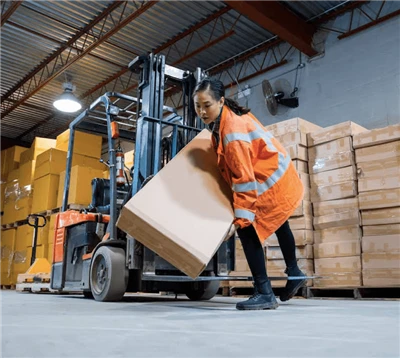
Evaluating a manual vs robot palletize workflow highlights the critical role reliable EOAT plays in overall plant performance:
| Operational Parameter | Manual Offloading | Automated Industrial Robot Cell |
| Continuous Line Speed | Drops during late shifts due to physical fatigue. | Maintains 100% rated machine speed continuously. |
| Box Edge Material Scrap | 2%-4% damage rate from drops and rough handling. | < 0.1% scrap rate with proper EOAT force control. |
| Labor Requirement | 1 operator per shift (3 total for continuous 24/7). | 0 direct operators (1 technician for material reload). |
| Stack Alignment Accuracy | Variable corner stacking quality. | Precise pallet stack edges within ± 1.5mm. |
A properly integrated industrial palletizing robot equipped with application-specific EOAT eliminates manual handling bottlenecking at the outfeed of high-speed flexo lines, reducing box scrap rates while maintaining consistent production flow.
Global Equipment Integration and Sourcing Strategy
When sourcing complete automated packaging cells from global OEMs or system integrators-including specialized palletizing robot China manufacturers-engineering teams must verify the commercial availability of mechanical and pneumatic sub-components:
- Pneumatic Standardization: Ensure clamping cylinders, valve manifolds, and pressure regulators use globally supported brands (e.g., SMC, Festo) with standard ISO mounting patterns.
- Linear Motion Components: Linear guide rails and bearings should conform to international dimensions (e.g., THK, HIWIN) to ensure local maintenance teams can source replacement parts quickly.
- Sensor Interfacing: Proximity sensors, photoelectric switches, and vacuum transducers should utilize standard M12 quick-disconnect connectors and communicate over standard industrial fieldbus networks.

7. Technical Procurement Checklist for EOAT Specification
When preparing a Request for Proposal (RFP) for a robotic palletizing system, provide machine builders with detailed operational parameters to ensure proper EOAT design:
1. Corrugated Bundle Parameters
[ ] Minimum and maximum bundle dimensions (L × W × H in mm).
[ ] Minimum and maximum bundle weights (kg).
[ ] Corrugated flute profiles (e.g., E, B, C, BC double-wall) and paper weights (g/m²).
[ ] Bundle condition: Strapped (PP/PET strap count and direction) vs. Unstrapped.
[ ] Average bundle surface temperature and moisture content exiting converting machinery.
2. Line Production Metrics
[ ] Upstream equipment type (Flexo Folder Gluer, Rotary Die Cutter, Semi-Automatic Strapper).
[ ] Maximum bundle discharge rate (bundles per minute).
[ ] Required pallet pattern layouts (column stack, interlocked pattern, split-layer).
[ ] Need for intermediate slip-sheet or bottom-pallet board placement.
3. Utility and Environment Constraints
[ ] Available plant compressed air pressure (bar) and flow capacity (L/min).
[ ] Plant electrical supply voltage ((480V 3Ø 60Hz / 380V 3Ø 50Hz)).
[ ] Ambient operating temperature range (℃) and airborne paper dust levels.
[ ] Physical footprint restrictions and clear overhead height under crane ways.
8. Summary and Implementation Roadmap
Selecting between vacuum suction, mechanical side clamps, and hybrid tooling is a critical engineering decision when installing an automated palletizing cell.
For standard corrugated packaging applications, system engineers should follow this implementation logic:
- For High-Speed Strapped Bundle Lines: Deploy pneumatic side-clamp grippers with proportional force regulation to achieve high cycle speeds without box deformation.
- For Loose, Unstrapped, or Heavy Die-Cut Sheets: Integrate hybrid combination tooling with retractable bottom-support forks to carry the payload weight mechanically, preventing sheet sag and dropping risks.
- For Tight Layout Footprints Requiring Zero Bundle Clearance: Utilize high-flow side-channel vacuum blower systems with foam sealing plates and automatic self-closing check valves, backed by routine air filtration maintenance.
Properly aligning End-of-Arm Tooling design with plant operating conditions ensures long-term operational reliability, minimal product scrap, and rapid return on investment across modern automated packaging facilities.