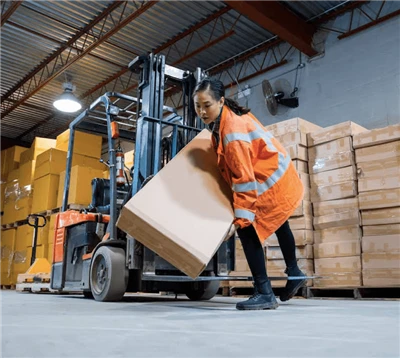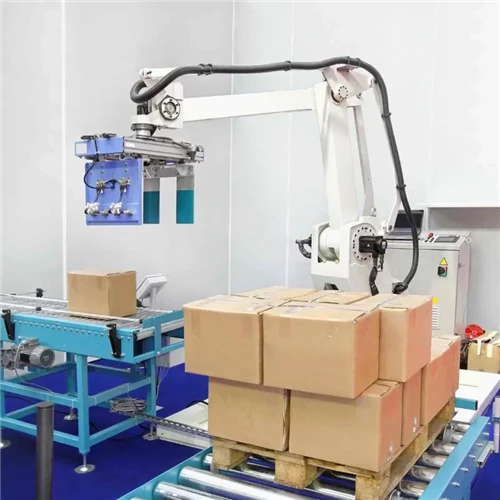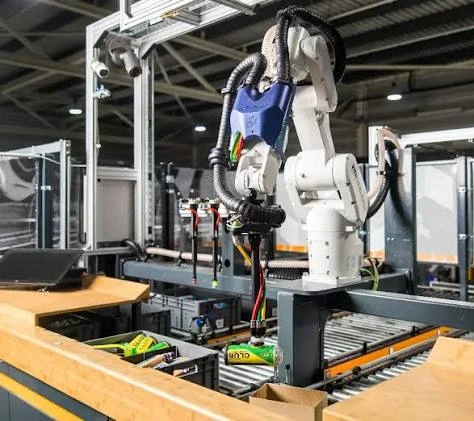
A turnkey fully automatic robot palletizing system for corrugated packaging plants and manufacturing facilities in 2026 typically costs between $55,000 and $280,000, depending on payload capacity, line speed, End-of-Arm Tooling (EOAT) customization, and peripheral line integration. Operating a multi-shift production facility allows most plant managers to recover their total capital investment within 10 to 18 months by eliminating manual offloading labor, preventing box-edge material scrap, and maintaining continuous high-speed converting line output.
1. System Cost Overview and Price Tiers
Determining the capital expenditure for a robotic end-of-line packaging cell requires breaking down the total expenditure into standalone robot hardware, custom tooling engineering, peripheral material handling conveyors, safety enclosures, and system controls integration. A standard 4-axis or 6-axis industrial robot arm cannot function independently on a plant floor; it requires an integrated environment to accept incoming corrugated box bundles, position timber skids, insert slip sheets, and discharge finished pallet stacks.
Budgeting Matrix by System Capacity and Complexity
| System Configuration | Estimated Price Range (USD) | Operating Speed Capacity | Target Facility Application | Typical Payback Window |
|---|---|---|---|---|
| Basic Standalone Palletizing Cell | $55,000 – $85,000 | 10 – 16 bundles / min | Single slow-to-medium Flexo Folder Gluer (FFG) or semi-automatic strapper outfeed. Manual pallet placement on marked floor positions. | 14 – 18 Months |
| High-ROI Integrated Cell | $85,000 – $150,000 | 18 – 28 bundles / min | High-speed FFG or Rotary Die-Cutter outfeed. Features powered bundle squaring, multi-pick mechanical gripper, and remote PLC diagnostic connectivity. | 10 – 14 Months |
| High-Speed Multi-Line Automated System | $150,000 – $280,000+ | 30+ bundles / min | Centralized multi-line feed. Includes automatic pallet dispensers, inline sheet inserters, motorized chain conveyors, and AGV docking stations. | 18 – 24 Months |
The baseline palletizing robot price varies significantly based on whether the machine is purchased as a bare mechanical arm or as a fully integrated end-of-line automation cell. Evaluating individual subsystem expenses helps plant engineering teams distribute capital across mechanical, electrical, and control disciplines.
Itemized Subsystem Capital Expenditure Breakdown
- Articulated Mechanical Robot Arm (25% – 35% of total budget): $35,000 – $75,000. Covers the primary 4-axis or 6-axis articulated robot arm with payload ratings between 110 kg and 300 kg, including the structural base pedestal, internal harness cabling, and servo drive controllers.
- End-of-Arm Tooling / Custom Gripper (15% – 25% of total budget): $12,000 – $35,000. Includes mechanical side-clamp assemblies, pneumatic bottom-support forks, vacuum suction plates, or hybrid grippers engineered specifically for corrugated board geometries and bundle weights.
- Infeed Conveyors, Squaring Units & Pallet Handling (20% – 30% of total budget): $15,000 – $50,000. Encompasses powered roller beds, bundle-centering mechanisms, automatic timber pallet magazine dispensers, and heavy-duty outfeed drag-chain conveyors.
- Safety Enclosures, Interlocks & Power Panels (10% – 15% of total budget): $8,000 – $20,000. Covers physical perimeter wire mesh fencing, safety light curtains, interlocked access doors, and an IP54 / NEMA 12 main control enclosure equipped with an industrial cabinet air conditioner.
- PLC Programming, Systems Integration & Testing (8% – 12% of total budget): $5,000 – $15,000. Includes custom HMI touchscreen recipe programming, fieldbus handshake communication with upstream converting lines, and pre-shipment factory acceptance dry-run testing.

2. Technical Factors Impacting Equipment Cost
Evaluating modern palletizing robot systems requires inspecting specific mechanical engineering and operational parameters. Equipment proposals vary based on kinematic performance, cycle rates, and structural rigidity.
📌 Equipment Sourcing Note: When evaluating technical capabilities across global manufacturers, review regional industry rankings for detailed vendor profiles:
Robot Arm Payload and Working Envelope
The mechanical payload rating determines the maximum mass the arm can maneuver at maximum acceleration (> 1.2 g) without causing motor thermal overloads or position fault errors.
- Light to Medium Payload (110 kg – 180 kg): Configured for single-bundle or dual-bundle pick sequences. Handles standard corrugated boxes exiting converting lines at speeds up to 18 cycles per minute.
- Heavy Payload (240 kg – 300 kg+): Essential for multi-pick routines where the gripper lifts entire layers or multiple heavy corrugated bundles simultaneously (30+ bundles per minute equivalent throughput).
- Reach Envelope (2,400 mm – 3,100 mm): Extended arm reach allows a single robot arm to service two separate palletizing bays (dual-bay layout), eliminating the requirement for a secondary robot unit.
End-of-Arm Tooling (EOAT) Engineering
Handling corrugated paper bundles presents complex material handling requirements. Freshly glued boxes exiting flexo folder gluers retain residual humidity, and loose PP/PET strapping can slip during rapid rotational motion.
- Pneumatic Side-Clamp Grippers: Use padded aluminum or carbon steel plates to clamp bundles laterally. Well-suited for tightly strapped corrugated bundles.
- Bottom-Support Mechanical Forks: Servo-driven or pneumatic fork fingers slide underneath the bundle before lifting. Recommended for unstrapped bundles or heavy die-cut sheets to eliminate bottom-sheet sag.
- Vacuum Suction Plates: Utilize high-flow vacuum blowers or compressed air ejectors combined with foam sealing pads. Effective for solid full-layer sheet handling, though paper dust requires routine air filter maintenance.
- Hybrid Combination Grippers: Integrate side-clamping plates, pneumatic bottom support forks, and top-holding pads. Provides maximum stability for un-cured, loose bundles moving at high acceleration rates.
Infeed Alignment and Active Bundle Squaring
A robot arm can only form straight, stable pallet loads if incoming bundles arrive in precise physical orientations. High-speed automation cells position an active bundle squarer directly upstream of the pick position. This assembly uses motorized side belts and end-stops to square loose bundles prior to clamping, ensuring straight pallet corners that comply with strict warehouse racking and export shipping mandates.
3. Industrial Component Standards and Integration Protocols
An industrial palletizing robot cell must be built using non-proprietary industrial components so that internal maintenance technicians can perform replacement tasks using locally available commercial stock.
Standardized Component Brand Matrix
| Subsystem Module | Standard Component Brand | Technical Operational Function |
|---|---|---|
| PLC Control Architecture | Siemens S7-1500 / Allen-Bradley ControlLogix | Central cell control, recipe storage, motion sequencing logic, and line handshakes. |
| Pneumatic Actuation | SMC / Festo | Gripper clamping cylinders, bottom fork actuation, and bundle squarer drive positioning. |
| Conveyor Gearmotors | SEW-Eurodrive / Nord | Motorized drives for infeed roller beds and heavy-duty full-pallet chain conveyors. |
| Low-Voltage Electricals | Schneider Electric / ABB | Thermal breakers, contactors, overload relays, and main safety disconnect switches. |
| Sensors & Safety Curtains | Sick / Banner Engineering / Omron | Bundle detection, pallet positioning optical sensors, and perimeter safety area monitoring. |
Control Protocols and Line Communication
Seamless communication between the palletizing cell and upstream converting equipment prevents line stoppages and material backup. Modern cell controllers utilize fieldbus networks such as PROFINET or EtherNet/IP. When the upstream converting line changes order recipes, the master line PLC automatically updates bundle dimensions, layer stacking patterns, and maximum stack heights to the robot cell HMI. The operator does not need to manually adjust motion coordinates, reducing job changeover duration from 20 minutes to under 30 seconds.

4. Hidden Capex/Opex and Site Integration Realities
Evaluating equipment proposals based solely on FOB machine prices often leads to unexpected budget overruns during site commissioning. Plant managers must budget for logistics, civil modifications, utility connections, and ongoing service coverage.
Hidden Cost Items and Site Integration Budget Planner
| Expense Category | Estimated Cost Range (USD) | Description and Cost Mitigation Strategy |
|---|---|---|
| Freight, Packaging & Marine Insurance | $4,000 – $12,000 | Ocean containerization (40ft High Cube or Open Top), vacuum-sealed anti-rust foil wrapping, and transit insurance. |
| Customs Duties & Import Clearance | 5% – 12% of CIF Value | Varies by importing jurisdiction (e.g., SAT regulations in Mexico, ASEAN tariff frameworks). Secure precise HS Code classifications early. |
| Civil Works & Facility Utility Drops | $3,000 – $8,000 | Reinforced concrete floor leveling (minimum 150mm depth with rebar), main 480V / 380V power drops, and dry compressed air drops (6 bar). |
| On-Site Installation & Commissioning | $6,000 – $15,000 | Field service engineer daily rates, travel expenses, mechanical anchor bolting, and line integration. (Reduced by ordering pre-wired modular cells). |
| Annual Service Level Agreement (SLA) | $2,000 – $5,000 / year | Includes 24/7 remote PLC network access, emergency field service guarantees, scheduled joint lubrication, and local spare parts inventory access. |
Power Supply Conditioning and Dust Protection
Manufacturing plants operating in regional industrial zones frequently experience line voltage sags and electrical transients. Servo controllers on industrial robot arms are sensitive to voltage instability.
An unconditioned electrical supply can cause servo drive fault trips, resulting in lost encoder position reference and mid-cycle line halts. Installing an isolation transformer and an line voltage regulator inside the main enclosure protects control electronics.
In addition, ambient high temperatures paired with fine paper dust cause internal electrical cabinet overheating. Equipping the main control panel with an IP54 / NEMA 12 air conditioner protects internal servo amplifiers and PLC processor hardware.

5. Sourcing Strategy: Global Tier-1 vs. Specialized Chinese System Integrators
When procuring machinery, corporate buyers must evaluate the higher price points of Western integrators against the capital efficiency offered by specialized global machinery OEMs. Selecting a palletizing robot China OEM solution allows box plants to implement modern automated handling while preserving capital for upstream corrugator and printing line investments.
Supplier Comparison Matrix
| Evaluation Criteria | Tier-1 Global Integrators (US / EU) | Specialized Chinese System Integrators |
|---|---|---|
| Turnkey Cell Initial Cost | High ($160,000 – $300,000+) | Competitive ($60,000 – $120,000) |
| Core Robot Arm Brand | Native/proprietary Tier-1 brand arm | FANUC / ABB / KUKA arm OR heavy-duty domestic industrial arm |
| Layout Customization Flexibility | Rigid modular standards; custom engineering incurs heavy surcharges | High flexibility; custom L-shape or tight-footprint cell frames built to CAD drawings |
| Component Standard Quality | Global standard (Siemens, Allen-Bradley) | Global standard components utilized (Siemens, SMC, Schneider, SEW) |
| Technical Support & Remote Access | Regional branch offices; higher field service rates | 24/7 remote PLC router diagnostics + regional service network dispatch |
| Average Payback Window | 22 – 36 Months | 10 – 14 Months |
Selecting a reputable Chinese machinery manufacturer requires verifying that the supplier integrates non-proprietary international component brands for high-wear subassemblies.
Utilizing standard SMC pneumatic valves, Siemens PLCs, and Schneider switchgear ensures that if a solenoid valve or photoelectric sensor needs replacement after years of continuous operation, site maintenance personnel can source standard replacement parts locally without waiting for international shipments.
6. Comprehensive Financial ROI and Payback Framework
To justify equipment capital expenditure to board members and financial controllers, plant engineering directors must quantify operational savings using realistic factory performance metrics.
Payback Period Calculation Formula
3-Shift Corrugated Line Financial Case Study
Consider a corrugated box facility running a high-speed Flexo Folder Gluer producing 220 sheets per minute across 3 operating shifts (24-hour continuous production):
- Manual Offloading Labor: Requires 1 manual operator per shift at the converting line outfeed (3 total workers across 24 hours).
- Fully Burdened Labor Cost: $18,000 USD per worker per year (includes wages, taxes, health insurance, and administrative overhead).
- Total Direct Annual Labor Cost: $18,000 × 3 = $54,000 USD / year
- Total Installed Capital Investment: A complete high-ROI industrial palletizing robot cell costs $75,000 USD fully landed, installed, and commissioned.
- Secondary Financial Savings:
- Box Edge Scrap Elimination: Manual offloading causes edge damage on the top and bottom sheets of unstrapped bundles. Eliminating board drops saves $6,000 USD / year in scrap paperboard.
- Recovered Converting Line Throughput: Fatigue during late shifts forces manual operators to run the converting line at 80% maximum rated speed. Automated palletizing maintains 100% rated machine speed continuously, generating an estimated $10,000 USD / year in additional net margin.
Multi-Shift Operational Payback Comparison
| Financial Parameter | 1-Shift Operation (8 hrs/day) | 2-Shift Operation (16 hrs/day) | 3-Shift Operation (24 hrs/day) |
|---|---|---|---|
| Replaced Offloading Labor | 1 Worker | 2 Workers | 3 Workers |
| Annual Direct Labor Savings | $18,000 | $36,000 | $54,000 |
| Annual Material Scrap Savings | $2,000 | $4,000 | $6,000 |
| Recovered Capacity Margin | $3,000 | $6,000 | $10,000 |
| Total Combined Annual Savings | $23,000 / year | $46,000 / year | $70,000 / year |
| Total Installed System Cost | $75,000 | $75,000 | $75,000 |
| Calculated Payback Period | 39.1 Months | 19.5 Months | 12.8 Months |
- Total Annual Financial Benefit: $54,000 (Labor) + $6,000 (Scrap) + $10,000 (Capacity) = $70,000 USD / year
- Payback Calculation: ($75,000 Investment ÷ $70,000 Annual Savings) × 12 = 12.8 Months
For 3-shift plant operations, the automated packaging cell recovers its entire turnkey investment in under 13 months. Over the machine's remaining 8- to 10-year operating lifespan, ongoing labor and material savings directly lower operational cost per unit.

7. Technical Procurement Checklist & RFP Data Sheet
Before issuing a Request for Proposal (RFP) to machinery manufacturers, compile the following plant parameters to ensure accurate engineering reviews and binding equipment quotes:
Technical RFP Data Sheet
- Converting Equipment Outfeed Specifications: Outfeed conveyor centerline height, maximum sheet production rate (sheets/min), and strapping machine configuration.
- Corrugated Bundle Dimension Range:
- Minimum Bundle Size: Length × Width × Height (mm) and weight (kg).
- Maximum Bundle Size: Length × Width × Height (mm) and weight (kg).
- Board Attributes: Flute profiles (E, B, C, BC double-wall) and compression threshold limits.
- Finished Pallet Stacking Specifications:
- Timber Skid Dimensions: Standard ISO pallets, US skids (48 x 40 inches), or custom skids.
- Maximum Finished Load Height: Including timber skid base (e.g., 1,800 mm, 2,100 mm).
- Stacking Pattern Configurations: Column stacking, pinwheel interlocking, or intermediate slip-sheet requirements.
- Available Floor Space & Overhead Clearance: Available cell length, width, and overhead crane clear height (mm). Attach DWG/CAD floor plans showing building columns, main access aisles, and forklift traffic paths.
- Site Utility Infrastructure: Available line voltage (480V 3-Phase 60Hz or 380V 3-Phase 50Hz), air compressor line delivery pressure (bar), and localized indoor ambient temperature range (°C).
8. Implementation Next Steps
Modernizing end-of-line packaging with a dedicated fully automatic robot palletizing system removes manual labor constraints, stabilizes production output, and ensures consistent finished pallet load quality.
To evaluate custom machinery configurations for your plant:
- Compile detailed box bundle dimensional ranges and target line speeds.
- Request itemized proposals that include commercial wear parts listings and remote PLC service level agreements.
- Require equipment vendors to provide a customized 3D cell layout simulation matching your plant CAD drawing to verify cycle times and forklift maneuverability prior to issuing purchase orders.