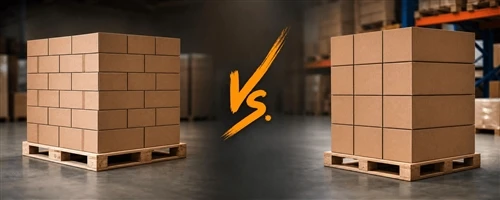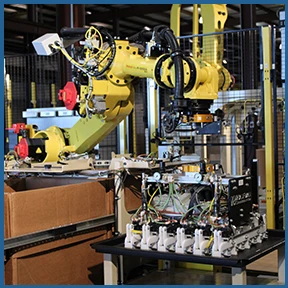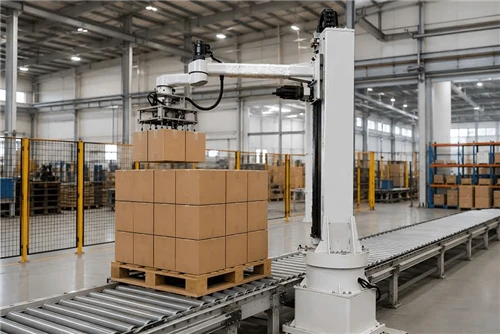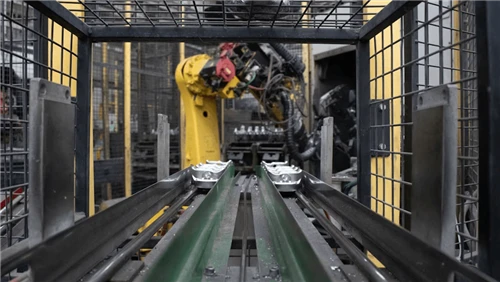
Selecting between interlocked and column stacking patterns when programming an industrial palletizing robot directly impacts box integrity, transit safety, and daily line throughput. Column stacking preserves 100% of a corrugated box's inherent compressive strength by aligning all vertical corners, but requires immediate stretch wrapping or strapping to stay stable during transit. Interlocked stacking locks boxes together using surface friction for immediate structural integrity without extra wrapping, but reduces top-load strength by 20% to 40%. Balancing both methods depends on your factory's shipping distance, wrapping setup, end-of-arm tooling, and automated palletizing robot arm configuration.
1. Corrugated Box Mechanics: What Keeps a Box Standing?
When deploying an industrial palletizing robot, understanding how paper boxes carry top loads is essential to preventing crushed goods during transit. Corrugated packaging containers derive their primary vertical load resistance from internal fluting mediums positioned between outer linerboards and, most importantly, their four vertical corners.
The "Corner Rule" of Packaging
The four vertical corners of a standard corrugated container carry 60% to 70% of its total top-load weight.
- Direct Alignment: When boxes are stacked perfectly corner-on-corner, you utilize 100% of the paperboard's material strength.
- Panel Loading: When an upper box corner rests on the middle of a lower box's top panel, the lower box panel flexes, causing the side walls to bulge outward and rapidly lose structural load capacity.
Key Operational Factors Decreasing Box Strength
- Vertical Corner Misalignment: Even a minor 5 mm placement offset shifts the load away from the rigid corner post to the flex zone of the box lid, reducing total compressive resistance by 10% to 15%.
- Pallet Edge Overhang: Allowing boxes to stick out even 10 mm past the perimeter of a wooden pallet removes base support from the outer corners, reducing total stack load capacity by up to 30%.
- Humidity & Environmental Creep: Paperboard fibers absorb atmospheric moisture. High relative humidity in storage facilities (>75% RH) softens paperboard, cutting effective stack strength in half over long-distance storage or ocean freight transport.


2. Column Stacking Patterns: Maximum Vertical Load Capacity
In column stacking (also known as straight stacking), boxes are placed directly on top of one another across all layers, keeping all four vertical edges aligned continuously from the pallet surface to the top layer.
| Performance Metric | Column Stacking Parameter | Practical Production Impact |
| Strength Retention Rate | 90% – 100% of theoretical box capacity | Allows factories to use lighter-weight paperboard without box crushing. |
| Lateral Frictional Stability | Poor (Individual columns act as separate towers) | Requires immediate stretch wrapping, banding, or corner posts. |
| Robot Arm Motion Profile | Simple, uniform Z-axis drop / Identical orientation | Simplifies path programming and maximizes pick-and-place cycle speeds. |
| Infeed Alignment Tolerance | ±1.0 mm to ±2.0 mm | Requires precise bundle squaring prior to robot pick execution. |
Operational Advantages
- Optimized Material Costs: Because vertical corners carry the entire stack load, procurement teams can order lower-grade Edge Crush Test (ECT) paperboard without risking bottom-box collapse.
- Maximum Vertical Height: Allows plants to stack pallets higher in storage warehouses and shipping containers, reducing overall freight and warehousing costs per unit.
- Faster Robot Cycle Rates: Since every box in every layer shares the exact same orientation, the robot arm does not need to execute 90-degree wrist rotations between cycles, shaving seconds off layer completion times.
Operational Vulnerabilities & Countermeasures
Column stacks lack internal friction to lock adjacent boxes together. During sudden forklift braking, sharp warehouse turns, or truck transit acceleration, independent columns tend to lean away from each other (column tipping).
To counteract column tipping without changing the pattern, automated packaging lines utilize three primary peripheral tools:
- Automatic Inline Stretch Wrapping: Applying pre-stretched film immediately after palletization applies radial tension that holds independent columns together.
- Intermediate Slip-Sheets: Dropping a thin paperboard or corrugated tier sheet every 2 to 3 layers ties independent vertical columns into a unified plane.
- Solid Fiberboard Corner Posts: Placing rigid cardboard V-boards on the four outer corners distributes wrap tension evenly and prevents individual box columns from shifting.
3. Interlocked Stacking Patterns: Built-In Frictional Stability
Interlocked stacking involves rotating the box arrangement by 90 degrees on alternating layers (such as pinwheel or interlocking brick patterns). This overlaps joints and locks the entire pallet load into a cohesive block using surface friction.
| Performance Metric | Interlocked Stacking Parameter | Practical Production Impact |
| Strength Retention Rate | 60% – 80% of theoretical box capacity | Requires heavier corrugated board or reduced stack heights. |
| Lateral Frictional Stability | High (Surface friction locks layers together) | Prevents load shifting during internal warehouse transport before wrapping. |
| Robot Arm Motion Profile | Alternating A/B layer patterns with 90° wrist rotation | Requires multi-axis wrist articulation and multi-zone gripper control. |
| Sensitivity to Overhang | High | Corner-on-panel positions accelerate sidewall bulging if edges hang over. |
Operational Advantages
- Immediate Structural Integrity: Interlocked loads remain stable on internal conveyor systems or during short forklift moves even before reaching the stretch wrapper.
- Superior Transit Resistance: Interlocking layer joints resist torsional twisting and lateral forces experienced during long-haul road transport or rail shipping.
- Elimination of Tier Sheets: In many applications, interlocked friction eliminates the need for intermediate kraftliner slip-sheets, reducing packaging consumable expenses.
Operational Vulnerabilities & Countermeasures
Because the rigid corners of upper boxes sit over the flexible top panels of lower boxes, interlocked patterns induce localized flexing. Over time, this causes lower boxes to bulge, leading to a 20% to 40% loss in total stack load capacity.
To mitigate strength loss in interlocked patterns:
- Cap the Stack Height: Limit the total layer count compared to column-stacked lines running the same box specification.
- Upgrade Paperboard Specification: Increase the ECT rating or flute thickness (e.g., switching from B-flute to C-flute or double-wall BC-flute) for high-stack export shipments.
4. Comprehensive Pattern Comparison Matrix
Selecting the optimal pattern requires balancing structural paper capabilities, packaging line speeds, and logistics requirements.
| Technical Evaluation Criteria | Column Stacking Configuration | Interlocked Stacking Configuration |
| Compressive Load Retention | Maximum (90% - 100%): Best for heavy top loads. | Reduced (60% - 80%): Limited by lower-panel flex. |
| Resistance to Tilting & Sliding | Low: Relies on external film or strapping. | High: Internal friction locks layers automatically. |
| Gripper Tooling Complexity | Standard: Basic vacuum plate or side clamp. | Advanced: Multi-zone vacuum or servo-rotational clamp. |
| Cycle Time Efficiency | Faster: Uniform pick-and-place trajectories. | Slower: 90° J6 wrist rotation required on alternate layers. |
| Dependence on In-Line Wrapping | Critical: Must be wrapped immediately after cell output. | Flexible: Can travel on conveyors unwrapped for short distances. |
| High-Rack Storage Performance | Optimal: Weight rests evenly on rack beams. | Moderate: Mid-panel flex can lead to uneven rack seating. |
5. End-of-Arm Tooling (EOAT) & Gripper Matching
The choice between column and interlocked patterns dictates the mechanical and electrical architecture of the robot's End-of-Arm Tooling (EOAT).
1. Vacuum Foam Plates (Univalve / Area Grippers)
- Best Used For: Standard RSC boxes with consistent top surfaces.
- Pattern Adaptability: Excellent for both patterns. Multi-zone vacuum control allows the robot to pick single boxes or multiple bundles simultaneously, shutting off unused vacuum zones when forming complex interlocked gaps.
2. Side-Clamping Mechanical Grippers
- Best Used For: Heavy bundles, unsealed top flaps, or low-vacuum porous paperboard.
- Pattern Adaptability: Highly effective for column stacking. When executing interlocked patterns, side clamps require precise clearance algorithms so the open clamp arms do not collide with previously placed adjacent boxes.
3. Bottom-Support (Pancake / Fork) Grippers
- Best Used For: Very heavy boxes (>30kg) or delicate bottom-sealed containers.
- Pattern Adaptability: Ideal for simple patterns, but requires small air gaps between adjacent boxes in interlocked layouts to allow support forks to retract without disturbing neighboring stacks.
6. Industry-Specific Pattern Selection Matrix
Different manufacturing sectors prioritize stacking configurations based on their unique product weights, packaging materials, and supply chain environments.
Industry 1: High-Speed Corrugated Box Converting & Printing
- Primary Product: Unfolded corrugated box bundles, die-cut sheets.
- Recommended Pattern: Column Stacking + Intermediate Slip-Sheets.
- Engineering Rationale: Freshly glued or printed corrugated bundles need uniform pressure across all four corners to prevent permanent warping while drying on the pallet.
Industry 2: Food & Beverage (Canned Goods, Bottled Liquids)
- Primary Product: Heavy trays, wrap-around cartons containing liquids or metal cans.
- Recommended Pattern: Column Stacking + Inline Stretch Wrapping.
- Engineering Rationale: Liquid containers carry their own internal vertical load. Column stacking aligns the internal rigid cans directly over one another, allowing double-stacking in warehouses.
Industry 3: Consumer Packaged Goods (CPG) & E-Commerce Retail
- Primary Product: Mixed-size RSC boxes, lightweight retail-ready packaging.
- Recommended Pattern: Interlocked Stacking (Pinwheel Layout).
- Engineering Rationale: E-commerce fulfillment centers move pallets frequently via internal conveyor loops and AGVs. Interlocked friction prevents individual boxes from sliding off during frequent start-stop transport.
Industry 4: Chemical & Agricultural Raw Materials
- Primary Product: Multi-wall paper bags, valve sacks, bag-in-box containers.
- Recommended Pattern: Interlocked Stacking + Top Cap Sheet.
- Engineering Rationale: Soft or semi-flexible bags shift under vibration. Interlocking alternate layers creates a self-supporting block load that resists settling and dynamic transit sway.

7. Robot Kinematics: Managing Acceleration & Centrifugal Forces
Programming palletizing robot arms requires precise motion trajectory control to achieve maximum throughput without disturbing un-wrapped box stacks during placement.
Centrifugal Inertia and Payload Slippage
When a robot arm swings a heavy corrugated bundle at speeds exceeding 2.5m/s, centrifugal force acts on the payload:
- The Physics in Practice: Sudden angular acceleration at the end of the swing creates lateral inertial forces. If the gripper's holding force is insufficient, or if the box board surface has a low coefficient of static friction, the payload will shift in the gripper or slide across lower layers during placement.
- Motion Path Smoothing: Modern palletizing robot systems utilize S-curve acceleration profiles. Instead of applying abrupt trapezoidal speed changes, S-curve algorithms smooth out jerk (the rate of change of acceleration). The robot accelerates smoothly out of the pick zone, reaches maximum velocity mid-swing, and decelerates gently prior to dropping the box.
4-Axis vs. 6-Axis Kinematic Comparison
Choosing between 4-axis and 6-axis robot architectures impacts both pattern flexibility and cell throughput.
4-Axis Dedicated Palletizing Arms
- Kinematic Structure: Parallel mechanical linkages keep the wrist flange parallel to the floor at all times.
- Key Advantage: Designed for maximum speed and high payload capacity (180kg - 300kg+), achieving 20 to 28 picks/min.
- Pattern Capability: Ideal for both column and interlocked patterns. The J4 vertical axis rotates payloads 90° or 180° effortlessly on horizontal planes.
6-Axis Articulated Industrial Arms
- Kinematic Structure: Six independent rotational joints offering full 3D spatial orientation.
- Key Advantage: Unlimited dexterity. Can pick or place boxes from non-horizontal conveyors or navigate complex cell obstacles.
- Pattern Capability: Essential for complex retail-ready display pallets or mixed-case rainbow pallet building, though overall cycle speeds are slightly lower than 4-axis equivalents.
8. On-Site Troubleshooting Guide for Plant Engineers
Even with precise programming, real-world box dimensional tolerances and paperboard variations cause stack defects. Use this troubleshooting matrix to resolve common cell issues:
| Observed Plant Fault | Root Cause Analysis | Corrective Action / Program Adjustment |
| Bottom Box Bulging in Interlocked Stacks | Upper box corners are pressing into the center lid flex zone of lower boxes. |
1. Reduce total layer height by 1–2 layers. 2. Insert a rigid corrugated sheet every 3 layers. 3. Increase box ECT paperboard specification. |
| Column Tipping During Robot Transfer | Acceleration jerk is too high; lack of internal friction in column configuration. |
1. Enable S-curve motion smoothing on J1/J2 robot axes. 2. Reduce arm rotation speed during loaded travel. 3. Add an inline top-press plate to hold columns steady. |
| Box Corner Damage During Interlocked Placement | Gripper tolerances are too tight; placing box collides with adjacent installed box. |
1. Increase pattern clearance gap by 3mm to 5mm in pattern software. 2. Recalibrate box squaring station sensors at infeed. |
| Vacuum Loss on Porous Recycled Paperboard | High-porosity linerboard allows air leakage through vacuum cups/plates. |
1. Switch to high-flow vacuum blowers or sponge-foam plates. 2. Increase pneumatic vacuum pressure thresholds. |
| Pallet Stack Leaning to One Side | Box height manufacturing tolerances (±2mm) accumulating across layers. |
1. Implement 180° layer orientation flipping on alternate layers. 2. Inspect box folder-gluer for uneven slot cutting. |
9. Financial ROI: Manual vs. Automated Robot Palletizing
Upgrading from manual offloading to an industrial palletizing robot eliminates ergonomic injury risks, stabilizes line speeds, and yields predictable payback timelines.
| Operational Performance Parameter | Manual Offloading Operation | Automated Industrial Robot Cell |
| Line Speed Consistency | Fluctuates due to fatigue, heat, and worker rotation. | Operates at 100% rated capacity 24/7 without speed drops. |
| Stacking Repeatability | Variable alignment; frequent box overhang (±10mm). | Precise placement repeatability (±1.0mm to ±1.5mm). |
| Product Scrap Rate | 2%-4% damage from dropped bundles and dented corners. | < 0.1% product scrap rate via controlled gripper forces. |
| Labor Overhead | Requires 1 operator per shift (3 total for 24/7 plant operation). | 0 direct operators (1 supervisor oversees multiple cells). |
| Workplace Injury Claims | High incidence of repetitive strain injuries (RSI) and back issues. | Zero manual lifting hazards; meets OSHA/CE safety standards. |
Financial Payback Model
While palletizing robot price varies based on payload, payload speed, and peripheral integration, a standard cell ($85,000 – $150,000 total installed cost) operating in a two-shift or three-shift manufacturing plant typically achieves full payback within 10 to 18 months. Long-term savings continue via reduced labor turnover, lowered scrap rates, and increased upstream converting line speed.
10. Commercial & Integration FAQ for Machinery Buyers
Q1: Can a single industrial palletizing robot handle both column and interlocked patterns?
Yes. Modern pattern generation software allows operators to switch between column and interlocked patterns on the HMI touchscreen with a single button click. The robot controller automatically adjusts its J6 wrist rotation and pick-and-place coordinates accordingly.
Q2: What is the average installation and commissioning timeline for a palletizing cell?
A standard standalone cell typically requires 2 to 3 weeks for mechanical installation, electrical wiring, and PLC integration on-site, following 4 to 6 weeks of factory acceptance testing (FAT) at the supplier's facility.
Q3: How do Chinese palletizing robot OEMs compare with European or Japanese brands?
Leading palletizing robot China OEMs provide competitive cost-to-performance ratios (30%-40% capital savings), using international standard components (e.g., Siemens/AB PLCs, SMC pneumatics, Sick sensors) while delivering high-payload 4-axis arms built for round-the-clock industrial duty.
Q4: Do I need an inline stretch wrapper if I use an interlocked stacking pattern?
While interlocked patterns provide enough frictional stability for short warehouse moves, an inline stretch wrapper or automatic strapping machine is still strongly recommended for all final shipping pallets to protect against moisture, dust, and dynamic transit forces.
Q5: How do I handle boxes with unsealed top flaps or loose bundle straps?
For loose or unsealed bundles, vacuum grippers may fail to establish a seal. In these cases, mechanical side-clamping or bottom-support fork grippers are used to secure the bundle from the sides or underneath.
11. Factory Acceptance Testing (FAT) & Quality Checklist
Before taking delivery of an automated packaging cell, plant managers should enforce the following Factory Acceptance Testing protocol at the integrator's facility:
Pre-Shipment Validation Protocols
[ ] Dry Cycle Speed Test: Run the robot arm at 100% speed for 2 continuous hours without product to verify thermal stability of servos and gearboxes.
[ ] Pattern Changeover Verification: Test switching between Column Stacking and Interlocked A/B Layer patterns via the HMI within <30 seconds.
[ ] Placement Repeatability Measurement: Verify using laser measurement that box placement accuracy remains within ± 1.5 mm across 10 consecutive full pallet stacks.
[ ] Safety Interlock Testing: Trigger safety light curtains, E-stop buttons, and interlocked fence doors during full-speed operation to confirm immediate Performance Level d (PLd) safety stopping.
[ ] Full Payload Gripper Slip Test: Perform maximum acceleration (100% velocity 100% acceleration) with maximum bundle weight to confirm zero payload slippage within the gripper.
12. Summary Decision Framework for Plant Managers
To select the right stacking pattern and robotic system configuration for your plant, follow this simple engineering logic:
OR Direct Place (Column)
Column Stacking
- ✦ Priority: Max Vertical Strength
- ✦ Corrugated Board: Lightweight / ECT Optimized
- ✦ Downstream: Immediate Stretch Wrapping
- ✦ Robot Kinematics: High-Speed 4-Axis Pick
Interlocked Stacking
- ✦ Priority: Inherent Transit Friction
- ✦ Corrugated Board: Standard / Heavy-Duty
- ✦ Downstream: Unwrapped Conveyor Moves
- ✦ Robot Kinematics: 90° Articulated Rotation
- Choose Column Stacking when: Paperboard cost reduction is critical, total vertical stack height must be maximized, and your production line features an automated inline stretch wrapper positioned directly after the robot cell output.
- Choose Interlocked Stacking when: Pallets must be transported unwrapped across internal warehouse conveyors, shipping transit involves severe road/rail vibration, or maximum lateral friction is required without extra consumable accessories.
By matching paperboard structural limits with correct robotic kinematics and gripper engineering, corrugated converting facilities and packaging plants can maximize continuous line output, eliminate shipping product damage, and secure maximum return on automation investment.