The Role of Die Cutting in the High-Value Packaging Market
In the diverse landscape of corrugated manufacturing, not every product is a standard rectangular shipper. As e-commerce and retail-ready packaging (RRP) continue to dominate the market, the demand for complex shapes and functional designs has skyrocketed. This is where the rotary die cutting machine for corrugated boxes becomes indispensable. Unlike standard slotting units that can only perform straight vertical and horizontal cuts, a dedicated die cutter allows for the creation of intricate patterns, ventilation holes, and ergonomic handles.
For plant managers looking to diversify their product portfolio, investing in a high-quality automatic rotary die cutter is the primary step toward capturing higher margins. While a standard box is a commodity, a custom-die-cut gift box or a heavy-duty vegetable crate with precise ventilation is a specialty product. Understanding the mechanical harmony of this equipment is essential for maintaining a competitive edge in 2026's fast-paced packaging economy.

Integration with the Printing and Slotting Phases
For many integrated plants, the die cutting process doesn't exist in a vacuum. It is often the final stage of a multi-process sequence. A carton printing slotting die cutting machine represents the ultimate in "one-pass" manufacturing efficiency, similar to the high-speed output found in a flexo folder gluer machine. By combining the high-graphic capabilities of flexographic printing with the geometric precision of a rotary die cutter, manufacturers can take raw corrugated sheets and turn them into shelf-ready retail packaging in seconds.
The synchronization within a printing slotting die cutting machine is a marvel of modern engineering. Each section-feeding, printing, slotting, and die cutting-must be perfectly phased using independent servo drives. If the timing between the printing cylinders and the die-cutting anvil is off by even a fraction of a millimeter, the printed graphics will not align with the physical cutouts, leading to immediate rejection by high-end brand owners.
The Mechanics of the Rotary System: Cylinders and Anvils
The heart of an automatic rotary die cutter consists of two massive cylinders: the die cylinder and the anvil cylinder. The die cylinder holds a curved wooden or composite die board equipped with steel cutting and creasing rules. As the board passes through, the anvil cylinder provides the necessary back-pressure to ensure the steel rules penetrate the corrugated layers cleanly.
A critical technical feature of a rotary die cutting machine for corrugated boxes is the anvil cover. Usually made of durable polyurethane, these covers must withstand millions of strikes. To prevent uneven wear, advanced machines utilize an "anvil trimming" or "oscillation" system. This ensures that the die doesn't strike the same spot on the anvil every time, significantly extending the life of the consumables and maintaining a clean cut across the entire width of the machine.
Technical Specifications and Performance Metrics
When evaluating a printing slotting die cutting machine, technical parameters provide the roadmap for ROI. Below is a comparison of typical performance tiers for modern industrial units:
| Feature | Standard Production Level | High-Performance Industrial Level |
| Max Production Speed | 120 - 180 sheets/min | 250 - 350 sheets/min |
| Feeding Method | Manual or Kick Feeder | Vacuum Lead Edge Feeder |
| Registration Precision | +/- 1.0 mm | +/- 0.5 mm or better |
| Drive System | Gear or Chain Drive | Full Servo Independent Drive |
| Ink Drying Options | Natural Air | Infrared (IR) or UV Curing |
Achieving Precision Through Lead Edge Feeding
Precision in a carton printing slotting die cutting machine begins long before the board reaches the cutting cylinder. It starts at the feeding section. High-speed operations require a Vacuum Lead Edge Feeder to ensure that every sheet enters the machine at exactly the same interval. This consistency is the foundation of "Registration"-the alignment of print to cut.
Without a stable feeding environment, even the most expensive automatic rotary die cutter will produce inconsistent results. Modern feeders use high-pressure suction and specialized rollers that can handle different flute profiles (from micro-flute E-flute to heavy-duty BC-flute) without crushing the internal structure of the board. This structural integrity is vital for the compression strength of the final box.
Managing the Waste: Stripping and Scrap Removal
One of the biggest challenges in a rotary die cutting machine for corrugated boxes is the management of "waste" or "scrap." When you cut a handle hole or a complex vent, the small pieces of cardboard must be removed instantly to prevent them from interfering with the stacking process or clogging the machine.
Advanced automatic rotary die cutter systems include an integrated stripping section. This usually involves a combination of vibrating conveyors and high-velocity air blowers that shake the scrap away from the finished sheets. For the most complex shapes, specialized "waste-stripping dies" are used to ensure that even the smallest chads are ejected efficiently, leaving a clean, retail-ready product.
The Advantage of the Inline "One-Pass" Solution
The financial logic of a carton printing slotting die cutting machine is rooted in the "One-Pass" philosophy. Traditionally, a plant might print on one machine and die-cut on another. This required extra labor, extra floor space, and increased the risk of damage during transport between stations.
By utilizing a fully integrated printing slotting die cutting machine, the labor cost per unit is slashed. The "Inline" process ensures that ink is still fresh (or dried via IR) as it enters the die-cut section, and the board is processed in a single continuous movement. This efficiency is the key driver of the corrugated box manufacturing automatic plant cost, as it maximizes the "square meters per hour" metric that determines profitability.
Maintenance: Sustaining Accuracy in a High-Vibration Environment
A rotary die cutting machine for corrugated boxes is a high-vibration environment due to the constant striking of the steel rules against the polyurethane anvil. Maintenance is therefore a non-negotiable part of the operation.
Key areas of focus include:
- Anvil Leveling: Regularly checking the anvil's surface for deep grooves or uneven wear.
- Gear Lubrication: Ensuring the phased gears in the printing slotting die cutting machine are perfectly lubricated to prevent mechanical backlash.
- Servo Calibration: In an automatic rotary die cutter, the software must be periodically recalibrated to account for mechanical wear and tear, ensuring that the 10-millionth box is as accurate as the first.
Impact on Downstream Efficiency and Palletizing
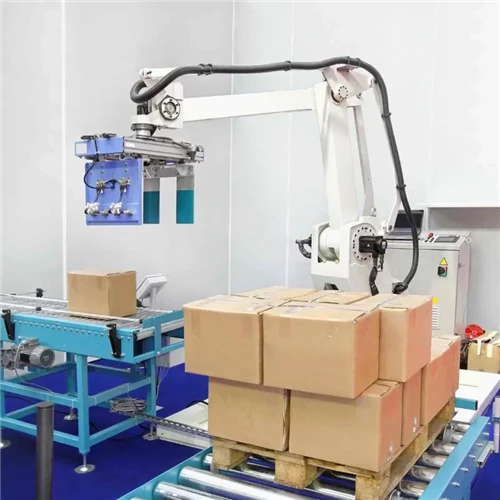
The quality of the output from a carton printing slotting die cutting machine directly impacts the final stage of production: the robotic palletizer. Unlike standard boxes, die-cut boxes often have irregular shapes or open gaps. If the stripping section has not removed all the scrap, the robotic case packer and palletiser sensors may misread the stack, leading to a line stoppage.
Furthermore, precision in the rotary die cutting machine for corrugated boxes ensures that the bundles are perfectly squared, a standard of accuracy also required in the industrial slitting process. When these bundles are stacked by a high-speed robot, a perfectly cut box creates a stable, aesthetic pallet that is safe for long-distance transport. A "clean cut" isn't just about looks-it's about the structural success of the entire supply chain.
Investing in the Future of Packaging
The automatic rotary die cutter is more than just a piece of hardware; it is a gateway to the most profitable sectors of the packaging industry. As consumer brands push for more creative and sustainable packaging solutions, the versatility offered by a printing slotting die cutting machine becomes a significant competitive asset.
By mastering the technical nuances of the rotary die cutting machine for corrugated boxes, from lead-edge feeding to precision anvil trimming, a plant ensures its long-term viability. In an era where efficiency and quality are the only metrics that truly matter, the right carton printing slotting die cutting machine is the cornerstone of a successful, automated corrugated plant.