When you invest in a palletizer, the most common question is simple: how fast is it? But in a real corrugated box plant, the answer is never just one number. A palletizer that runs at 30 cases per minute for small cartons may only handle 12 cases per minute for large industrial boxes. Understanding this relationship is the difference between a system that keeps up with your production line and one that becomes a bottleneck.
This guide walks you through how to evaluate palletizer speed for mixed-size box production. You'll learn what speed specifications actually mean, how to match them to your existing equipment, and why a well-matched palletizer improves both throughput and stack quality.

Why One Speed Number Doesn't Tell the Full Story
Most manufacturers list a maximum speed for their palletizers. That number is often based on ideal conditions: a single box size, consistent infeed, and perfect stacking patterns. But in a typical corrugated plant, conditions are rarely ideal.
Your production line runs multiple box sizes. Small e-commerce cartons arrive at high rates. Large appliance boxes arrive slowly. A palletizer that can't adapt its speed to box size will either run too slow for small boxes (creating a bottleneck) or try to run too fast for large boxes (causing dropped loads and mis-stacks).
The table below shows typical speed ranges for different box sizes in a well-matched palletizer system.
| Box Type | Typical Size Range | Recommended Palletizer Speed |
|---|---|---|
| Small e-commerce cartons | 250–600 mm | 35–45 packs per minute |
| Medium shipping boxes | 600–1,000 mm | 25–35 packs per minute |
| Large industrial boxes | 1,000–1,500 mm | 12–18 packs per minute |
These ranges reflect real-world production data. The speed variation is not a limitation of the palletizer-it's a function of how boxes physically behave at different sizes. Larger boxes require more careful placement, longer gripper movements, and slower acceleration to prevent shifting during stacking.
Key Factors That Affect Palletizer Speed
When evaluating a palletizer for your line, you need to look beyond the headline speed figure. Four factors determine actual throughput.
1. Box Size Range
The wider your box size range, the more speed variation you should expect. A palletizer that handles both 300mm and 1,500mm boxes must have adjustable grippers and programmable acceleration profiles. Systems that lack these features often force you to run the entire line at the speed of the largest box-which wastes capacity on small-box runs.
2. Stack Height
A palletizer that can stack to 1,800 mm offers a significant efficiency advantage over systems limited to 1,500 mm. Higher stacks mean fewer pallet changes, which reduces downtime and increases overall throughput. However, stacking higher requires precise layer placement to maintain stability, especially with large boxes.
3. Gripper Design
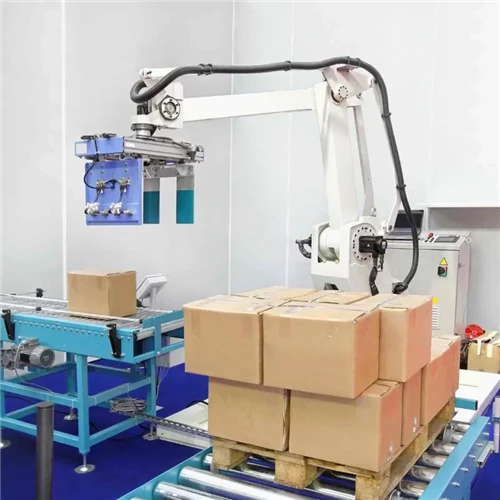
The end-of-arm tooling directly impacts cycle time. A pallet gripper that adjusts automatically between box sizes eliminates manual changeovers. Vacuum-based grippers with zone control can handle different box sizes without retooling. Mechanical grippers that require physical adjustment will add minutes to every size change.
4. Infeed Conveyor Speed
Your palletizer can only stack boxes as fast as they arrive. If your folder gluer or stitching machine delivers boxes at 30 meters per minute, the palletizer must be able to accept them at that rate. Matching conveyor speed to stacking speed is essential for continuous operation.
How to Calculate Your Actual Palletizer Speed Needs?
Instead of asking "how fast is the palletizer," ask "how fast does my line need it to be?" You can estimate your speed requirements with a simple calculation.
Step 1: Determine your peak box output per minute
If your folder gluer runs at 250 boxes per minute for small cartons, that's your peak demand. But note: box size affects output. The same machine may only produce 80 large boxes per minute.
Step 2: Account for stacking time
Each stacking cycle includes: gripping, lifting, moving to pallet, placing, and returning. For small boxes, this cycle can be under 2 seconds (30+ per minute). For large boxes, the cycle extends to 4–5 seconds (12–15 per minute).
Step 3: Factor in pallet changes
Every time a pallet fills, production pauses. A palletizer that stacks 1,800 mm high needs fewer pauses than one limited to 1,500 mm. For a line running 8 hours, the taller stack can save 2–3 pallet changes per shift, adding 10–15 minutes of productive time.
Speed Matching in Practice: A Case Example
Consider a plant running two types of jobs on the same palletizer.
| Job Type | Box Size | Line Speed | Palletizer Speed Required | Actual Palletizer Capability |
|---|---|---|---|---|
| Job A | 350 mm cartons | 40 packs/min | 40 packs/min | 45 packs/min (sufficient) |
| Job B | 1,200 mm industrial boxes | 15 packs/min | 15 packs/min | 18 packs/min (sufficient) |
In this example, the palletizer is well-matched to both jobs. The key is that the system automatically adjusts its speed based on the box size. Operators do not need to reconfigure settings between jobs.
If the same palletizer had a fixed speed of 20 packs per minute, it would handle Job B but would create a bottleneck for Job A, forcing the folder gluer to slow down.
The Relationship Between Stack Height and Throughput
Stack height directly affects how often you interrupt production to change pallets. A palletizer with a maximum stacking height of 1,800 mm can hold significantly more boxes than one with 1,500 mm.
For a typical box height of 150 mm:
- 1,500 mm stack = 10 layers
- 1,800 mm stack = 12 layers
That's 20% more boxes per pallet. Over a full shift, the taller stack reduces pallet changes by 2–3 events, saving 10–15 minutes of downtime. In a facility running two shifts, that's 20–30 extra minutes of production per day-which over a year adds up to dozens of additional operating hours.
Common Speed Selection Mistakes to Avoid
When choosing a palletizer, buyers often make these mistakes. Avoiding them will save you from underperforming equipment.
Mistake 1: Chasing Maximum Speed Only
A palletizer rated at 45 packs per minute for small boxes may not be the best choice if your mix is 70% large boxes. Match the equipment to your actual product mix, not the highest number in the brochure.
Mistake 2: Ignoring Changeover Time
Some palletizers achieve high cycle times but take 20 minutes to switch between box sizes. A slower palletizer with 3-minute changeovers can outperform a faster one if you change sizes multiple times per shift.
Mistake 3: Overlooking Infeed Integration
A palletizer is only as fast as the conveyor feeding it. Ensure your infeed system can handle the same speed range. If your conveyor tops out at 20 m/min, a high-speed palletizer won't reach its potential.
Technical Specifications to Compare
When evaluating palletizer options, request these specific data points from suppliers. They will help you compare speed capabilities directly.
| Specification | What to Look For |
|---|---|
| Speed by box size | Ask for separate numbers: small, medium, large |
| Maximum stack height | 1,800 mm preferred for fewer pallet changes |
| Gripper adjustment | Automatic servo-driven vs. manual |
| Infeed conveyor speed | Must match or exceed palletizer speed |
| Changeover time | Under 3 minutes between size extremes |
| Power requirements | 380VAC typical for industrial palletizers |
| Air pressure requirement | >=0.6 Mpa for consistent gripper operation |
Making the Right Choice for Your Line
Choosing a palletizer for speed matching comes down to understanding your own production profile. Start by documenting three things:
- Your box size range – smallest and largest lengths you run regularly
- Your peak speeds – packs per minute for each major box size
- Your changeover frequency – how many size changes per shift
With these numbers in hand, you can compare palletizer specifications against your actual needs. Look for a system that offers speed ranges aligned with your box sizes, not just a single maximum number.
A well-matched palletizer does more than keep up with production. It reduces pallet change downtime, improves stack stability, and allows your folder gluer or stitching machine to run at its designed speed without waiting on downstream bottlenecks.
If you're currently evaluating palletizer options for your corrugated plant, consider how your box size mix affects speed requirements. Document your current speeds and compare them against the specifications above. A well-matched palletizer will pay for itself through reduced downtime and consistent output.