Choosing the right corrugated folder gluer machine depends directly on your plant's daily production volume, box complexity, labor costs, and required setup times. Manual models fit low-volume, custom packaging short runs; semi-automatic machines serve medium-batch operations balancing manual folding with auto-gluing; and fully automatic systems maximize high-speed output for large-scale industrial packaging plants.
1. Understanding the Core Role of a Corrugated Folder Gluer
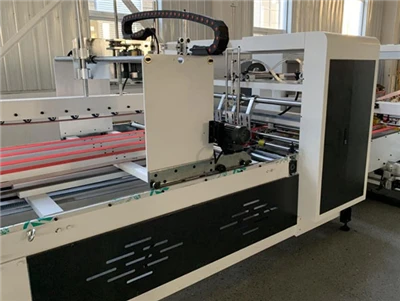
A corrugated folder gluer machine serves as the essential finishing equipment in corrugated box manufacturing. After corrugated board undergoes printing, slotting, or die-cutting, it must be folded along pre-creased score lines and joined along the manufacturer's joint (glue lap) using cold adhesive or hot-melt glue.
In modern packaging plants, the finishing section determines the entire facility's throughput limit. A bottleneck at the gluing stage prevents upstream printing presses and slotters from running at rated speeds, leading to plant floor congestion. Evaluating machine types based on automation levels ensures your finishing line matches your overall operational scale.
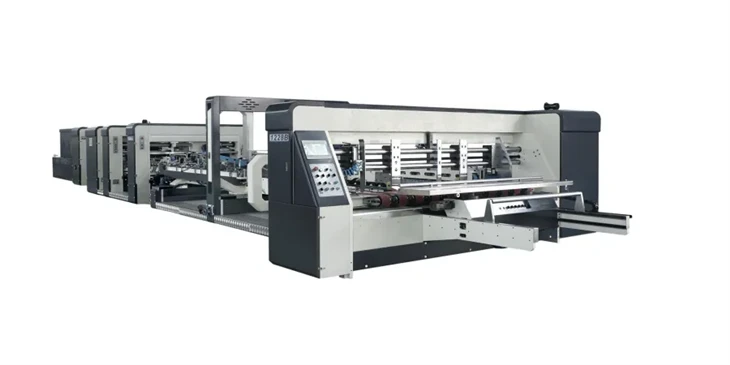
2. Structural Breakdown: Manual, Semi-Automatic, and Fully Automatic Solutions
Different machine configurations address distinct production environments. Evaluating mechanical design and labor allocation highlights the operational differences across these three categories.
Manual Gluing Solutions
Manual gluing systems rely heavily on manual operator intervention at every stage of the process.
- Operating Principle: Operators manually feed individual corrugated sheets, apply adhesive using hand-held applicators or simple motorized glue wheels, fold the panels by hand, and stack the finished boxes into pressing tables.
- Labor Requirement: High labor dependency. Typically requires 2 to 3 operators per station to maintain steady output.
- Production Speed: Low throughput, averaging 10 to 20 boxes per minute depending on operator speed and box dimensions.
- Best Fit: Specialized packaging shops producing heavy-duty double-wall or triple-wall boxes, oversized industrial containers, or ultra-short custom orders (under 500 units).
Semi-Automatic Folder Gluers
Semi-automatic machines bridge the gap between manual work and full automation by mechanizing the glue application and pressing stages.
- Operating Principle: Operators manually fold the corrugated board along its pre-scored lines and feed it into the machine's entry guide. The machine automatically applies precise glue beads, passes the joint through pressing rollers, and transfers the box to an automatic squarer and counter-ejector.
- Labor Requirement: Moderate labor. Requires 1 or 2 operators to fold and feed sheets into the machine inlet.
- Production Speed: Medium throughput, operating between 40 to 100 boxes per minute.
- Best Fit: Small-to-medium box plants running frequent order changes, medium-sized batches (1,000 to 5,000 units), and mixed flute profiles.
Fully Automatic Folder Gluers
Fully automatic systems manage the entire sequence-feeding, gluing, folding, squaring, counting, and bundling-without manual operator intervention during run time.
- Operating Principle: A high-speed suction belt feeder pulls single sheets from a hopper. The board passes through automatic motorized folding belts and glue spray nozzles, moves into a squaring section to align the manufacturer's joint, and exits via an automated bundle counter-ejector.
- Labor Requirement: Low direct labor. Requires 1 machine operator for setup and HMI supervision, alongside 1 downstream operator for bundle tying.
- Production Speed: High throughput, reaching 150 to 350 boxes per minute (or up to 180 to 300 meters per minute linear belt speed).
- Best Fit: High-volume box plants, high-speed inline flexo folder gluer (FFG) lines, and large-scale manufacturing servicing food, beverage, and e-commerce logistics.
3. Side-by-Side Solution Comparison
Comparing key performance metrics helps identify the right equipment for specific plant conditions.
| Performance Metric | Manual Gluing Setup | Semi-Automatic Folder Gluer | Fully Automatic Folder Gluer |
| Output Speed (Boxes/Min) | 10 – 20 | 40 – 100 | 150 – 350+ |
| Setup / Changeover Time | 0 – 5 Minutes | 5 – 15 Minutes | 5 – 20 Minutes (Motorized / Computerized) |
| Labor Allocation | 2 – 3 Workers | 1 – 2 Workers | 1 Operator + 1 Pack-off Worker |
| Dimensional Accuracy | Low (Operator Dependent) | Moderate (±2.0mm) | High (±1.0mm to ±1.5mm) |
| Flute Compatibility | All (A, B, C, E, F, BC, AAC) | Single & Double Wall (A, B, C, E, BC) | Single & Micro-Flute (E, F, B, C, EB) |
| Capital Investment (CAPEX) | Very Low | Moderate | High |
| Target Order Volume | < 500 Boxes | 1,000 – 5,000 Boxes | > 5,000+ Boxes |

4. Key Engineering Parameters for Equipment Selection
Selecting a corrugated folder gluer machine requires verifying specific mechanical and technical capabilities against your product mix.
1. Board Thickness and Flute Compatibility
Corrugated board ranges from thin micro-flute (E and F flutes, 1.0mm to 1.8mm) to thick heavy-duty double-wall board (BC and AA flutes, 6.0mm to 10.0mm).
- High-speed automatic machines require precise belt gauge adjustments and specialized feeding belts to prevent crushing delicate micro-flutes.
- Heavier double-wall boards require higher feed torque, reinforced folding arms, and heavy-duty side belts to fold thick paperboard without score-line cracking.
2. Maximum and Minimum Blank Sizes
Verify the machine's dimensional limits against your product portfolio.
- Maximum Blank Width and Length: Determines whether the machine can process large master shipping cartons.
- Minimum Blank Width and Length: Crucial for plants servicing e-commerce and small retail packaging, where compact box sizes are common.
3. Adhesive System Architecture: Cold Spray vs. Hot Melt
The choice of gluing system affects bond strength, consumable costs, and maintenance needs:
- Extrusion Cold Glue Systems: The standard choice for RSC (Regular Slotted Containers). Utilizes high-pressure cold adhesive spray valves controlled by optical sensors, delivering low operating costs and strong fiber-tearing bonds.
- Hot-Melt Adhesive Systems: Essential for wax-coated boards, heavy water-resistant liners, or high-speed crash-lock bottom boxes requiring instant tack before exiting the pressing section.
- Dual Cold/Hot Hybrid Systems: Used in premium automatic machines to provide instant hot-melt tack for line speed alongside long-term cold glue penetration strength.
4. Box Style Capability
Standard RSC boxes require straightforward parallel folding belts. However, complex box geometries demand specific machine features:
- Crash-Lock Auto-Bottom Boxes: Requires multi-stage pre-folding hooks, back-folding modules, and timed glue spray valves.
- 4-Corner and 6-Corner Trays: Demands servo-driven back-folding hooks to fold trailing flaps at high production speeds.
- Double-Piece (Two-Piece) Joined Boxes: Requires a dual-feeder indexing system to align and glue two separate corrugated sheets into a single large container.
5. Calculating Total Cost of Ownership and Production Efficiency
Evaluating machine ROI requires analyzing labor costs, scrap rates, and power consumption alongside the initial purchase price.
The daily throughput of a folder gluer is determined by multiplying operational run time by target speed, adjusted for setup delays and scrap loss. In practical plant calculations, total daily output equals total operating minutes minus total setup downtime, multiplied by average running speed in boxes per minute, multiplied by one minus the scrap rate percentage.
For example, consider a plant operating an 8-hour shift (480 minutes) with 4 order changes averaging 15 minutes each (60 minutes total setup downtime). The net running time is 420 minutes. Running a semi-automatic folder gluer at an average speed of 60 boxes per minute with a 1.5% scrap rate yields a net output of 24,822 finished boxes per shift. Running a fully automatic machine at 200 boxes per minute with a 0.5% scrap rate under the same setup conditions yields a net output of 83,580 finished boxes per shift.
Evaluating overall efficiency also involves calculating the payback period based on direct labor savings:
The payback period in years is calculated by dividing the initial capital investment of the machine by the net annual labor savings minus annual maintenance costs. Net annual labor savings are calculated by taking the number of eliminated operator positions multiplied by the fully loaded annual labor cost per worker.
If a fully automatic system eliminates two operator positions on a two-shift operation (4 total headcount savings) at an average annual cost of $35,000 per worker, gross annual labor savings equal $140,000. Subtracting $10,000 in annual maintenance and replacement parts yields a net annual savings of $130,000. For an initial machine investment of $195,000, the calculated payback period is 1.5 years.

6. Sourcing Considerations: Selecting a Reliable Equipment Manufacturer
Sourcing machinery requires evaluating manufacturing quality, component standardization, and technical support capabilities.
Working with an established auto folder gluer machine factory or carton folder gluer machine manufacturer ensures long-term access to replacement parts and technical support. When evaluating suppliers or purchasing through wholesale folder gluer machine channels, consider the following technical factors:
- Standardized Component Sourcing: Ensure the machine uses globally available electrical and pneumatic components (such as Siemens PLCs, Schneider electronics, SMC pneumatics, and Nordson or Valco Melton glue systems) to simplify local maintenance.
- Frame Construction and Rigidity: Heavy cast-iron side frames (30 mm to 40 mm thick) absorb vibration at high speeds, preserving folding accuracy and extending bearing life.
- HMI and Motorized Memory Setup: Modern automatic gluing machine corrugated box setups feature computer controlled positioning. The HMI stores order memory for feeder guides, folding belts, and glue nozzles, reducing setup times on repeat orders to under 3 minutes.
7. Operational Troubleshooting Matrix
Common operational issues can be addressed through systematic mechanical and pneumatic adjustments.
| Problem | Root Cause Analysis | Corrective Action |
| Fish-Tailing (Joint Skewing) | Uneven belt tension; improper folding guide alignment; differential belt wear. | Align folding belt speeds, equalize side-guide pressure, and check for worn transport belts. |
| Score Line Cracking (Flute Bursting) | Low ambient humidity; overly deep scoring; incorrect folding belt pressure on thick linerboard. | Apply water mist to score lines, adjust score profile wheels, or slow initial folding angle. |
| Glue Over-Spray or Flagging | Incorrect glue valve pressure; improper sensor timing; adhesive viscosity out of specification. | Clean spray nozzles, adjust PLC sensor delay settings, and verify glue viscosity. |
| Poor Adhesion (Pop-Open Joints) | Insufficient compression time; cold glue open time exceeded; wax-coated board surface. | Increase trombone belt compression pressure, adjust glue volume, or switch to hot-melt adhesive. |
| Board Jamming at Feeder | Worn suction feeder belts; improper gate height setting; warped corrugated sheets. | Replace feeder belts, re-set feed gate gap to 1.5 times board thickness, and adjust vacuum pressure. |
8. Summary Selection Protocol
To select the correct machinery configuration for your facility, apply this decision sequence:
- Assess Order Profile: For low-volume, short-run, or oversized heavy-duty boxes under 1,000 units, manual or semi-automatic folder gluers provide low capital investment and quick flexibility.
- Evaluate Throughput Requirements: For medium-to-large runs exceeding 5,000 units per order, fully automatic folder gluer machines deliver the speed and labor efficiency necessary to maintain profitability.
- Check Product Specifications: Verify flute profiles, maximum blank sizes, and box styles (RSC versus crash-lock) against candidate machine specifications.
- Audit Technical Quality: Partner with a proven carton folder gluer machine manufacturer that provides standardized components, robust frame construction, and reliable after-sales support.