Deploying palletizing robot systems allows box manufacturing plants to reduce direct packaging line labor costs by 60% or more by replacing multi-worker manual stacking teams with automated end-of-line robotics. Automating the material handling process eliminates turnover-related hiring costs, minimizes costly ergonomics workers' compensation claims, and establishes consistent pallet stacking throughput that optimizes downstream warehousing.
1. The Labor Crisis in Modern Corrugated Box Production
Corrugated packaging plants face mounting operational pressures driven by changing workforce demographics, rising minimum wages, and increasing throughput expectations from high-speed finishing equipment. While upstream machinery-such as flexo folder gluers, rotary die cutters, and folder gluers-has evolved to process thousands of blanks per hour, end-of-line palletizing frequently remains a labor-intensive bottleneck.
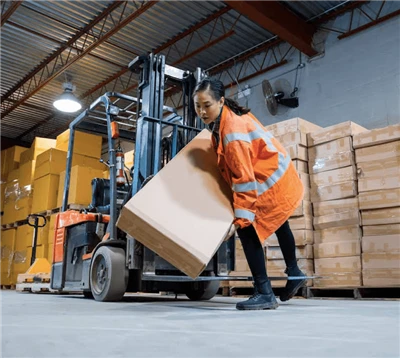
Manual palletizing requires workers to lift, rotate, and stack corrugated bundles continuously throughout an eight-hour shift. A standard corrugated finishing line producing 10,000 corrugated boxes per hour creates a heavy physical load. Workers handle bundles weighing between 10 kg and 25 kg every few seconds. Over a full shift, a manual stacking team shifts metric tons of material.
Operational Impact of Manual Stacking
- High Employee Turnover: Manual bundle stacking is among the most physically demanding jobs in a packaging facility. Box plants report annual turnover rates exceeding 40% to 60% in end-of-line manual handling positions.
- Ergonomic and Safety Claims: Repetitive bending, twisting, and heavy lifting lead to chronic musculoskeletal disorders. Back and shoulder injuries from manual palletizing account for significant workers' compensation costs in converting operations.
- Inconsistent Line Speeds: Human physical fatigue causes operational pacing to drop during the second half of shifts, forcing plant managers to derate upstream printing and converting equipment speeds.
- Pallet Quality Issues: Variable stacking alignment by tired workers results in unstable pallet loads, leading to shipping damage, customer rejections, and warehouse storage inefficiencies.
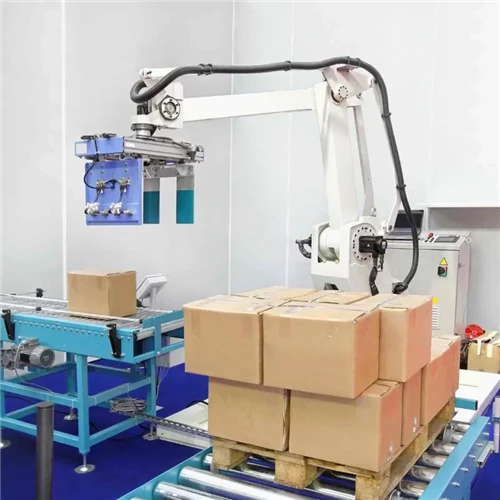
Integrating a dedicated case palletizer or industrial articulated robot arm directly at the finishing line discharge replaces manual labor with reliable automation.
2. Direct Labor Reduction: The Mechanics of a 60% Cost Cut
Achieving a 60% reduction in end-of-line labor costs is rooted in headcount optimization and shift coverage efficiency. In a traditional manual packaging plant, operating a high-speed converting line across multiple shifts requires dedicated manual personnel at every discharge point.
Traditional Manual Palletizing Cell
A standard manual packaging line operating on a two-shift schedule requires four to six dedicated stacking operators per day. On Shift 1, two operators position empty wooden pallets, take bundles from the outfeed conveyor, align tie-sheets, and hand-stack up to 2.0 meters high. On Shift 2, two additional operators perform identical manual handling duties. With one floating worker needed to cover breaks, lunch periods, and shift rotations, the facility must allocate a total headcount of five dedicated workers.
Robotic Palletizing Cell
Replacing manual operations with a robotic arm changes the labor requirement from active physical lifting to periodic supervisory monitoring. On Shift 1, a single line operator manages the upstream folder gluer while supervising the robotic cell, with a forklift driver replacing finished pallets periodically. Shift 2 operates under the same structure. The total dedicated stacking headcount drops to zero dedicated stacking personnel, as one floating operator covers material replenishment across multiple automated lines.
By shifting human labor from manual lifting to supervisory roles across multiple lines, facilities eliminate four out of five dedicated stacking positions, yielding a direct labor savings of 60% to 80% per finishing line.
3. Financial Comparison: Manual vs. Robot Palletize Operations
Evaluating the total cost structure of end-of-line operations requires examining direct wages, indirect employment overhead, equipment maintenance, and capital expenditure over a five-year operational horizon.
When evaluating manual vs robot palletize workflows, plant managers must account for hidden overhead expenses associated with human labor, including medical insurance, payroll taxes, recruitment fees, training costs, and safety equipment.
| Expense Category | Manual Palletizing Team (4 Workers) | Single-Arm Industrial Robotic Cell |
| Initial Capital Investment (CAPEX) | $0 | $150,000 – $220,000 |
| Annual Direct Wages ($20/hr base) | $166,400 | $0 |
| Annual Payroll Taxes & Benefits (30%) | $49,920 | $0 |
| Annual Turnover & Recruitment Costs | $12,000 | $0 |
| Annual Workers' Comp Insurance Premium | $18,000 | $2,000 |
| Annual Power & Utility Consumption | $0 | $3,500 |
| Annual Preventive Maintenance & Parts | $0 | $4,500 |
| 5-Year Total Operational Cost | $1,231,600 | $210,000 – $280,000 |
| Net 5-Year Savings with Robotics | - | $951,600 – $1,021,600 |
The financial data confirms that while manual stacking carries zero upfront capital expenditure, its ongoing operational cost scales linearly with labor rates and headcount requirements. A robotic cell amortizes its initial capital cost within 12 to 18 months of full-time operation.
4. Key Components of Automated Palletizing Robot Systems
Modern palletizing robot systems engineered for corrugated packaging plants consist of synchronized mechanical, electrical, and optical sub-systems designed to process varied box dimensions without human intervention.
1. The Articulated Industrial Robot Arm
The central motion component is typically a 4-axis or 6-axis industrial articulated robot arm rated for payloads between 110 kg and 300 kg. Four-axis robots are the standard for palletizing because they maintain the End-of-Arm Tooling parallel to the floor surface throughout their working envelope, simplifying motion control logic and offering higher high-speed cycle rates.
2. Specialized End-of-Arm Tooling (EOAT)
The EOAT (or gripper) interfaces directly with the corrugated board. Vacuum grid grippers utilize high-volume vacuum blowers combined with foam seal mats or area-selective suction cups, making them ideal for picking flat corrugated bundles or closed shipping cartons without crushing fragile flutes. Mechanical side-clamp grippers use pneumatic servo-driven side plates to clamp bundles securely from the sides, featuring bottom support fingers that extend under the load during high-speed travel. Combination grippers feature integrated vacuum cups for tie-sheet placement and pneumatic forks for picking empty wooden pallets from an adjacent dispenser.
3. Infeed Squaring and Centering Conveyors
Bundles exiting a folder gluer or bundle strapper often exhibit minor alignment variations. Before a robot picks a load, the infeed conveyor centers and squares the bundle using motorized side guides. Precise infeed positioning is essential for the robot controller to calculate exact pick-and-place coordinates.
4. Automated Tie-Sheet and Slip-Sheet Dispensers
Unstable or tall pallet stacks require solid fiberboard or corrugated tie-sheets placed every few layers to lock the load together. Automated tie-sheet dispensers use dedicated vacuum suction cups to pick a sheet from a storage rack and place it onto the developing pallet stack between robot pick cycles.
5. Automatic Empty Pallet Dispensers and Outfeed Conveyors
To eliminate all manual lifting, an automated pallet dispenser stores up to 15 empty pallets and dispenses them one by one onto an inline roller conveyor. Once a pallet reaches its programmed stack height, the heavy-duty powered outfeed conveyor transfers the finished load out of the cell to an automatic stretch wrapper while a new empty pallet immediately enters the picking zone.

5. Payback Analysis and Return on Investment (ROI) Calculations
Calculating the financial feasibility of installing an automated palletizer requires evaluating capital expenditure against operating expenses over the equipment's expected lifetime.
The payback period in years is calculated by dividing the total capital investment by the net annual cost savings generated by the automation system. Total investment includes the base machine price, end-of-arm tooling, safety enclosure, installation labor, freight, and commissioning. Net annual cost savings are determined by subtracting new annual operating expenses-such as electrical power consumption and routine maintenance-from annual labor savings and reduced workers' compensation costs.
In a representative practical application, if the total machinery, tooling, shipping, and installation investment totals $200,000, and replacing four manual stacking workers across two shifts yields $180,000 in annual labor savings while incurring $8,000 in combined annual electricity and maintenance expenses, the net annual savings equal $172,000. Dividing the $200,000 initial investment by the $172,000 net annual savings yields a payback period of 1.16 years, or approximately 14 months.
After the 14-month payback threshold is crossed, the cell generates $172,000 in net positive cash flow annually for the remainder of its 10-to-15-year mechanical lifespan.
6. Sourcing Considerations: Evaluating a Palletizer Manufacturer and Global Supply Chains
Selecting the right equipment partner requires evaluating structural build quality, control system architecture, and long-term technical support. Procurement teams often weigh domestic integrators against specialized overseas manufacturers when evaluating total project costs.
Evaluating Global Sourcing and Procurement Options
Sourcing a palletizing robot China OEM supplier offers significant capital savings, provided the machinery meets regional electrical and safety standards. Packaging plants evaluating international manufacturers should verify that the machine uses globally standardized PLC platforms (such as Siemens or Rockwell Automation) and standard robotic arms (such as FANUC, ABB, KUKA, or Yaskawa) to guarantee local spare parts availability. Furthermore, verify that the robotic cell complies with ISO 10218-1/2 for robot safety and ISO 13849-1 for functional safety. Working directly with an established palletizer manufacturer that provides pre-configured, modular cell layouts simplifies installation and minimizes commissioning times on the factory floor.
Understanding Factors Influencing Palletizing Robot Price
The total palletizing robot price varies based on mechanical complexity, payload capacity, and line automation levels:
- Entry-Level Collaborative Palletizing Cells ($60,000 – $90,000): Feature lower-payload cobots (10 kg to 30 kg) without physical perimeter safety fencing. Best suited for low-speed lines running 5 to 10 picks per minute.
- Standard Industrial Single-Arm Cells ($130,000 – $190,000): Feature 4-axis industrial articulated arms (100 kg to 180 kg payload), complete safety enclosure, automated infeed conveyors, and tie-sheet placement. Designed for high-speed corrugated finishing lines running 12 to 25 picks per minute.
- High-Speed Multi-Line Cells ($220,000 – $350,000+): Feature heavy-payload robots (300 kg+), dual-pallet picking zones, automatic pallet dispensers, motorized outfeed shuttle cars, and integrated stretch wrappers.
7. Beyond Labor: Additional Operational Benefits of Automated Stacking
While a 60% reduction in labor expenses drives the primary financial justification for robotic equipment, automated end-of-line systems provide substantial secondary operational advantages across the manufacturing plant.
1. Consistent Line Throughput
Unlike human operators whose working speeds decline due to fatigue over a shift, an industrial robot operates continuously at 100% rated speed. Eliminating end-of-line bottlenecks allows plant managers to run upstream flexo folder gluers and rotary die cutters at their maximum rated mechanical velocity, increasing overall plant capacity without adding machinery.
2. Perfect Pallet Cube Optimization
Robotic vision systems and pre-programmed pattern software ensure every bundle is placed with millimeter-level positional repeatability. Perfectly square pallet stacks maximize vertical warehouse storage space and prevent pallet leaning during transport.
3. Reduction in Finished Goods Scrap and Damage
Manual handling of corrugated bundles frequently causes edge damage, crushed flutes, and torn outer liners when workers drop or force bundles into tight patterns. Servo-controlled vacuum grippers lift and place bundles with regulated pressure, eliminating transit-related material scrap and reducing customer return rates.
8. Troubleshooting Common Operational Issues in Robotic Cells
Maintaining peak operational uptime requires understanding common fault conditions and implementing preventive maintenance routines.
| Operational Issue | Root Cause Analysis | Corrective Action |
| Bundle Dropping During Transfer | Vacuum pressure loss; worn vacuum foam seal; porous corrugated linerboard. | Inspect vacuum pump filters and relief valves, replace worn foam sealing pads on EOAT, and increase vacuum blowback pressure in PLC parameters. |
| Pallet Pattern Misalignment | Infeed bundle centering guides out of adjustment; slip on infeed conveyor belt. | Recalibrate infeed squaring pneumatic cylinder stroke and clean conveyor belt surfaces to remove corrugated dust and paper debris. |
| Tie-Sheet Pick Failure | Static electricity binding sheets together; worn suction cups on tie-sheet arm. | Install anti-static ionizer bars over the tie-sheet storage rack and replace worn silicone vacuum cups on the sheet dispenser. |
| Intermittent Cell Trips (Safety Circuit) | Optical misalignment of safety light curtains due to conveyor floor vibration. | Re-align light curtain emitter and receiver posts using laser tools, and install anti-vibration rubber dampening pads beneath safety fence mounts. |
| Robot Stops with Payload Error | Exceeded joint torque limits caused by incorrect bundle weight inputs in HMI. | Verify paperboard basis weight parameters in job recipe settings and update payload mass properties in the robot controller program. |
9. Commissioning and Implementation Roadmap
Transitioning a corrugated box packaging line from manual handling to automated robotic palletizing requires careful site preparation and systematic execution.
Phase 1: Engineering Audit and Cell Design (Weeks 1–4)
Audit the complete range of finished box dimensions, bundle weights, stack heights, and pallet footprints. Determine required picking cycle speeds based on maximum upstream finishing line output, and select the appropriate cell footprint configuration.
Phase 2: Procurement and Factory Testing (Weeks 5–12)
Finalize equipment purchase orders with the selected palletizer manufacturer. Complete Factory Acceptance Testing at the builder's facility using production samples of your corrugated bundles and pallets, verifying safety interlocks, light curtain response distances, and recipe changeover functions.
Phase 3: Site Preparation and Mechanical Installation (Weeks 13–14)
Run high-voltage electrical power lines and compressed air lines to the cell drop point. Level and anchor the industrial robot mounting base to the concrete floor using heavy-duty chemical expansion bolts, then assemble physical perimeter safety fencing, interlocked access gates, and optical sensors.
Phase 4: Integration and Operator Training (Weeks 15–16)
Wire input and output signals between the upstream conveyor control panel and the Safety PLC. Program box stacking patterns into the pattern generation software, and conduct comprehensive operator training focusing on recipe selection, HMI navigation, safety reset procedures, and routine daily maintenance.
10. Strategic Conclusion for Plant Operations
Automating the end-of-line packaging process with palletizing robot systems represents one of the most effective capital investments available to corrugated box manufacturers today. By directly addressing the industry-wide challenges of rising labor costs, high employee turnover, and physical ergonomic risks, robotic automation provides a clear path to sustainable manufacturing.
Transitioning from manual stacking to robotic palletizing yields a direct 60% or higher reduction in packaging line labor costs, amortizes capital equipment expenses within 12 to 18 months, and improves finished product quality. Plant managers who adopt automated palletizing position their facilities to operate with lower overhead, higher throughput, and predictable, long-term operational costs.