In the competitive landscape of the corrugated paperboard production line, the double facer corrugated machine is the heart of the finishing process. It is the critical juncture where the single-face web and the bottom liner are bonded to create a rigid, high-quality board. However, one issue continues to plague plant managers worldwide: double facer coating blistering.
Localized delamination-commonly known as blistering-occurs when the bond between the liner and the flute tips fails. This leads to massive waste, jam-ups in the automatic box gluing machine, and rejected orders from clients. As we move through 2026, with the rise of lightweight and high-recycle-content papers, solving blistering requires more than just "turning up the heat." It requires a mastery of thermal stability, mechanical mass, and moisture equilibrium.

The Science Behind Double Facer Coating Blistering
Double facer coating blistering is essentially a failure of the "Bonding Trinity": Heat, Pressure, and Time. When these three variables are out of alignment, the starch adhesive fails to gelatinize, or trapped moisture turns into steam that "blows" the liner away from the flutes.
The "Flash Steam" Effect
In high-speed production, if the heating section is too short, operators often increase the steam pressure to compensate. This creates a dangerous "Flash Steam" effect. The moisture in the paper turns to steam so rapidly that it cannot escape through the liner's pores, creating a bubble-or blister-in the center of the board.
To prevent this, a standardized 21,000mm (21-meter) heating length is the industry gold standard. This extended path allows for a "Tapered Heating" profile, where moisture is released gradually without compromising the adhesive bond.
Why Mechanical Mass Matters?
A common but overlooked cause of double facer coating blistering is micro-vibration. If the heating plates or the pressure system vibrate during high-speed operation, the contact between the flute tips and the liner becomes intermittent. Even a vibration of 0.5mm can prevent a consistent bond.
Our heavy-duty double facer corrugated machine series is engineered with a massive structural foundation. With total weights ranging from 38T to 47T, these machines provide a dampened, vibration-free environment. This physical mass ensures that the pressure belt remains in constant, uniform contact with the board across the entire 21-meter heating section.
Performance & Output Matching Matrix (2026 Specs)
Selecting the right width is essential for your facility's throughput, but the core technology remains consistent across our entire range. All models feature the optimized 4KW motor power, ensuring maximum energy efficiency without sacrificing the stability needed to prevent blistering.
| Model Width (mm) | External Dimensions (LWH) | Total Weight (T) | Motor Power (KW) | Strategic Application |
| 1400 | 2100023202160 | 38 | 4 | Niche/Boutique Packaging |
| 1600 | 2100025202160 | 40 | 4 | Standard Carton Mainstay |
| 1800 | 2100027202160 | 42 | 4 | Global Export Benchmark |
| 2000 | 2100029202160 | 44 | 4 | High-Speed Automation Lines |
| 2200 | 2100031202160 | 46 | 4 | Industrial-Grade Heavy Board |
| 2300 | 2100032202160 | 47 | 4 | Flagship Maximum Capacity |
Solving Blistering: A 4-Step Technical Protocol
If your corrugated paperboard production line is currently generating blisters, follow this audit protocol to identify and fix the issue within your double facer corrugated machine.
Step 1: Heat Gradient Calibration
Do not run all steam plates at the same temperature. Use a "Tapered" approach. The first 5-7 meters should be at maximum temperature to initiate starch gelatinization. The middle section should maintain this heat, while the final 5 meters should slightly taper off to allow for moisture stabilization. Our 21m length makes this gradient control much easier to manage than shorter machines.
Step 2: Pressure Uniformity Check
Blistering in the center of the board often indicates that the pressure belt or rollers are "crowning" or worn. Use carbon-sensitive paper to check the footprint of your pressure system. The 47-ton frame of our flagship 2300mm model is designed to resist thermal bowing, ensuring that pressure remains even from edge to center.
Step 3: Starch Gel Point vs. Line Speed
Ensure your glue kitchen is delivering a starch with a gel point that matches your speed. If you are running at 250m/min over a 21,000mm heating section, your starch needs to "fire" at exactly the right moment. If it fires too early, it dries out; too late, and it remains wet, causing double facer coating blistering.
Step 4: Moisture Control (Pre-Conditioning)
Verify the moisture content of your liners. If the moisture is above 9%, you must increase the wrap angle on your pre-heaters before the paper enters the double facer corrugated machine.
The Economic Impact of Equipment Choice
In 2026, the cost of paper is the highest expense in any plant. A 2% waste rate due to blistering on a high-speed corrugated paperboard production line can cost a company over $250,000 annually in raw materials alone.
Choosing a machine with a 21-meter heating path and a heavy-duty 47T frame is an investment in waste reduction. Furthermore, our 4KW motor system significantly lowers the operational overhead. When you combine reduced waste with lower energy consumption, the ROI (Return on Investment) of a premium double facer becomes clear within the first 18 months of operation.
Integration with Robotic Palletizing Systems
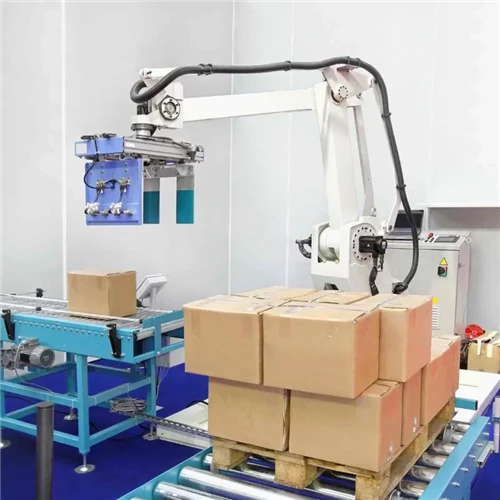
The quality of the bond created in the double facer corrugated machine dictates the success of your downstream automation. Boxes with micro-blisters have poor vertical crush resistance. When these boxes reach the automatic case palletizersr or any Robotic Palletizing Systems, the bottom layers of the pallet may collapse. A "perfect bond" is not just about aesthetics; it is a requirement for modern, automated logistics.
Engineering Out the Defects
Double facer coating blistering is a problem that can be engineered out of existence. By providing enough length for moisture to escape (21m), enough weight to stop vibration (up to 47T), and enough technical control to manage heat gradients, you ensure that your corrugated paperboard production line stays profitable.
Consistency is the ultimate goal. Whether you are running a 1400mm or a 2300mm wide line, our equipment is built to handle the rigors of 24/7 production, delivering blister-free board that meets the highest international standards.