
In the downstream automation layout of modern corrugated plants and paper mills, high-volume materials must be stabilized, secured, and prepared for heavy logistics before they leave the manufacturing floor. When routing product from an automatic corrugated box machine, structural packaging engineers frequently evaluate two core stabilization technologies: the unitizer and the palletizer.
While both machinery categories serve the universal commercial goal of preparing bundled goods for transit, they rely on entirely different mechanical principles, handle completely different load scales, and occupy distinct physical positions within the factory workflow.
This technical guide clarifies the mechanical architecture, material handlings limits, and deployment criteria for both systems, allowing procurement officers and factory directors to select the correct equipment configuration.
Mechanical Definitions and Core Functions
To establish a clear structural boundary, engineers must evaluate how each machine handles raw material geometry.
What is a Palletizer?
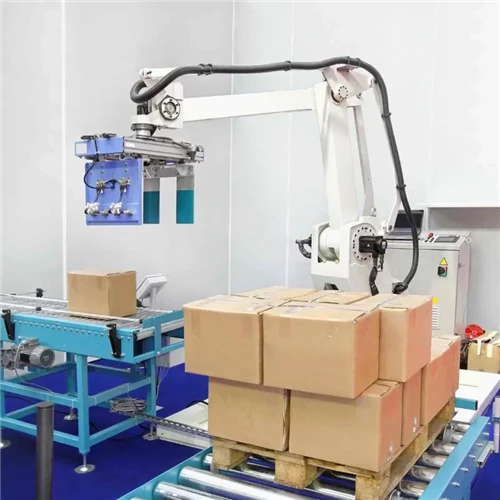
A palletizer is an automated system designed to arrange, orient, and stack individual smaller units-such as secondary shipping cartons, plastic trays, or plastic bundles-onto a rigid shipping base, typically a wooden or plastic pallet (1200 * 1000 mm or 1200 * 800 mm).
The functional architecture of a palletizer relies heavily on precise kinematics, often using a multi-axis arm robot or a high-level mechanical layer-forming matrix. The system takes single individual items coming off a low-clearance conveyor, executes a pre-programmed interlocking layer configuration, and builds a stable vertical stack directly on top of the pallet foundation.
What is a Unitizer?
A unitizer is a high-pressure, heavy-duty machinery center designed to stabilize massive bulk loads by compressing and binding an entire single mass into a unified "unit." In the corrugated packaging industry, a unitizer does not process individual boxes. Instead, it processes a pre-formed stack of hundreds of flat-packed corrugated sheets or finished, un-folded box bundles that have been loaded directly onto transport runners or a master shipping sheet.
The core of a unitizer consists of a massive hydraulic or pneumatic compression platen and automated strapping or band-delivery heads. The machine drives a large vertical force downward onto the top of the stack to displace trapped internal air between individual sheets, then feeds high-tensile polypropylene (PP) or polyester (PET) strapping through the internal voids to bind the compressed stack under high tension.
Read More : 《Palletizers Vs. Manual Labor:Choosing The Right Solution For Your Business Storage Pallet Racking》
Read More : 《Robotic Palletizer ROI Guide 2026》

Material Flow and Shop Floor Positioning
Evaluating what robots are used for and where automated lines interface requires analyzing the material progression through the factory matrix.
Upstream/Downstream Line Sequence
The Palletising Matrix: Positioned immediately after secondary case packaging or individual bundling stations. If a factory runs an automated line where a 5 ply flute laminator finishes heavy combined board and sends it through a die-cutter, a collaborative or traditional cobot palletiser lifts individual bundles to construct the stack layer-by-layer.
The Unitising Matrix: Positioned at the absolute end of the primary logistics corridor. It often serves as a centralized terminal node that processes bulk loads coming from multiple individual production lines simultaneously.
Material Geometry Changes
A palletizer increases the structural load by adding spatial layers; it takes low, loose items and transforms them into a taller, orderly cuboid mass.
A unitizer changes the physical density of the load without adding units. It compresses a loose, structurally unstable tower of paperboard into an extremely dense, rigid blocks that cannot slide or shift during long-distance maritime freight or intermodal rail transport.
Head-to-Head Architectural Comparison
| Engineering Variable | Automated Palletising System | Industrial Bulk Unitizer |
| Primary Material Input | Individual cartons, bags, cases, or small bundled items. | Pre-stacked bundles of flat sheets or un-folded boxes (large batch volumes). |
| Stabilization Method | Mechanical interlocking stacking patterns via robotic path-planning or layers. | High-pressure vertical compression combined with high-tension strap banding. |
| Load Foundation Base | Requires a standardized transport base (wooden, plastic, or slip sheet). | Can process loads on pallets, wood skids, or completely palletless via bottom runners. |
| Force Application Metric | Low mechanical force; focuses on precision placement and orientation. | Massive vertical force (typically 2,000 kg to 5,000 kg+ of platen compression pressure). |
| Operational Throughput | Measured in items/minute or cycles/minute (e.g., 10-40 cycles/min). | Measured in bulk units/hour or total processed container tons per operational shift. |
| Factory Line Integration | Decentralized (placed at the exit gate of individual converting centers). | Centralized (acts as a terminal choke point for multiple incoming factory transport lines). |
Deep Mechanical Analysis of Stabilization Forces
The absolute engineering differentiator between these two machinery platforms is the physical mechanism used to prevent shifting during transit forces (braking, cornering, and acceleration).
Layer Interlocking vs. Friction Matrix
A palletizer secures materials by utilizing spatial geometry. By rotating alternate layers by 90° or 180°, the machine builds an interlocking structural brick pattern. This mechanical layout distributes the center of gravity evenly and uses the weight of the upper packages to hold down the lower layers.
Volumetric Air Displacement
A unitizer secures materials by altering the internal coefficient of friction between smooth paperboard surfaces. When an automatic corrugated box machine stacks flat box blanks, air becomes trapped between each layer of paperboard. If this air remains inside, the stack acts like a loose deck of playing cards; a sudden shift causes the top layers to slide off completely.
The unitizer applies tons of top-down mechanical compression to force all trapped air out of the stack matrix. While the load is held under this extreme pressure, multiple automated strapping heads weld heavy-duty plastic bands tightly around the bundle. When the platen lifts, the internal spring-back tension of the compressed cardboard pushes outward against the rigid plastic straps, locking the entire mass together via pure friction.

Selection Criteria-Which Equipment Matches Your Factory Output?
When contacting an equipment manufacturer to specify an end-of-line system, mechanical engineers must match the machine configuration to the specific output profile of the plant.
Choose a Palletizer Setup If:
- Your factory manufactures finished three-dimensional containers filled with goods (e.g., consumer goods, canned beverages, packaged food cartons) that cannot withstand vertical crushing forces.
- Your downstream production requires sorting various distinct product SKU lines into dedicated, individual shipping destinations.
- Your logistics system relies completely on standard wooden pallets for fork-truck distribution.
Choose a Unitizer Setup If:
- Your facility is a high-output corrugated plant or sheet feeder mill that converts thousands of tons of flat-packed containerboard daily.
- Your primary shipping output consists of dense, un-folded box blanks or collapsed bundles destined for a secondary converter factory.
- You need to maximize shipping container volume by utilizing palletless shipping techniques (using a unitizer to bind the cardboard tightly onto thin bottom paperboard runners).
Achieving Automated Continuity
For high-volume industrial installations, modern plant design does not force a choice between these two platforms; instead, they are integrated into a single automated ecosystem.
In a fully optimized material handling layout, an automatic palletizing robot works at the decentralized cell level to handle high-speed layer creation and precision package manipulation. The completed stacks are then routed via heavy-duty chain driven roller conveyors to a centralized industrial unitizer terminal. The unitizer applies heavy vertical compression and runs high-tensile straps through the load, locking the layers together.
By combining the precision kinematics of the palletizer arm with the brute force compression of the unitizer, factories can eliminate manual strapping, reduce product transit damage to zero, and maximize daily production throughput.