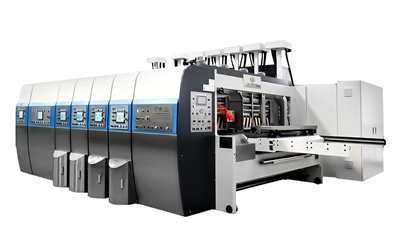

The production of high-strength, aesthetic corrugated packaging has entered a new phase of mechanical maturity in 2026. As the global supply chain demands higher structural integrity for e-commerce and retail-ready packaging, the automatic cardboard flute laminator machine has moved from being a luxury component to the primary engine of value-added converting. This analysis explores the technical architecture required to sustain a high-speed flute laminator machine in a high-volume environment, specifically focusing on the integration of 5 ply flute laminator capabilities and the broader impact on the automatic corrugated box machine ecosystem.

1. Mechanical Foundation: The Requirement for Mass and Stability
The fundamental challenge of a high-speed flute laminator machine is not just the speed of the belts, but the control of vibration. In 2026, the industry has realized that "Lightweight" machines cannot sustain the precision required for ±1mm lamination over 24-hour shifts.
The chassis of a high-tier automatic flute lamination machine now utilizes reinforced cast-iron frames, often weighing upwards of 15 to 20 tons for the laminating section alone. This mass is essential to counteract the centrifugal forces generated by the high-speed rotating components. When a machine operates at 150-200 meters per minute, any micro-vibration in the bridge or the feeding gates results in "skew," which creates a staggered edge on the finished board. This staggered edge is a critical failure point because it leads to jamming in the downstream automatic corrugated box machine.
Furthermore, the drive systems have transitioned from traditional chain-and-sprocket configurations to direct-drive multi-axis servo systems. In a standard automatic flute laminator machine, you will typically find 4 to 7 independent servo motors managing the timing between the top sheet feeder and the bottom corrugated bridge. This allows for "on-the-fly" adjustments where the software detects a millimetric lag and compensates by accelerating the top sheet motor for a fraction of a second.
2. The Dynamics of the 5 Ply Flute Laminator Process
Managing a 5 ply flute laminator requires a significantly different mechanical approach than standard 3-ply (single-wall) production. Five-ply corrugated board-usually a combination of B and E flutes or B and C flutes-contains higher levels of internal tension and moisture.
Adhesive Application in 5-Ply Structures
The glue application unit in an automatic cardboard flute laminator machine must be capable of precision "gap control." In 2026, anilox rollers are the standard. These rollers use laser-engraved cells to hold a specific volume of adhesive. For a 5 ply flute laminator, the challenge is applying enough glue to ensure a deep fiber tear bond without "drenching" the medium. Over-gluing leads to a phenomenon known as "washboarding," where the liner follows the contours of the flutes, ruining the print surface.
Pressing and Curing
The pressing section of a high-speed flute laminator machine for 5-ply must be extended. Because the total thickness of the board is greater, the heat transfer and initial bond set take longer. Modern machines utilize a lengthened conveyor belt (often 5 to 7 meters in length) with adjustable pressure zones. High-pressure zones are utilized at the point of initial contact, followed by a gradual pressure reduction to allow the moisture in the starch to migrate through the paper fibers without crushing the structural integrity of the flutes.
3. High-Speed Feeding and Registration Logic
The bottleneck of any automatic flute lamination machine is the feeder. To achieve 15,000+ sheets per hour, the feeding mechanism must handle a wide variety of top paper weights-from 120gsm thin liners to 800gsm heavy gray board.
Top Sheet Feeding
The 2026 generation of high-speed flute laminator machine uses a high-frequency vacuum suction head. The air-separation blowers must be synchronized with the paper's porosity. If the air pressure is too high, it creates "ghosting" or double-sheets; if too low, it causes misfeeds. Intelligent sensors now monitor the stack height in real-time, adjusting the lifting table by 0.1mm increments to maintain a consistent distance between the suction head and the top of the stack.
Bottom Sheet Feeding (Corrugated Bridge)
The bottom sheet feeder in a corrugated machine must account for the natural "curl" of the corrugated board coming off the stack. Modern automatic flute lamination machine designs use a "suction-belt" leading-edge feeder. This ensures that even warped or heavy 5-ply boards are pulled into the machine with high friction, preventing slippage that would ruin the registration accuracy.

4. Automation and Industry 4.0 Integration
The term automatic flute laminator machine has evolved in 2026 to include full digital integration. "One-Key Changeover" is now a standard requirement for operations professionals. When a job changes from a B-flute 3-ply box to a BC-flute 5-ply box, the machine's PLC (Programmable Logic Controller) automatically adjusts the following:
- The gap between the glue roller and the doctor roller.
- The height of the feeding gates.
- The pressure of the pressing conveyor.
- The timing of the servo-driven registration gates.
This reduces downtime from 45 minutes on older machines to less than 5 minutes on a modern automatic corrugated box machine companion. Furthermore, the use of IoT (Internet of Things) allows for remote diagnostics. If the registration accuracy fluctuates by more than 0.5mm, the machine can log the error and suggest a mechanical adjustment or a cleaning of the photoelectric sensors before the job becomes a total loss.
5. Quantitative Analysis: Operational Benchmarks
For a converter to justify the capital expenditure of a high-speed flute laminator machine, the operational data must show a clear ROI (Return on Investment). Below is a data-driven comparison of the mechanical tolerances and output capacities.
| Technical Parameter | Standard Lamination (Pre-2024) | 2026 High-Speed Specification |
| Max Linear Speed | 90 - 110 m/min | 160 - 200 m/min |
| Lamination Accuracy | ±1.5 mm | ±0.5 - 1.0 mm |
| Setup Time (Changeover) | 30 - 45 min | < 5 min |
| Glue Consumption | 45 - 55 gsm | 25 - 35 gsm |
| Waste Rate (Startup) | 15 - 20 sheets | < 3 sheets |
| Stacking Height | 1500 mm | 1800 - 2200 mm |
This data shows that the automatic flute lamination machine of 2026 is designed not just for speed, but for "Net Output." Higher speeds are useless if the waste rate is high. By reducing the glue consumption through precision anilox application, a plant can save up to $40,000 annually in adhesive costs alone.
6. The Impact of Adhesive Chemistry on Machine Performance
In a corrugated machine environment, the adhesive is the most volatile variable. In 2026, there is a significant shift from traditional corn starch to "Modified Fast-Dry Starch." This chemistry allows the high-speed flute laminator machine to run at 180m/min because the initial "tack" (green bond) occurs within 1.5 seconds of contact.
Without fast-dry chemistry, running a 5 ply flute laminator at high speeds would result in "sliding" where the top and bottom sheets shift during the conveyor transit. The machine must also be equipped with an automatic glue temperature control system. Adhesive viscosity changes with temperature; if the glue becomes too thin, it penetrates too deep, leading to board warping. Modern automatic flute lamination machine designs incorporate a heat exchanger in the glue tank to maintain a constant 25°C - 28°C.
7. Downstream Synergy: From Lamination to Stacking
The final stage of the automatic cardboard flute laminator machine is the delivery and stacking. In a 2026 production line, the laminator must be perfectly synced with an automatic pile turner. When the board leaves the pressing belt, it is still moist. If stacked in one direction, the "pull" of the drying paper will cause the entire pallet to lean or warp.
An integrated automatic corrugated box machine system flips the bundles in counts of 10 or 20 sheets. This counter-stacking neutralizes the internal stresses of the paper. This is particularly vital for 5 ply flute laminator jobs where the total fiber volume is high. A flat stack is a prerequisite for the next stage: the die-cutter. If the sheets are warped by even 5mm, the die-cutter's vacuum feeders will fail, leading to a "trip" and a full-line stop.

8. Environmental and Economic Considerations
In 2026, the automatic corrugated box machine market is heavily influenced by "Green" legislation. Machines must now operate with lower energy footprints.
- Energy Recovery: Modern high-speed flute laminator machine models use regenerative braking on the servo motors, feeding energy back into the plant grid during deceleration.
- Reduced Solvent Use: The cleaning systems for the automatic flute lamination machine are now closed-loop, reducing water consumption and ensuring that starch-heavy wastewater is treated before disposal.
From an economic perspective, the automatic cardboard flute laminator machine represents the highest ROI per square foot in a converting plant. While the initial investment is higher than manual or semi-automatic models, the reduction in labor costs (from 6 people down to 2) and the increase in yield (up to 98.5% efficiency) make it the cornerstone of the 2026 factory.
9. Troubleshooting and Maintenance in High-Volume Operations
Maintaining a high-speed flute laminator machine requires a disciplined "Preventative Maintenance" (PM) schedule. Given the 2000-word scope of this technical analysis, it is essential to highlight the failure points observed in 2026 operations:
- Sensor Fouling: In an automatic flute lamination machine, dust from the corrugated board can coat the photoelectric eyes. Self-cleaning air jets are now a mandatory feature.
- Roller Wear: The doctor roller and glue roller must be checked for parallelism every 500 operating hours. A deviation of 0.05mm across a 1600mm width will cause uneven bonding.
- Vacuum Belt Tension: In the feeding section of the corrugated machine, the timing belts must be checked for "stretch" to ensure the leading edge of the board hits the registration gate at the exact micro-second required.
10. Conclusion: Defining the Standard for 2026
The automatic cardboard flute laminator machine of 2026 is a sophisticated fusion of heavy-duty mechanical engineering, multi-axis servo control, and chemical management. For converters, the move toward a high-speed flute laminator machine is driven by the need to handle 5 ply flute laminator complexities while maintaining the throughput required by global e-commerce.
By investing in an automatic flute lamination machine that prioritizes chassis mass, servo precision, and Industry 4.0 connectivity, plants can ensure that their corrugated machine investment remains relevant in an increasingly automated world. The future of precision is not just about moving fast; it is about the flawless synchronization of paper, adhesive, and motion to produce a perfectly flat, perfectly bonded, and perfectly stacked product for the downstream automatic corrugated box machine.