
According to industry data compiled by the Association for Packaging and Processing Technologies (PMMI), material accumulation and handling at the end of the line account for up to 60% of unplanned downtime in secondary packaging facilities. While an upstream cardboard box making machine for sale might entice procurement teams with promised manufacturing speeds of over 300 blanks per minute, that capacity remains purely theoretical if your downstream configuration cannot handle the physical output.
When a high-speed folder-gluer runs at full capacity, it pumps out compressed, finished cartons in tight bundles. If the subsequent stacking and palleting department relies on manual labor or siloed legacy machinery, a localized logistical gridlock forms instantly. This structural friction drastically limits your facility's overall throughput and limits the return on investment (ROI) of your high-performance converting assets. Eliminating this barrier requires a seamless mechanical and digital link between your advanced box gluing machine and a fully synchronized, intelligent end-of-line system.
1. The Operational Friction: Why Folder-Gluers Outrun Manual End-of-Line Systems
A modern box gluing machine is built for extreme, continuous velocity. As it processes corrugated or folding carton blanks, it folds, glues, squints, and delivers counted, compressed shingled streams or strapped bundles to the outfeed table.
When operators try to clear this outfeed table manually, several compounding limiting factors emerge:
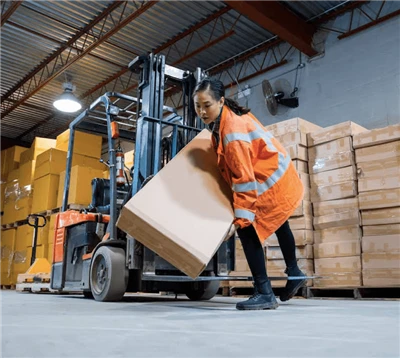
- The Velocity Disconnect: A high-speed line can deliver 40 to 60 bundles per minute. A human operator can safely lift, rotate, and stack only 10 to 15 bundles per minute over a standard 8-hour shift before experiencing physical fatigue or repetitive strain injuries.
- Stack Deflection and Integrity Risks: Unlike rigid wooden blocks, newly glued and folded boxes possess inherent spring-back memory and uneven cross-sectional thickness. Manual handling often destabilizes the structural nesting of the bundle, leading to overlapping edges, lean, and eventual pallet collapse inside the shipping trailer.
- Siloed Machine Control: When the upstream converting line and the downstream collection zone operate on separate, unlinked control architectures, they cannot adapt to real-time changes in speed. If a minor jam occurs at the sorting table, the entire folding line must be stopped abruptly, causing severe disruptions to the machine's thermal glue application states and reducing your Overall Equipment Effectiveness (OEE).
2. Selecting Your Automation Framework: Automatic Palletizing Robot vs. Cobot Palletiser
To resolve this outfeed friction, modern packaging facilities deploy automated stacking architectures. Depending on your available plant floor space, capital budget, and product variation profiles, the ideal integration relies on choosing either a heavy-industrial robotic system or a collaborative robot setup.
Option A: The Dedicated Automatic Palletizing Robot Cell
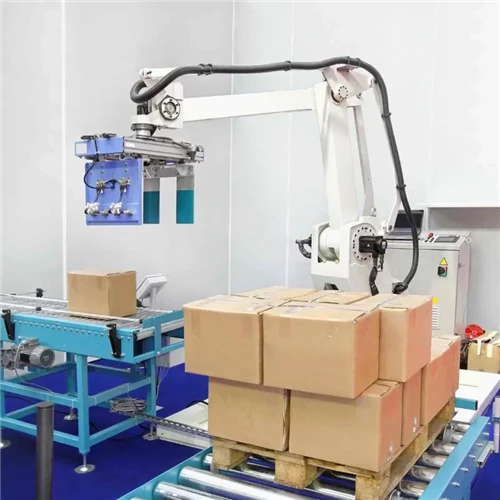
For high-volume, single-source converting lines where production runs continuously across multiple shifts, a full industrial automatic palletizing robot offers the necessary speed ceiling and structural durability.
- Kinematics & Payload: These large-scale 4-axis or 5-axis articulated arms are anchored securely to a heavy steel floor plate. They handle massive payload capacities (ranging from 100kg to over 500kg), allowing them to lift entire rows of heavy boxes simultaneously.
- High Volumetric Delivery: Operating via complex mathematical paths, an industrial robot cell easily processes 30 to 50 cycles per minute. When engineered with a custom multi-pick vacuum plate, it can lift multiple shingled rows from the conveyor simultaneously, allowing it to comfortably match the peak velocity of your upstream machinery.
Option B: The Compact Cobot Palletiser Working Station
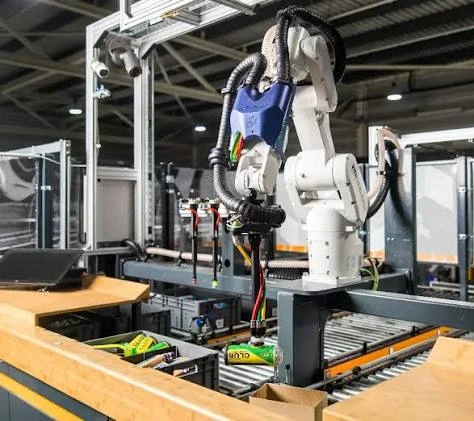
For facilities dealing with tight footprint layouts, retrofitted production lines, or frequent product adjustments, the modern cobot palletiser has become the industry standard for agile, flexible automation.
- Shared Workspace Operations: Collaborative robots feature built-in power and force-limiting sensors, coupled with rounded joint geometries. This mechanical safety layer allows them to work directly alongside your existing crew members without requiring massive, expensive hard-wire safety fencing or light curtains.
- Footprint Efficiency: A collaborative cell occupies a minimal floor footprint, often matching the exact dimensions of a standard shipping pallet base. It can be easily moved around the shop floor using a standard pallet jack, allowing you to quickly wheel it into position behind different outfeed lines depending on your daily schedules.
Read More:《What Is A Cobot Palletiser? The Definitive Guide To Collaborative Robotic Stacking》

3. Engineering the Interface: End-of-Arm Tooling and Infeed Handling
The success of integrating a box gluing machine with automated palletizing depends entirely on the engineering of the transition conveyor and the End-of-Arm Tooling (EOAT). Cartons cannot simply dump onto a flat table; they must be conditioned, metered, and accurately oriented before the robotic arm makes contact.
The Infeed Conditioning Sequence
Before picking, bundles exiting the compression apron of the folder-gluer pass through an automated spacing and indexing conveyor. Dual-speed belts create uniform physical gaps between the incoming units, while photoelectric sensors scan the leading edges to determine their precise spatial coordinates. If your stacking recipe requires a complex interlocking pallet pattern to prevent tipping during transport, integrated mechanical orientation gates or high-speed servo turning wheels automatically spin select bundles 90° or 180° mid-transit.
Advanced End-of-Arm Tooling (EOAT) Dynamics
Because folded cardboard boxes can present uneven surfaces, variable weights, and porous exterior finishes, selecting the correct gripper technology is essential to prevent product dropping and surface scuffing:
- Zoned Foam Vacuum Grids: Utilizing a high-flow, low-vacuum blower system, these large sponge pads adapt instantly to varying box topography. The internal check valves automatically seal off any uncovered vacuum zones, allowing the robot to pick up varying quantities of boxes without swapping out hardware.
- Side-Clamp Mechanical Grippers: For heavy bundles that are lightly strapped or shrink-wrapped, pneumatically actuated side clamps apply uniform, regulated lateral pressure to secure the sides of the load, while supporting fingers slide beneath the bottom edges to prevent slippage.
4. Systems Comparison: Industrial Robots vs. Cobots for Folder-Gluer Lines
To help your production management and equipment procurement teams evaluate the best fit for your existing facility layout, review this comparative technical breakdown:
End-of-Line Palletizing Technology Matrix
| Operational Parameter | High-Speed Industrial Robot Cell | Compact Cobot Palletiser Station |
| Primary Production Focus | Maximum raw speed, heavy payloads, and continuous multi-shift high-volume contracts. | High flexibility, compact layouts, and rapid changeovers across multiple SKUs. |
| Footprint Requirements | Large & Restricted: Requires a dedicated structural cell with full safety guarding. | Minimal & Open: Fits tightly alongside existing conveyors without bulky safety enclosures. |
| Throughput Speed Limits | High capacity, delivering up to 40+ cycles/minute; handles multi-pick row lifting easily. | Balanced capacity, delivering 8 to 15 cycles/minute; generally handles single-bundle picking. |
| Capital Investment (CapEx) | Higher initial machinery cost, balanced by long-term durability and unmatched output scale. | Lower initial barrier to entry; delivers rapid ROI through minimal setup costs. |
| System Relocation Flex | Permanent Installation: Anchored deeply to the factory floor; requires extensive rigging to move. | Highly Mobile: Often mounted on a mobile pedestal base for quick relocation across different lines. |
5. Maximizing Overall Equipment Effectiveness (OEE) and Long-Term Maintenance
Integrating your finishing equipment into a single automated line directly optimizes your plant's financial performance. By pairing a reliable gluer with a matching automatic palletizing robot or collaborative system, you insulate your facility from labor availability fluctuations and ensure consistent, predictable production output.
From a maintenance perspective, modern automated cells deliver long-term reliability. Unlike mechanical layer-forming systems that rely on hundreds of exposed wear items like chains, sprockets, and pneumatic cylinders, modern articulated arms feature enclosed, sealed gearboxes that require minimal preventative care beyond standard fluid checks.
To maximize your long-term return on investment, look for hardware configurations backed by responsive after-sales technical support programs. Utilizing remote internet-connected diagnostics, support technicians can log directly into your system's controller to adjust code parameters, update pallet configuration recipes, and troubleshoot sensors on the fly-keeping your end-of-line packaging infrastructure running efficiently at peak performance for years to come.