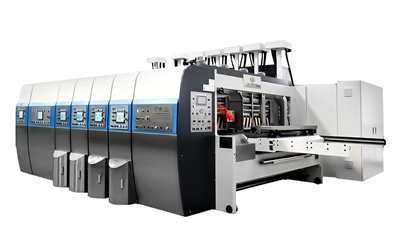

For packaging operations managers, the interface directly following a high-speed box gluing machine represents one of the most mechanically unstable zones on the production floor. As newly folded, glued, and compressed cartons exit the final delivery apron, they exist in a highly vulnerable physical state. The adhesive has not fully polymerized or set, the cardboard fibers retain an inherent material elasticity that causes constant spring-back tension, and high-end graphic coatings remain sensitive to shear friction.
Deploying an uncalibrated or generic gripper at this precise junction leads to immediate quality control failures: crushed corrugated flutes, micro-slippage along the fresh glue line, and severe carton surface scuffing. Achieving a zero-defect packaging line requires precise engineering at the End-of-Arm Tooling (EOAT) level. Whether you are running a high-volume industrial converting line fed by a heavy-duty cardboard box making machine for sale or managing an agile, short-run cell utilizing a flexible cobot palletiser, the mechanics of how the tool contacts, secures, and deposits each bundle dictates the structural integrity of your final pallet and the market-readiness of your product.
1. The Physics of the "Freshly Glued" Carton: Internal and External Forces
An automated end-of-line system cannot treat a freshly processed bundle of flat-packed boxes with the same mechanical logic used for fully cured, sealed, and rigid shipping containers. The moment a carton clears the compression belt of a folder-gluer, it introduces a unique set of physical variables that the EOAT must balance through targeted force dynamics.
The Dynamics of Adhesive Tacking
Cold Polyvinyl Acetate (PVA) glues and hot-melt formulations require distinct compression and tack windows to achieve full fiber tear strength. During the initial seconds following application, the bond is held together purely by wet tack or superficial cooling. If an automated gripper applies aggressive, concentrated lateral clamping forces to the outer walls of the bundle, the internal panels slide against one another. This movement causes an out-of-square defect known as "squinting," resulting in permanently warped boxes that will jam downstream automated filling lines at your client's facility.
Friction Coefficients and Graphic Degradation
Modern consumer packaging relies heavily on delicate surface treatments, including aqueous coatings, matte UV varnishes, soft-touch laminates, and metallic foil stamping. These premium finishes have low resistance to surface shear stress. When heavy mechanical pushers or rigid vacuum cups slip across these surfaces even by a fraction of a millimeter during high-acceleration sweeps, they alter the surface gloss. This friction creates visible scuff marks that lead to entire pallet rejections during strict quality audits.
Asymmetrical Mass Distribution
Because folded cartons feature overlapping glue flaps, internal reinforcement tabs, and double-thickness manufacturer seams, a compressed shingled bundle does not form a perfectly symmetrical geometric block. One side of the bundle is invariably thicker and more dense than the opposite side. If a gripping tool applies uniform mechanical travel across this uneven topography without compensating for the variance in thickness, the center of gravity shifts, causing the load to tilt, twist, or drop entirely under high centrifugal forces during rapid arm rotation.
2. Vacuum Sponge Pad Matrix: Area-Distributed Atmospheric Retention
For delicate retail folding cartons, pharmaceutical packaging, and lightweight micro-flute corrugated boxes coming straight off the box gluing machine, a high-flow, low-vacuum sponge pad matrix is the most effective engineering solution to prevent material distortion.
Mechanical Working Principle
Unlike traditional localized silicone suction cups that rely on concentrated vacuum depth to create holding force-which often dimples thin paperboard and deforms the box structure-a sponge matrix distributes the vacuum force over a wide surface area. This setup utilizes a large, continuous block of specialized, non-marking, open-cell technical foam attached to a lightweight aluminum plenum chamber.
An industrial regenerative blower or a multi-stage venturi system evacuates air from the plenum, drawing a massive volume of air (high CFM) through the porous foam face at a lower vacuum pressure (low kPa). The atmospheric pressure of the room pushes the entire surface of the carton bundle uniformly against the foam pad.
Engineering Advantages and Surface Protection
- Elimination of Shear Stress: Because the holding force is applied evenly across hundreds of square centimeters rather than concentrated into small pockets, the local pressure drop is minimal. This completely eliminates the physical deformation of the cardboard flutes and stops abrasive friction, ensuring zero cosmetic degradation.
- Topographical Conformance: The flexible nature of the technical foam allows it to naturally compress and contour around uneven shingled steps, overlapping seams, and strapping lines, establishing an airtight seal despite asymmetrical bundle thickness.
- Internal Check-Valve Isolation: Industrial-grade vacuum grids integrate a dense internal matrix of independent ball-check valves. If the robot picks up a short bundle or an irregular shape that leaves a portion of the foam pad exposed to open air, the sudden rush of high-velocity air causes the internal balls to seat instantly, sealing off the exposed zones. This preserves maximum vacuum depth on the sections in direct contact with the product, allowing the system to run multiple SKU sizes sequentially without stopping for mechanical tool changes.
3. Mechanical Clamp Grippers: Enforced Stability for Heavy-Duty Corrugated Formats
When the upstream department is anchored by a high-output cardboard box making machine for sale running dense, multi-wall structural shipping containers or large, heavy industrial flats, the inertial forces generated during high-speed industrial robot manipulation often exceed the capabilities of pure vacuum suction. In these scenarios, engineered mechanical clamping provides the necessary physical restraint.
Mechanical Working Principle
A professional packaging mechanical clamp utilizes dual parallel side plates mounted to high-precision linear guide rails. These plates are driven inward by dual-acting pneumatic cylinders or high-torque electric servo actuators to secure the vertical sides of the corrugated bundle via lateral compression.
Precision Engineering Controls for Flute Protection
- Closed-Loop Proportional Pneumatics: To run heavy corrugated materials without crushing the internal fluting structure, advanced systems deploy electronic proportional pressure valves (I/P transducers) connected directly to the master PLC. The system dynamically scales the pneumatic pressure output down to the exact kilopascal limit required to hold the bundle's weight based on the pre-programmed structural gsm limits of the specific product profile.
- Servo-Driven Side Synchronization: If a mechanical clamp closes unevenly, it shoves the carton bundle off-center, ruining the alignment coming out of the gluer. Utilizing synchronized dual servo drives ensures that both clamping plates move at identical speeds to the exact millimeter, centering the load precisely beneath the robot's primary tool center point (TCP).
- Retractable Mechanical Bottom Support: The most effective method for minimizing crushing lateral force is the integration of ultra-thin, high-strength steel or carbon-fiber bottom support fingers. As the clamp closes, these fingers slide underneath the bottom edge of the bundle. The side plates only apply a minimal amount of stabilizing pressure to keep the stack vertical, while the bottom fingers support the dead weight of the load during high-acceleration travel curves.
4. Technical Selector Matrix: Matching EOAT to Material Specifications
To assist engineering teams in specifying the correct tool layout for an automated cell or a compact cobot palletiser installation, the following operational parameters outline the clear boundaries between these two primary technologies:
Mechanical Tooling Performance Comparison
| Engineering & Material Metrics | High-Flow Vacuum Sponge Pad Matrix | Synchronized Servo Mechanical Clamp |
| Primary Method of Retention | Top-down distributed atmospheric pressure over a wide surface area. | Dual-sided lateral compression with integrated mechanical bottom support. |
| Material Thickness Compatibility | Optimized for thin paperboard, micro-flute (E, F, G flutes), and light corrugated flats. | Engineered for heavy-duty structural corrugated board (A, B, C, BC double-wall flutes). |
| Cosmetic Finish Protection | Maximum Safety: Zero friction sliding; zero risk of marring high-gloss varnishes. | Conditional Safety: Requires urethane or vulcanized rubber jaw padding to prevent scuffing. |
| Bundle Shape Irregularity Flex | High: Automatically adapts to uneven shingle steps up to 12mm deep via foam compression. | Moderate: Requires flat, parallel vertical side profiles to achieve perpendicular clamping. |
| Operational Component Wear | Consumable foam pads require periodic, low-cost replacement based on cardboard dust abrasion. | Mechanical pivot pins, linear bearings, and pneumatic seals require routine lubrication. |
| Payload Capacity per Cycle | Limited by surface area; typically optimized for payloads under 40kg. | High structural capacity; easily handles dense bundles weighing up to 150kg+. |
5. Industrial Integration, Data Feedback, and System Longevity
Deploying a high-performance gripper requires a synchronized digital relationship between the tool sensors and the primary control architecture of the line. Whether your production floor uses a large-scale, high-payload industrial machine or a space-saving, open-workspace cobot palletiser, the tool can no longer operate as a blind mechanical attachment.
Modern intelligent EOAT systems use digital IO-Link communications to pass real-time operational diagnostics directly back to the main PLC. Before the robot arm moves away from the pickup station, internal digital pressure transducers monitor vacuum depth (in kPa) or precise servo encoder positions (in mm). If an incoming bundle contains a misaligned box that escaped the compression section of the box gluing machine, the gripper detects an improper vacuum seal or an out-of-spec stroke width instantly. The system pauses the cycle, rejects the bundle onto a bypass conveyor, and updates the HMI screen before a dropped load or a physical tool collision can cause an expensive line stoppage.
To maintain maximum uptime across multi-shift operations, plant engineers should choose hardware built on an open, non-proprietary control platform that is fully backed by structured after-sales technical support agreements. Implementing remote cloud-connected gateway diagnostics allows specialized automation technicians to log into your palletizing system from off-site locations. They can analyze vacuum decay curves, modify clamp acceleration profiles, and adjust sensor thresholds on the fly, ensuring your finished cartons transition smoothly from the gluer to the shipping pallet without a single mark or defect.