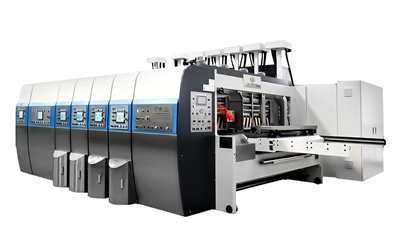
For corrugated box plant investors and operations managers, selecting the primary converting infrastructure is the single most critical decision impacting long-term profitability, floor layout, and manufacturing capacity. The debate over production floor layouts invariably centers on a fundamental engineering choice: do you deploy a fully integrated, all-in-one inline system, or do you opt for a modular, standalone configuration?
Specifically, this choice pits the Flexo Printer Slotter (paired with independent downstream finishing equipment) against a full Flexo Folder Gluer (FFG) line. Both configurations utilize flexographic printing and rotary converting technologies, but their mechanical integration, workflow dynamics, and economic return profiles are radically distinct. Choosing the wrong inline configuration can create systemic material handling bottlenecks, deflate your facility's daily throughput, and trap capital in underutilized machinery.

1. Architectural Breakdown and Mechanical Workflows
To accurately evaluate these systems, we must first break down the physical modules, mechanical pathways, and structural outputs that define each machine class.
The Flexo Printer Slotter Blueprint
A standalone Flexo Printer Slotter is a modular Flexo Machine designed to feed, print, crease, slot, and occasionally die-cut corrugated sheets, delivering them as flat, unfolded blanks. The machine architecture typically consists of the following consecutive stages:
- Lead-Edge Vacuum Feeder: Utilizes high-friction rollers and adjustable vacuum chambers to precisely square and feed warped or heavy-gauge corrugated sheets into the first printing gate without crushing the flutes.
- Flexographic Printing Stations: Each color station features a ceramic anilox roll, a chambered doctor blade system for uniform ink metering, and a plate cylinder. Sheets are transferred via vacuum transport sheets or mechanical grippers between stations to ensure tight color registration.
- Creaser-Slotter Module: Features dual-shaft or multi-shaft configurations where computerized creasing wheels pre-score the fold lines, and motorized slotting knives cut out the manufacturer's flap and corner slots.
- Rotary Die Cutter (Optional/Integrated): Uses a heavy steel cylinder wrapped with custom wooden die boards and polyurethane anvil covers to punch out complex handholes, ventilation slots, or non-rectilinear shapes.
The critical characteristic of this configuration is its structural output: it yields a flat, unglued box blank that must be stacked, palletized, and transferred via forklift or WIP (Work-in-Progress) conveyor systems to a completely separate, standalone Folder Gluer Machine or stitching unit to complete the conversion process.
[Mechanical Flow: Sheet Infeed -> Flexo Printing -> Slitting/Creasing -> Flat Blank Outfeed]
The Flexo Folder Gluer (FFG) Blueprint
A modern flexo folder gluer machine takes the identical printing and slotting foundations but appends an unbroken, automated folding, gluing, counting, and stacking mechanism to the end of the line. For large integrated facilities looking to achieve absolute automation from raw corrugated sheet to fully palletized bundles, investing in a comprehensive Printing Slotting Die Cutting Folder Gluer Strapping Line represents the pinnacle of high-volume efficiency.
The FFG architecture introduces several critical downstream modules directly coupled to the slotter outfeed:
- The Glue Application Station: High-speed electronic contact extrusion heads or non-contact spray systems apply a precise bead of cold PVA or hot-melt adhesive to the moving manufacturer's joint tab at speeds exceeding 300 sheets per minute.
- The Folding Beam Apron: Utilizing differential-speed folding belts and specialized spiral guide bars, the flat blank is progressively folded along its pre-scored scores by 180 degrees while in continuous linear motion.
- The Counter-Ejector and Squaring Unit: The folded cartons are received in an overhead stacking hopper where pneumatic or mechanical squaring plates tap the bundles to eliminate "fishtailing" (misaligned joints). Once a pre-set count (e.g., 10, 20, or 25 boxes) is reached, the bundle is instantly ejected.
The structural output of an FFG is a fully closed, counted, and bundled shipping box ready for immediate palletizing and shipping to the end consumer.
[Mechanical Flow: Sheet Infeed -> Flexo Printing -> Slitting/Creasing -> Inline Gluing -> Folding -> Counter-Ejection -> Bundled Box Outfeed]
Read More:《The Guide Of The Flexo Folder Gluer (FFG)》
2. Head-to-Head Operational Comparison
Evaluating which configuration fits your plant requires a data-driven look at operational metrics, floor logistics, and financial scaling variables.
Overall Equipment Effectiveness (OEE) and Systemic Risk
When analyzing box plant OEE, the mechanical connection between modules alters how downtime impacts your facility.
In a full inline FFG configuration, the system acts as a single rigid chain. If a minor sensor error occurs at the folding beam, or if the glue nozzle clogs, the entire line-including the upstream printing and feeding stations-must come to an absolute halt. There is no buffering capacity. Consequently, if one component experiences frequent micro-stops, the overall OEE of the entire asset drops significantly. However, when running smoothly, its peak volumetric output is unmatched, often exceeding 20,000 boxes per hour.
Conversely, pairing a standalone Flexo Printer Slotter with an independent, offline corrugated folder gluer machine creates a unlinked production model. If the standalone gluer requires a knife adjustment or undergoes preventative maintenance, the upstream printer slotter can continue running at full capacity, stacking flat blanks in a WIP storage zone. This buffer insulates the primary printing asset from downstream friction, often resulting in higher localized machine utilization rates for the individual components, though it introduces extra handling labor.
Order Changeover Time and Setup Dynamics
In modern packaging, market shifts toward just-in-time delivery have made short-run orders commonplace, turning order changeover time into a dominant variable for daily profitability.
| Metric / Parameter | Standalone Flexo Printer Slotter Setup | Fully Integrated Inline FFG System |
| Average Setup Mechanism | Segmented adjustments across separate machines (Printer + Offline Gluer). | Centralized, fully computerized CNC control from a single HMI terminal. |
| Typical Changeover Duration | 15 to 30 minutes (requires moving separate tooling sets and physical ink washes). | 2 to 8 minutes (utilizing automated "Order Set-up While Running" technology). |
| Tooling Synchronization | Independent calibration; operator must manually match gluer belt spacing to blank sizes. | Automatic; inputting box dimensions adjusts printing plates, slots, and folding guides simultaneously. |
Modern variants of the flexo folder gluer machine excel in high-mix environments because their integrated computer systems adjust every station simultaneously via servo motors. Some high-end units feature dual-slotter shafts, allowing the machine to set up the knives for Order B while Order A is actively running through the system, reducing physical downtime to near zero.
A standalone setup requires the operators to perform separate setups on two distinct machines, doubling the probability of human adjustment errors and expanding the total transition window between orders.
Plant Floor Space Optimization and Work-in-Progress (WIP) Logistics
Floor space calculation involves more than just measuring the physical footprint of the cast-iron frames; it must account for the surrounding material handling buffer zones.
Standalone Layout: [Printer Slotter] -> [WIP Storage Buffer Area] -> [Standalone Gluer]
Inline FFG Layout: [==================== Integrated FFG Line ====================]
An inline FFG line has a long physical length (often stretching 25 to 35 meters), but its lateral footprint is highly compact. Because material converts from a raw sheet to a finished bundle within a single continuous pass, there is zero need for interim storage between the printing and folding stages. This enables significant plant floor space optimization, minimizing the need for expensive automated internal transfer shuttles or rows of roller conveyors.
A standalone setup might feature shorter individual machines, but it demands a vast structural footprint to accommodate the WIP storage buffer between the printer slotter and the independent Folder Gluer Machine. A single high-speed printer slotter running flat blanks can easily generate multiple stacks of pallets per hour. If the downstream gluer cannot match that pace or is currently processing a different job, the plant floor quickly becomes congested with flat sheets, paralyzing internal logistics and increasing the risk of material damage from forklift transport.

3. Product Flexibility and Structural Limitations
The choice between these configurations is often dictated by the structural design, corrugated flute profile, and structural variety of the boxes your clients demand.
Regular Slotted Cartons (RSC) vs. Complex Die-Cuts
The classic Flexo Folder Gluer is engineered for speed and repetition. It is the ultimate weapon for manufacturing standard Regular Slotted Cartons (RSC), Half Slotted Cartons (HSC), and simple structural folders. If your target market consists of high-volume agricultural trays, standard shipping containers, or high-volume ecommerce boxes, a flexo folder gluer for sale offers an unbeatable cost-per-unit metric.
However, an FFG line struggles with complex, highly asymmetrical, or non-traditional structural packaging. When a box design features intricate compound angle die-cuts, integrated internal display dividers, or lacks a standard parallel linear manufacturer's joint, the inline folding belts cannot properly track or fold the blank.
This is where the modular approach shines. A standalone Flexo Printer Slotter equipped with a high-performance rotary die cutter can process incredibly complex geometric shapes, heavy-duty wrap-around blanks, and multi-point display structures. Once the flat blanks are output, they can be routed to specialized multi-point folder-gluers that feature custom timed-feed folding hooks, specialized overhead flame-sealers, or intricate side-register systems that an FFG line cannot support.
Flute Profiles and Board Gauge Variations
The structural thickness of your corrugated board significantly influences machine behavior during the folding stage:
Micro-Flutes (E, F, N): High Graphics / Crisp Folds -> Ideal for Vacuum Sponge/FFG
Heavy Double-Wall (BC, AA): High Spring-Back / High Force -> Requires Robust Folding Arms
- Micro-Flutes (E, F, N Flutes) and Solid Board: These materials possess low structural memory and fold cleanly along pre-scored lines. FFG lines run these formats at maximum velocity without experiencing dimensional drift.
- Heavy-Duty Double-Wall and Triple-Wall (BC, AB, AAA Flutes): High-caliper industrial packaging materials exhibit intense structural spring-back forces. When forced through an inline FFG's continuous folding belts at high speed, these thick boards often resist folding uniformly, causing the panels to twist or gap at the joint.
Processing these heavy-duty industrial formats is much more manageable on a standalone line. Flat blanks can be scored deeply on the printer slotter, allowed to settle, and then fed into a heavy-duty, dedicated industrial stitching or nailing machine where high-tensile steel wire fasteners physically lock the structural joint under stationary mechanical pressure.
4. Financial Procurement and ROI Analysis
Investing in heavy converting machinery requires looking past the initial invoice price to calculate the total operational cost per square meter of output.
Capital Expenditure (CapEx) Realities
Acquiring a top-tier, fully automated flexo folder gluer machine represents a major capital investment. Because you are purchasing a synchronized system controlled by an integrated CNC network and massive servo arrays across multiple stations, the entry barrier is high. For new startups or small-scale sheet plants with limited credit lines, a premium FFG can strain cash flow reserves.
A modular setup allows for a staged CapEx deployment. A plant can initially purchase a high-quality Flexo Machine to establish printing and slotting capabilities, while outsourcing the folding and gluing stages or utilizing low-cost manual folding tables. As sales revenue stabilizes, the facility can invest in a dedicated Folder Gluer Machine to automate the back end. This step-by-step scaling minimizes upfront financial risk, though the long-term total equipment cost may end up higher than buying an integrated line from the start.
Operational Expenditure (OpEx) and Labor Rationalization
Where the inline FFG line requires higher upfront capital, it dramatically reduces ongoing operational expenses through labor optimization:
- FFG Crew Configuration: A high-speed inline line typically requires only two to three operators: one at the lead-edge feeder monitoring sheet intake, one at the main central control console, and an assistant managing the automated bundle strapping outfeed.
- Standalone Crew Configuration: Running a split line requires a minimum of four to five operators. The printer slotter requires a feeder and a stacker operator. The material must then be staged and re-fed into the independent gluer, which requires its own dedicated feeder and outfeed packager. Over multiple shifts and years of operation, this doubled labor requirement can quickly outpace the initial capital savings of the cheaper equipment configuration.
5. Strategic Selection Guidelines
Making the final procurement choice requires aligning the equipment's mechanical strengths with your plant's specific business model and volume profiles.
When to Prioritize the Inline FFG Configuration
Investing in a dedicated inline flexo folder gluer line is the clear strategic path if your business profile meets the following operational conditions:
- High-Volume, Low-Mix Production: Your contract portfolio is dominated by standard RSC shipping boxes for food, beverage, ecommerce, or consumer goods FMCG markets where run lengths exceed 10,000 units per setup.
- Expensive Local Labor Markets: Operating in regions with high hourly wages or systemic shortages of skilled mechanical setup personnel makes minimizing your headcount per production line a financial necessity.
- Premium Real Estate Constraints: Your facility cannot expand its physical footprint, requiring maximum throughput per square meter of floor space via plant floor space optimization.
When to Prioritize the Standalone Modular Configuration
Opting for a separate Flexo Printer Slotter and finishing layout is the superior operational choice if your plant aligns with these parameters:
- High-Mix, Low-Volume Specialty Focus: Your core margin is derived from short-run, highly customized industrial packaging, complex die-cut retail displays, or heavy double-wall industrial containers.
- Staged Scaling Business Models: You need to match machinery acquisitions directly with active sales growth, preferring lower upfront CapEx over ultimate processing velocity.
- Regional Technical Ecosystems: Your local operations require mechanical simplicity, where maintenance teams prefer separate, unlinked mechanical gearboxes over highly complex, single-source software networks.
Ultimately, the choice hinges on balancing the predictable velocity of an integrated line against the adaptable processing range of a modular setup. By auditing your current order profile, factoring in your physical floor space constraints, and projecting your long-term volume goals, you can select the infrastructure configuration that maximizes your facility's long-term operational efficiency.