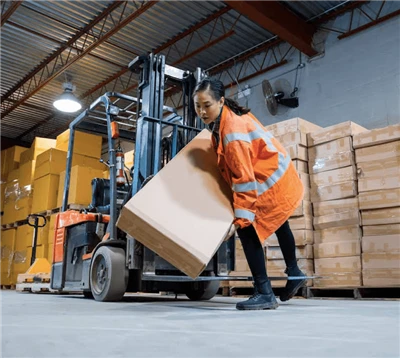
According to industry metrics compiled by the Association for Packaging and Processing Technologies (PMMI), the end-of-line packaging department handles over 95% of a facility's total volume weight, making it the primary operational regulator for the entire plant. While an upstream high-speed automatic carton making machine or a multi-stage box gluing machine can easily process hundreds of case blanks per minute, manual or inefficient stacking at the final stage creates an immediate material gridlock, severely dragging down your Overall Equipment Effectiveness (OEE).
When evaluating robotic vs. conventional palletizing, the procurement decision extends beyond simply handling corrugated boxes or heavy bags; it is a long-term capital expenditure (CapEx) strategy designed to eliminate downstream bottlenecks and ensure every load meets strict logistics stability standards. As an established industrial packaging machinery manufacturer, we have compiled the precise structural dynamics, velocity parameters, and volumetric realities of both systems to help you select the optimal machinery for your line layout.
Read More: 《Can A Palletizer Reduce Labor Costs?》
Read More: 《Palletizers Vs. Manual Labor:Choosing The Right Solution For Your Business Storage Pallet Racking》

1. Structural Architecture and Mechanical Stacking Physics
The core differentiation between robotic and conventional configurations lies in how they physically manipulate cartons, manage mechanical stress, and maintain stack alignment during continuous shifts.
The Stacking Physics of Conventional Mechanical Palletizers
Conventional palletizers (available as either high-level or low-level systems) do not handle individual boxes during the final stacking phase. Instead, they operate on a fluid, row-by-row and layer-by-layer accumulation principle inside a heavy, rigid structural steel mezzanine framework:
- Case Infeed and Turning: Cartons arrive from the upstream box gluing machine via powered roller conveyors. Mechanical star wheels, turning pins, or dual-speed rollers automatically rotate each carton 90° or 180° to match the programmed interlocking layer pattern.
- Row Stripping and Layer Forming: As cartons pass a secondary sensor gate, a mechanical ram or pusher sweeps the boxes laterally onto a pattern-forming table. Once a full matrix row is built, it is pushed onto a bi-parting sliding apron plate (stripping plate).
- The Hoist and Drop Mechanism: In high-level systems, a heavy-duty motor-driven lift elevator (hoist) raises a raw wooden pallet up to the stripping plate level. The stripping plate doors slide outward, and the complete layer drops cleanly onto the pallet.
- Layer Squeezing: Pneumatically or servo-actuated side plates clamp all four sides of the newly dropped layer simultaneously. This mechanical compression squares the stack, closes any gaps between cartons, and ensures structural stability before the hoist moves down to accept the next layer.
The Stacking Physics of an Automatic Palletizing Robot
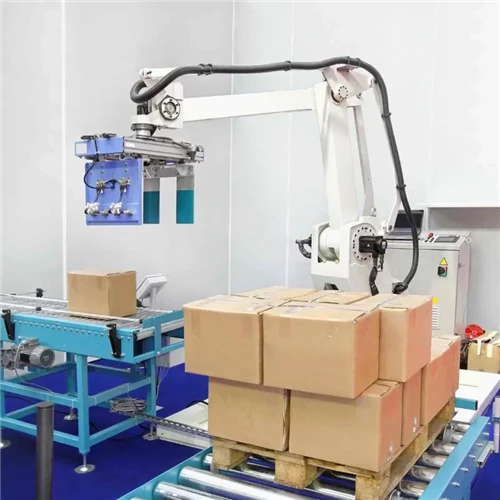
Robotic palletizing completely discards the accumulation table and sliding plate framework. It relies instead on a dynamic, articulated multi-axis robotic arm mounted to a compact, floor-anchored steel base plate:
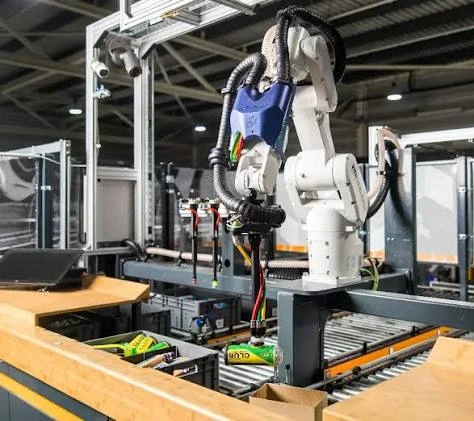
- Targeted Picking: Individual cartons or pre-grouped rows arrive at a fixed pickup station. Photoelectric sensors or standard vision systems detect the exact arrival coordinates of the box leading edge.
- End-of-Arm Tooling (EOAT) Selection: The robotic arm swings into place utilizing a custom gripper engineered specifically for your carton specifications. Depending on the cardboard gsm and density, engineers select either a high-vacuum sponge pad matrix (for varying box sizes), a mechanical side-clamp gripper (for heavy bundles), or a fork-and-paddle style bottom-support gripper (for fragile or heavy-duty boxes).
- Path-Optimized Placement: Driven by high-torque brushless AC servo motors, the robotic arm moves the load along an optimized mathematical curve, placing the cartons directly onto a stationary floor pallet station. The software updates its target coordinates layer by layer to execute complex interlocking patterns.
2. Speed, Throughput Metrics, and Volumetric Reality
A common point of confusion during procurement is comparing the speed performance of these two formats. They measure speed using entirely different mechanical variables.
Conventional Palletizing Throughput
Because conventional systems stack an entire layer of cartons at the exact same moment, their productivity is scaled by Layers Per Minute (LPM) rather than individual items. A standard mid-range high-level conventional palletizer handles 3 to 5 layers per minute.
If a standard interlocking pallet layer consists of 15 cartons, a conventional machine operating at 4 LPM delivers a real throughput of 60 Cases Per Minute (CPM). For massive, dedicated production lines running single-size corrugated boxes continuously, conventional systems provide an unmatched speed ceiling that can easily exceed 100 to 120 CPM on specialized high-speed configurations.
Robotic Palletizing Throughput
Robotic cell speed is determined strictly by the Cycles Per Minute (CPM) of the physical arm. A standard heavy-payload industrial robotic arm completes roughly 10 to 25 pick-and-place cycles per minute, depending on the total travel distance and arm rotation angles.
If the robot uses a basic single-zone gripper to pick up one carton per cycle, its throughput maxes out at 20 CPM-which will cause a serious bottleneck behind a high-speed box gluing machine.
To bypass this mechanical limitation, a high-tier machinery manufacturer implements advanced multi-pick grippers. By utilizing a wider mechanical clamp or a zoned vacuum matrix, the automatic palletizing robot can lift 2, 3, or an entire row of 4 cartons simultaneously in a single sweep. This raises the effective throughput to 40 to 80 CPM, allowing the robotic cell to match the output of modern high-volume converting lines.
3. Floor Space Management, Layout Flexibility, and Line Integration
Maximizing production floor real estate is a primary challenge when retrofitting modern automation machinery into existing packaging plants.
Conventional Systems Footprint
Traditional high-level mechanical palletizers require extensive, permanent floor space and significant vertical clearance. The overall layout must accommodate:
- The massive steel mezzanine structure.
- Long, inline accumulation conveyors required to pre-form rows before stripping.
- An integrated automatic pallet dispenser magazine.
- Heavy-duty safety fencing paths.
Because of this rigid inline requirement, conventional systems typically demand a long, straight-line factory blueprint and high ceilings, making them difficult to position around corners or inside tight, older production facilities.
Robotic Systems Footprint
An automatic palletizing robot cell excels in spatial efficiency and layout versatility. The primary mechanical arm requires minimal physical floor anchoring space, and its spherical working envelope allows engineers to design creative, non-linear floor plans.
Crucially, a single robotic arm can be engineered to manage multiple infeed paths simultaneously. For instance, the robot can sit centrally between two distinct outfeed tracks coming from separate carton box making machine lines, picking from both conveyor tracks independently and building two separate pallets on left and right floor stations. This multi-line capability reduces total footprint requirements and significantly lowers the initial capital expenditure (CapEx) per line.
4. SKU Proliferation and Job Changeover Agility
Modern consumer packaging demands shorter production runs, custom regional variations, and an explosion of distinct Stock Keeping Units (SKUs). This makes rapid changeover speed a critical metric for maintaining a profitable factory floor.
Conventional Changeover Dynamics
Switching box dimensions on a conventional layer palletizer can introduce significant machine downtime. When moving from a large shipping carton to a compact retail box, operators must stop the line to perform physical adjustments:
- Manually moving mechanical guide rails and turning gates on the infeed line.
- Adjusting the physical limits of the side squeezer plates.
- Uploading the new row-forming PLC parameters via the HMI.
If the new box size requires a drastically different pattern that exceeds the physical dimensions of the layer table, it can cause prolonged downtime, making conventional systems less ideal for plants that change product runs multiple times per shift.
Robotic Changeover Dynamics
Robotic cells handle product variations with exceptional software agility. Because an automatic palletizing robot relies on precise coordinate programming rather than physical side guide rails or drop aprons, changing box patterns requires zero mechanical downtime.
When a new product run comes off the automatic carton making machine, the operator simply selects the pre-loaded recipe profile on the central touchscreen terminal. The robot instantly updates its 3D motion paths, recalibrates its vacuum zone activation sequences, and modifies its placement coordinates on the fly without stopping the line.
5. Strategic Evaluation Matrix: Selecting Your System
To assist your plant engineering and financial procurement committees in making a data-driven choice, use this structured technical comparison matrix:
Automated Stacking Technology Comparison Matrix
| Technical & Operational Metric | Conventional Mechanical Palletizer | Automatic Palletizing Robot Cell |
| Primary Speed Metric | Ultra-High Layer Volumetrics: Optimized for 30 to 120+ CPM via full-layer drop. | Cycle-Dependent: 15 to 80 CPM depending on single or multi-pick gripper engineering. |
| Floor Layout Requirements | Large & Rigid: Requires extensive length for accumulation and high vertical clearance. | Compact & Scalable: Small footprint; adapts easily to tight spaces or angled corners. |
| Multi-Line Handling | Dedicated Single Line: Can only process incoming cartons from a single conveyor source. | Multi-Stream Flex: One arm can process inputs from 2 to 3 independent production lines. |
| Changeover Downtime | Mechanical Adjustment Needed: Requires physical rail tuning and squeezer plate adjustments. | Instantaneous: Swaps complex stacking patterns via software recipe selection on the HMI. |
| Maintenance Hotspots | High Mechanical Wear: Dozens of chains, sprocket tracks, hoist cables, and pusher switches. | Low Mechanical Wear: Enclosed, sealed gearboxes with fewer moving wear parts. |
| Fragile/Unique Load Handling | Restricted: High-pressure side squeezing can crush weak corrugation or unstable displays. | Excellent Protection: Vacuum or bottom-support grippers eliminate lateral box crushing. |
6. Long-Term Maintenance Profiles and Total Cost of Ownership (TCO)
Beyond the initial machinery investment, engineering teams must evaluate the preventative maintenance lifecycles and energy costs required to sustain high uptime over a 15-year operational window.
Preventative Maintenance Requirements
- The Conventional Maintenance Profile: Traditional mechanical palletizers contain a complex network of analog moving components. Maintenance staff must routinely inspect, lubricate, and adjust heavy roller chains, lifting cables, air cylinders, and pneumatic limit valves spread across a wide frame. A single misaligned sensor on the layer table can cause severe timing errors, resulting in accidental carton crushing and unexpected line stops.
- The Robotic Maintenance Profile: Modern industrial articulated robotic arms are highly reliable, sealed electromechanical structures. They utilize internal planetary gearboxes and low-friction brushless AC servo drives that require minimal intervention beyond automated grease and oil analysis every few thousand operating hours. The primary wear items are limited to the gripper face-such as inexpensive, easily replaceable rubber vacuum cups or foam pads that your in-house maintenance crew can swap out in minutes.
Engineering Your Stacking Department
Selecting between conventional mechanical layer palletizers and robotic cells is a strategic choice that depends on your factory's production volume, available space, and SKU complexity. For dedicated mass-production facilities running continuous, single-design carton contracts at maximum speed, a traditional high-level mechanical line provides the structural throughput needed to sustain large-scale output.
However, for modern converting facilities managing diverse product sizes, tight space constraints, and multi-line layouts, an automatic palletizing robot offers the software-driven agility, footprint efficiency, and reliable long-term performance required to future-proof your business.
As an established packaging machinery manufacturer, we specialize in designing custom end-of-line systems that integrate seamlessly with your existing production machinery. We back our hardware with comprehensive remote technical diagnostics and contractually guaranteed after-sales technical support response matrices to ensure your facility maintains strong OEE over the long term.