Are You Still Running Your End-of-Line Like It's 1995?
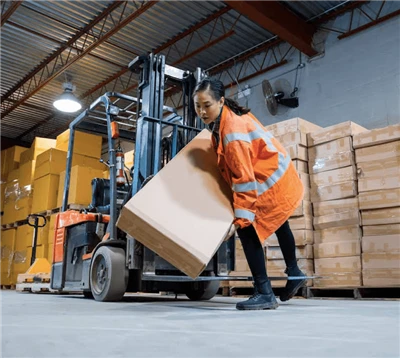
If you walk into a high-output corrugated facility today, you'll see state-of-the-art flexo-folder-gluers running at 300-400 sheets per minute. But the moment those finished bundles hit the end of the conveyor, the "modern" part often stops. In many plants, you still see a line of manual workers or a fleet of forklifts waiting to clear the deck.
Let's be blunt: a palletizing robots vs forklifts comparison is no longer just a technical debate for engineers; it is a survival strategy for plant owners. If your gluer has to slow down because the forklift driver is stuck in a "traffic jam" or taking a break, your multi-million dollar investment is being throttled by a $50,000 vehicle. Why let a legacy material-handling method dictate your plant's maximum speed?

The "Hidden" Cost of the Human Element: Labor and Reliability
When we talk about labor cost in palletizing, most managers look at the hourly rate on the payroll. That's a mistake. The true cost of a forklift-based system includes:
- The Recruitment Merry-Go-Round: In 2026, finding a certified forklift operator who actually wants to work a night shift in a hot, dusty box plant is a nightmare.
- The Training Vacuum: Every time a driver quits, you spend weeks training a new one. During that time, your automatic pallet stacking machine (if you had one) would have processed a million boxes without a single mistake.
- The "No-Show" Factor: If a robot's power is on, it works. If a driver's car breaks down, your finished goods area becomes a chaotic pile of cardboard.
In a direct palletizing robots vs forklifts comparison, the robot offers "Fixed Operational Costs." You know exactly what it costs to run for the next five years. Can you say the same about your labor union contracts or the local minimum wage?
Forklift Safety in Warehouses: A $100,000 Liability Waiting to Happen
We need to talk about the "Elephant in the Room." Forklift safety in warehouses is the single biggest liability for a plant manager. A 3,000kg machine moving at 10km/h in a confined space with pedestrians is, by definition, a hazard.
- Pedestrian Collisions: Even with blue lights and backup beepers, accidents happen. A single serious forklift injury can cost a company upwards of $100,000 in direct legal fees, not to mention the trauma to the team.
- Structural Impact: Have you looked at your racking uprights lately? Most are dented. Forklifts hit racks, they hit conveyors, and they hit the building's support pillars.
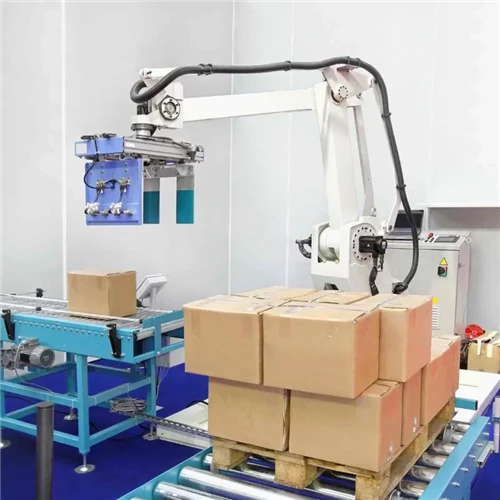
- The Robotic "Safety Bubble": An automatic pallet stacking machine lives in a controlled environment. It uses light curtains and laser scanners. If a human steps into its zone, it stops in milliseconds. It doesn't get distracted by a text message or a conversation with a co-worker.
Product Damage: The Silent Profit Killer in Corrugated Manufacturing
This is where the palletizing robots vs forklifts comparison gets personal for the finance department. Product damage in corrugated manufacturing is often treated as "the cost of doing business." It shouldn't be.
- The "Tine" Puncture: A forklift driver misjudges the entry by two inches. The fork tines go straight into the bottom three bundles of a pallet. That's 50 boxes straight into the scrap baler.
- The "Lean" Problem: Manual stacking is never perfect. If a forklift picks up a slightly leaning pallet and takes a sharp turn, the whole stack can shift. Even if it doesn't fall, the customer might reject the shipment because the boxes are scuffed or the edges are crushed.
- The Robot's "Soft Touch": A mechanical gripper for palletizing is programmed to the millimeter. It places the box with the same force every time. No crushing, no punctures, no "oops" moments.
Detailed Financial Breakdown: The 5-Year ROI Analysis
Let's get into the spreadsheets. Most owners are scared of the upfront price of a robotic palletizing system cost. But let's compare it to the "cheap" forklift over a 3-shift operation.
| Expense Category (5 Years) | Forklift-Based Setup (2 Drivers/Shift) | Robotic Palletizing Cell |
| Initial Purchase/Lease | $85,000 (2 Forklifts + Chargers) | $185,000 (Robot + Gripper + Fence) |
| Labor (Wages, Taxes, Benefits) | $675,000 ($45k/yr x 3 shifts x 5 yrs) | $0 |
| Maintenance & Parts | $45,000 (Tires, Batteries, Hydr.) | $12,500 (Annual Service + Grease) |
| Energy/Fuel (Propane or Elec.) | $35,000 | $8,500 (Low-KW Servo Motors) |
| Estimated Product Damage/Loss | $60,000 ($1k per month) | < $2,000 |
| Insurance Premium Impact | High (Due to forklift risk) | Lower (Automated Safety) |
| TOTAL 5-YEAR COST | $900,000+ | $208,000 - $220,000 |
The math is brutal. In a high-volume plant, the forklift is 4.5 times more expensive than the robot over five years.

Space Utilization: Why the Robot is Smaller Than You Think
The most common excuse for not automating is: "I don't have the floor space." This is a misunderstanding of how a warehouse actually functions.
- The "Turning Radius" Problem: A forklift needs a massive amount of "Dead Space" to maneuver. You need 3-4 meter aisles just so the driver doesn't hit the wall.
- The Robotic Footprint: An automatic pallet stacking machine sits in a footprint of roughly 4m x 4m. It receives the boxes directly from the gluer. There is no traffic.
- Vertical Storage: Robots stack pallets with 100% vertical accuracy. This means you can stack pallets higher and tighter in your warehouse because you aren't worried about them leaning and falling. You can increase your "Cube Utilization" by 15-20% just by having straighter stacks.
Maintenance: Internal Combustion vs. Precision Servos
Maintaining a forklift is like maintaining a car that you drive through a sandstorm. Paper dust gets into the engines, the radiators clog, and the hydraulic seals dry out.
An automatic box palletizer machine is built for the "Dull, Dirty, and Dangerous."
- Minimal Moving Parts: Unlike a forklift with a transmission, brakes, and steering rack, a robot is a series of sealed servo-motors.
- Cleanliness: No oil leaks on your clean floor. No tire marks on your concrete.
- Predictability: You know exactly when the robot needs grease. A forklift breaks down whenever it's most inconvenient-usually during your biggest order of the year.
Flexibility: Can a Robot Keep Up with "Short-Run" Orders?
Old robots were "dumb." They were programmed for one box size. Modern automatic box palletizer software has changed the game.
- The "60-Second Changeover": As we discussed in our previous guide, switching from a pizza box to a refrigerator crate is now a software command.
- The Multi-Line Robot: One robot can sit between two different production lines, palletizing Order A on the left and Order B on the right simultaneously. A forklift driver can only be in one place at a time.
- Pattern Intelligence: The robot can "interlock" boxes (tie-patterns) far better than a human. This makes the pallet much more stable during truck transport, reducing the amount of stretch wrap you need to use.
Safety Compliance and ISO Standards
In 2026, safety regulations are only getting tighter. Following robotic palletizer safety standards like ISO 10218 is a badge of honor for a modern factory. It shows your customers (who are often large corporations with strict ESG goals) that your plant is safe, modern, and ethical.
Manual palletizing is a leading cause of musculoskeletal disorders (MSDs). By automating, you remove the physical burden from your staff, allowing them to transition into higher-value "Technician" roles. This isn't just good for the workers; it's good for your retention rates.
Who Wins the Palletizing Robots vs. Forklifts Comparison?
If you are running a small, artisanal box shop with five orders a week, stick with the forklift. It's a versatile tool for low-volume work.
But if you are a professional corrugated box manufacturer looking to scale, there is no contest. The automatic pallet stacking machine wins on safety, wins on cost, and wins on quality. The forklift belongs on the loading dock, moving full pallets onto trucks. It does not belong at the end of your high-speed gluer.
Stop playing "Tetris" with human drivers and start manufacturing with robotic precision. Your bottom line-and your maintenance team-will thank you.