Why a robotic case packer and palletiser is the Heart of Modern Box Plants

The Engineering Logic of Dual-Station Systems
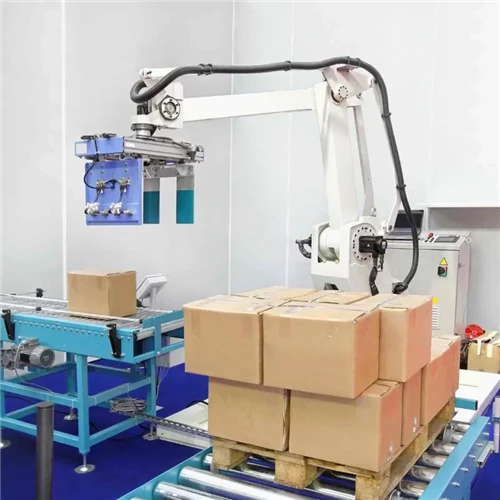
The primary advantage of a dual-station system is its ability to handle "live" pallet swaps without interrupting the upstream flow. While the robotic arm is meticulously building a stack on Station A, Station B is being cleared and prepped by the operator.
- The Instantaneous Pivot: The millisecond Pallet A reaches its 1800mm maximum stacking height, the system's software triggers an immediate pivot. The robot doesn't pause; it simply shifts its center of gravity and begins the first layer of the next order on Pallet B.
- The Forklift Safety Window: This layout provides your forklift operators with a generous window of time to remove full pallets. Because the robot is occupied with the second station, the first station becomes a safe zone, eliminating the frantic signaling common in single-station cells.
- Sustained Throughput: This constant-motion philosophy allows you to maintain a staggering 18-45 packs per minute output, ensuring the conveyor speed of 30m/min is never compromised.
Comparing Single vs. Dual Station Performance
To understand why the "extra station" pays for itself, we have to look at the math of downtime. Below is a comparison of how a high speed robotic palletizer performs in different configurations:
| Metric | Single Station Setup | Dual Station Setup (Our Spec) |
| Pallet Swap Downtime | 2-3 Minutes per swap | Zero |
| Max Throughput | 25-30 Packs/Min (Interrupted) | 18-45 Packs/Min (Continuous) |
| Gluer Efficiency | Throttled during swaps | 100% Full Speed |
| Safety Zone | Shared space during swaps | Isolated "Live" & "Safe" Zones |
| Max Stacking Height | Often limited by cycle time | Full 1800mm Capability |
Protecting Your Product: The Role of the Automatic Slip Sheet Dispenser
In the corrugated industry, the bottom layer of boxes is often the most vulnerable. Rough pallet surfaces or moisture can ruin a customer's order before it leaves your dock. Our industrial palletizing equipment end of line packaging solutions solve this by integrating an automatic slip sheet dispenser directly into the robotic workflow.
- Tier Stabilization: For stacks reaching 1800mm, stability is a major concern. The robot can be programmed to place a slip sheet between specific layers, creating a "friction lock" that prevents the load from shifting during high-speed transit.
- Hygienic Barriers: For food-grade or pharmaceutical packaging, the automatic placement of a bottom tier sheet acts as a critical barrier against pallet contamination.
- Labor-Free Integration: Because the dispenser is automated, the robot can prep Pallet B with a sheet while Pallet A is still being filled. This "hidden" cycle time is where the real efficiency gains are found.

From "Single Bundle" to "Double Bundle" Productivity
The versatility of the gripper is what truly defines a high speed robotic palletizer. To hit that 45 pack/min benchmark, the system must adapt its gripping logic based on the job "Recipe."
1,Heavy-Duty Single Packs: When handling bundles with a Maximum Gripping Height of 400mm, the robot focuses on torque and stability, ensuring heavy triple-wall boxes are placed with millimeter precision.
2,High-Volume Double Packs: For smaller ecommerce mailers (down to 290mm x 350mm), the robot utilizes dual-bundle capability to pick two units at once. This effectively doubles throughput without increasing mechanical wear on the arm.
3,Adaptive Height Control: With a Minimum Gripping Height of 50mm, the system is sensitive enough to handle thin retail packs without crushing the fluting.
The ROI of the "Extra Station": Why the Math Always Wins
The "premium" for a second station and an automatic slip sheet dispenser is usually recovered within the first few months of operation.
- The Downtime Gap: In a single-station setup, a pallet swap takes roughly 120 seconds. If your line does 6 swaps per hour, that's 12 minutes of lost time every hour.
- The Daily Recovery: Over a 24-hour production cycle (3 shifts), you are losing 4.8 hours of production time.
- The Profit Lift: If your line generates a $400 margin per hour, the dual-station feature "finds" you $1,920 in extra profit every single day. Over a 250-day working year, that is nearly $480,000 in additional revenue without adding a single cent to your labor costs.
Reliability in the "Corrugated Dust Zone"
A robotic case packer and palletiser in a box plant has to survive a brutal environment. Unlike the clean rooms of the electronics industry, paper plants are filled with fine particulate dust.
- Sealed Componentry: Our servos and sensors are ruggedized to prevent dust ingress, ensuring the 30m/min conveyor speed remains consistent over years of service.
- Plug-and-Play Infrastructure: Operating on standard 380VAC and requiring >=0.6Mpa air source, this system is designed for easy integration into existing plants.
- Oversized Load Capacity: Despite its compact footprint, the system handles a Maximum Pallet Size of 1500mm x 1500mm, allowing you to produce large-format industrial crates that previously required massive gantry systems.
Future-Proofing Your End-of-Line