1. Shanghai Meiguang
The Anchor of Heavy-Duty Reliability
1.1 Mechanical Architecture & Metallurgy
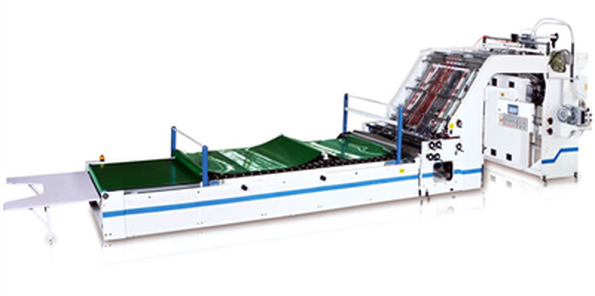
Meiguang's 2026 machines are built on a high-tensile, stress-relieved cast-iron base. Unlike cheaper welded frames that suffer from thermal expansion and contraction, Meiguang utilizes a proprietary aging process for its castings. This ensures that the Parallelism of the pressing rollers remains within a ±0.005mm tolerance over a 5-year period.
1.2 The "Zero-Deflection" Roller Technology
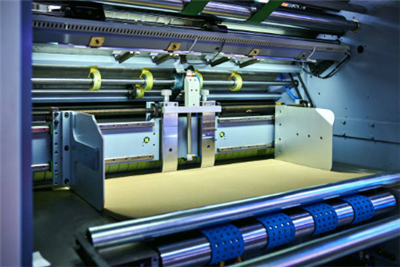
One of the most significant challenges in wide-format lamination (above 1650mm) is roller deflection. Meiguang has implemented a "Crown-Control" system where the rollers are slightly convex to counteract the natural bowing caused by nip pressure. This results in an perfectly even glue bond from the center to the edges, eliminating "edge-peeling" in heavy-duty shipping containers.
1.3 2026 Digital Twin Integration
Meiguang now offers a full Digital Twin interface. Before a machine is even shipped, the customer can run "Virtual Simulations" of their specific paper combinations (e.g., 450g Grey board + 180g B-Flute) to predict optimal pressure settings and glue viscosity requirements.
2. Guangdong Honghai
Architects of the "Dark Factory" Ecosystem
2.1 The Unified Control Protocol
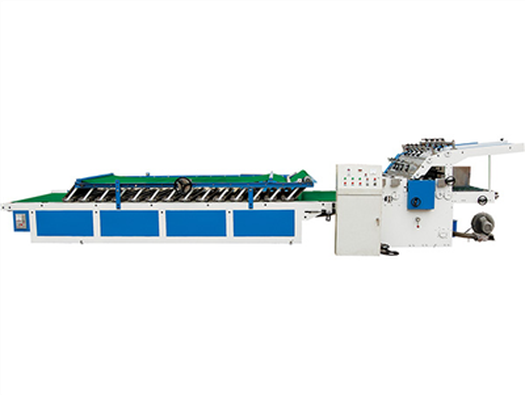
Honghai's brilliance lies in its communication architecture. While others use disparate PLCs for the feeder, laminator, and stacker, Honghai utilizes a Single-Brain Control System based on EtherCAT. This allows for sub-millisecond synchronization, meaning the stacker knows exactly when a "jam" is occurring at the feeder and can perform a controlled deceleration to prevent mechanical shock.
2.2 Intelligent Flip-Flop Stacking (Version 4.0)
In 2026, the bottleneck of high-speed lamination is the human element at the end of the line. Honghai's integrated stackers use AI vision to detect "warping" in real-time. If the board begins to curl upward due to humidity, the stacker automatically adjusts the "Inversion Frequency" to flatten the pile via counter-weighting.
2.3 Sustainable Glue Management
Honghai has introduced a "Closed-Loop Starch Recovery System." Any excess glue is filtered, temperature-stabilized, and reintroduced into the glue tray, reducing adhesive waste by an audited 18% compared to traditional open-tray systems.
3. Fengchi
The Pinnacle of Servo-Correction & Micro-Flute Specialization
3.1 Technical DNA: Ultra-High-Frequency Phase Alignment
Fengchi has established itself as the global leader in high-precision registration for ultra-thin flutes, specifically for the consumer electronics packaging market where G, N, and O flutes are replacing solid fiber boxboard. In 2026, Fengchi's machine architecture is centered around Sub-Millisecond EtherCAT Control Loop synchronization.
Traditional lamination relies on fixed entry points. Fengchi uses real-time visual inspection at the pre-nip point. If the top sheet is leading by even 0.05mm, the bottom sheet servo motor performs an "Advanced-Phase-Correction" before contact. This logic ensures perfect edge alignment without the need for mechanical registration gates, which can damage delicate micro-flutes.
3.2 The "Zero-Crush" Feeding and Gluing Protocol
Micro-flutes have a significantly lower caliper failure point than traditional B or C flutes. A compression force that is standard for heavy-duty boxes will completely flatten the flute structure of a G-flute sheet, destroying its compression test (BCT) strength.
-
Vacuum Staging: Fengchi utilizes a localized, multi-chamber vacuum table at the lamination point. This allows the machine to apply vacuum only to the areas of the base paper directly beneath the suction cups, minimizing the surface deformation common in full-vacuum beds.
-
Active Nip-Gap Sensors: Fengchi's 2026 machines are equipped with active digital gap sensors that adjust the nip pressure in real-time based on the incoming paper's calculated rigidity. This allows the machine to perform "Kiss-Touch" lamination, applying just enough pressure to transfer the adhesive without collapsing the corrugated medium.
3.3 Glueline Dynamics for Non-Absorbent Top Sheets
High-end G-flute boxes (like those for iPhones or premium cosmetics) are often paired with high-gloss, UV-coated, or film-laminated top sheets. These non-absorbent surfaces prevent standard starch glue from migrating into the fibers, leading to a weak bond or adhesive failure (lamination peeling).
Fengchi has re-engineered their glue metering system to handle Hybrid Adhesive Formulations (starch blended with specific PVA polymers). Their metering roller can apply a stable film as thin as 15 gsm with high viscosity, ensuring immediate tack and fiber-tearing bond, even on surface-treated liners.
3.4 2026-2030 Technology Roadmap: AI-Driven Surface Tension Detection
Fengchi is currently field-testing a module that uses infrared surface tension measurement on the incoming top sheet. By 2028, this AI module will automatically adjust the adhesive viscosity (via temperature and concentration control) in real-time to match the dyne level of the coating, moving lamination precision from purely mechanical to the chemical layer.
Best For: Premium packaging manufacturers specializing in electronics and luxury cosmetics where structure-to-graphic alignment must be flawless and flute preservation is paramount.
4. BHS Corrugated (Shanghai)
Global Engineering with Local Agility
4.1 The iCorr® Predictive Analytics Suite
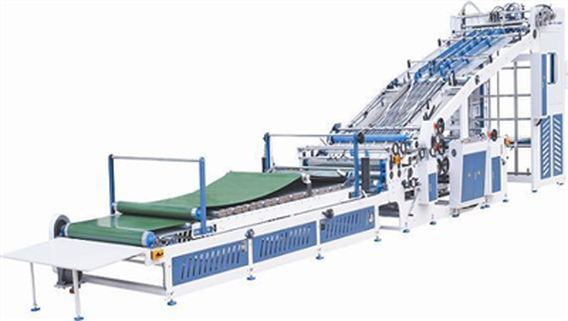
BHS is no longer just selling a machine; they are selling "Uptime." The 2026 Shanghai-built laminators are equipped with over 200 vibration and thermal sensors. These sensors feed data into the iCorr® Cloud Platform, which uses machine learning to identify the "Acoustic Signature" of a failing bearing weeks before it actually breaks.
4.2 High-Efficiency Heat Transfer
For 5-ply (double-wall) lamination, heat management is critical. BHS utilizes a specialized induction heating system for the pressure rollers, allowing for instantaneous temperature adjustments. This ensures that the starch adhesive gelatinizes at the exact millisecond of contact, preventing "cold-bonding" issues in high-speed runs.
5. Tangshan Jinguang
The Resilience Specialist for High-Recycle Content
5.1 High-Torque Feeding Systems
As the world moves toward 100% recycled paper, feeders face the challenge of "dusty" and "brittle" liners. Jinguang has re-engineered their vacuum suckers with high-frequency vibration nozzles that "shake off" paper dust before it enters the glue unit, significantly extending the life of the anilox rollers.
5.2 The "Northern Fortress" Chassis
Designed for environments with extreme temperature fluctuations, Jinguang's machines use specialized alloys with low thermal expansion coefficients. This makes them the preferred choice for factories in regions without sophisticated HVAC systems, as the registration remains stable from a 5°C morning start to a 35°C afternoon peak.
6. Dongguang Youlian
The Modular Disruptor for E-Commerce
6.1 Rapid-Changeover Architecture
Youlian's 2026 lineup is built like Lego. Their "Plug-and-Play" glue units can be swapped out in under 30 minutes. This is vital for plants that switch between traditional starch glue for corrugated boxes and specialized synthetic adhesives for premium coated liners.
6.2 The "E-Com" Optimization
Youlian has integrated a "Variable Data Inkjet" module directly into the lamination line. This allows manufacturers to print tracking codes or localized branding on the internal flute side during the lamination process, a revolutionary feature for the 2026 "Personalized Packaging" trend.
7. Tianjin Lishen
The Master of Fluid Dynamics and Surface Finish
7.1 Laser-Engraved Anilox Precision
Lishen's R&D focus is purely on the Glue-Transfer Coefficient. Their anilox rollers feature a "Hexagonal-Cell" design that ensures 98% of the glue is released onto the flute tips. This allows for a "Dry-Lamination" feel, where the board is immediately ready for die-cutting without 24 hours of curing time.
7.2 Active Air-Knife Cleaning
To combat the "glue-mist" that plagues high-speed machines, Lishen uses a localized air-curtain system. This prevents glue particles from settling on the optical sensors and encoders, reducing "false-stop" errors by 40%.
8. Qingdao Keqiang
The Pioneer of the IoT-Centric Workshop
8.1 Edge Computing Nodes
Keqiang's machines are equipped with onboard "Edge Computing" units. Instead of sending all data to the cloud (which creates latency), the machine processes its own sensor data locally to make real-time micro-adjustments to the feeder timing.
8.2 Energy Footprint Auditing
In 2026, many Western buyers require a "Carbon-per-Box" report. Keqiang's software automatically calculates the KWh-per-square-meter of every job, allowing plant managers to include energy efficiency data in their RFPs for ESG-conscious clients.
9. Ruian Rising Sun
The Speed of Transition (The Changeover King)
9.1 The "Intuitive HMI" (Human-Machine Interface)
Rising Sun has moved away from complex technical menus. Their 2026 interface is based on a 3D-visual representation of the machine. Operators simply touch the part of the machine they want to adjust, making the learning curve for new employees significantly shorter.
9.2 Automated Side-Guide Calibration
Using high-precision linear actuators, Rising Sun's machines can adjust their side-guides to within ±0.1mm in less than 15 seconds. This is critical for factories running "Short-Run" orders where the sheet size changes every 500 sheets.
10. Wanlian
The Full-Stream Synchronizer
10.1 "Live-Feed" Moisture Compensation
Wanlian's laminators are designed to talk to the Corrugator. Using infrared moisture sensors at the entry point, the laminator detects if the incoming corrugated board is too "wet" (common in high-humidity seasons). It then automatically increases the pressure-roller temperature and reduces glue volume to compensate, ensuring the final board remains flat.
10.2 Total Plant Integration
For a "Turn-Key" project, Wanlian offers a unified software layer that manages everything from paper roll stock to the final pallet of laminated boards. This prevents "Information Silos" where the laminator is running at a speed that the downstream die-cutter cannot handle.
Technical Appendix: The 2026 Auditing Framework
When evaluating these Top 10, procurement teams should use the following Weighted Scoring Matrix:
| Category | Weight | Key Metric to Verify |
| Registration Accuracy | 25% | Max deviation at 150m/min |
| Micro-Flute Integrity | 20% | Caliper loss (Crush %) on N-flute |
| Changeover Time | 15% | Physical time from Job A to Job B |
| Energy Efficiency | 15% | Watts per 1000 sheets |
| Software Openness | 10% | Ability to export MQTT/OPC-UA data |
| Metallurgy/Build | 15% | Weight and frame material certification |